Français
 English
Can you buy property in Spain without a NIE?

- What the NIE is: this 9-character code starts with the letter X, Y or Z depending on the year it was issued, followed by 7 digits and a letter. It stays the same for life and is not required before the age of 14.
- Buying without a NIE: the so-called start-up law, published on 22 December 2022, and an agreement between the General Council of Notaries and the Agencia Estatal de Administración Tributaria allow notaries to request a temporary NIF without the applicant being present.
- Deadlines: once the NIF is issued, the buyer has 3 months to get a NIE. ITP, the property transfer tax, must be paid within 30 days of the purchase.
- Two types of NIE: the white NIE, issued by a consulate or a police station, is provisional and valid for 3 months. The green NIE, or Certificado de Registro de Ciudadano de la Unión, is applied for in Spain by EU citizens staying more than 90 days.
- Key point: you apply with form EX-15 and pay the fee with form 790 (code 012), which is €9.84 for a first application. It takes about two weeks.
What exactly is a NIE?
This 9-character code (the letter X, Y or Z depending on the year it was issued, then 7 digits followed by another letter) is issued to foreigners and is required to identify yourself in Spain and it will stay the same for your whole life. If you make several stays in the land of Cervantes, you will keep using this same number.
To put it simply, it works as your Spanish ID card (but you must always carry the ID document of your home country) until you obtain Spanish nationality, if you eventually apply for it.
On that day you will get a DNI, the Documento Nacional de Identidad (the Spanish national identity document), and you can forget about the NIE!
Buying without a NIE: how it works
The COVID-19 pandemic shook up the rules and moved the lines in many areas. Spain realised that red tape, and especially getting a NIE, made it harder for entrepreneurs and investors to access its market.
The restrictions caused by the virus revealed how much the country depends on tourism, and the government reacted. About time! This new practice has its roots in the so-called start-up law (the law promoting the ecosystem of emerging companies), published on 22 December 2022.
An agreement between the General Council of Notaries and the tax agency (Agencia Estatal de Administración Tributaria) now allows notaries to request a tax number (the NIF, Número de Identificación Fiscal) on a temporary basis, without the applicant having to be present.

So how does buying in Spain without a NIE work in practice?
Fine, but what does it change for you? This tax number lets you do without a NIE for a while. You can complete your purchase without being held up by this formality.
Let's look at the NIF for a moment. The Número de Identificación Fiscal (tax identification number) is required for every individual and, of course, every legal entity (a company or an association, for example) to be identified for tax purposes. For an individual, it is the same as the NIE. Phew! That is why these two acronyms often come up together.
So, in the case we are looking at, how does it work?
It is quite simple and, above all, for a property purchase the notary takes care of it. Once you have this NIF, you have 3 months to get your NIE and regularise your situation. When you finally hold the holy grail, the earlier NIF stops being valid.
So don't panic if you don't have your NIE yet or don't have an appointment to get one.
All that is left is to pay your ITP on time. Another acronym?!
ITP is the property transfer tax (Impuesto sobre Transmisiones Patrimoniales), and it must be paid within 30 days of the purchase. You can find more information about ITP on our website.
Note that Alveo Search can help you get your NIE or use this option with the notary.
Now let's move on to the practical side.
Why might you need a NIE and how do you get one? Who issues it? Which documents do you need? Feeling a headache coming on? Don't panic, here is what you need to remember! For more details, read our practical guide.
Who can apply for a NIE?
Any foreign national, whether from the EU or not. Non-EU nationals who move to Spain receive it with their residence permit, and non-EU buyers who do not live in Spain can also apply for one. It is not required before the age of 14.
White NIE vs green NIE
Informally, people say there are 2 types of NIE in Spain: the white one and the green one.
- The white one is an A4 document, white in colour, issued by the Spanish consulate in your country or by a police station in Spain. It is provisional and valid for 3 months. Note that it does not allow you to settle in Spain for good. For that, you will need the green NIE (EU citizens) or a residence card (other nationals).
- The green NIE is actually called the Certificado de Registro de Ciudadano de la Unión (EU citizen registration certificate). It is a small green card that you must apply for directly in Spain: consulates cannot issue it from abroad. You must apply for it once you stay in Spain for more than 3 months. It is for EU citizens only: British and American buyers who move to Spain need a visa and then a residence card (TIE).
It is compulsory for EU citizens who want to stay in Spain for more than 90 days (retirees, workers, long-term students).
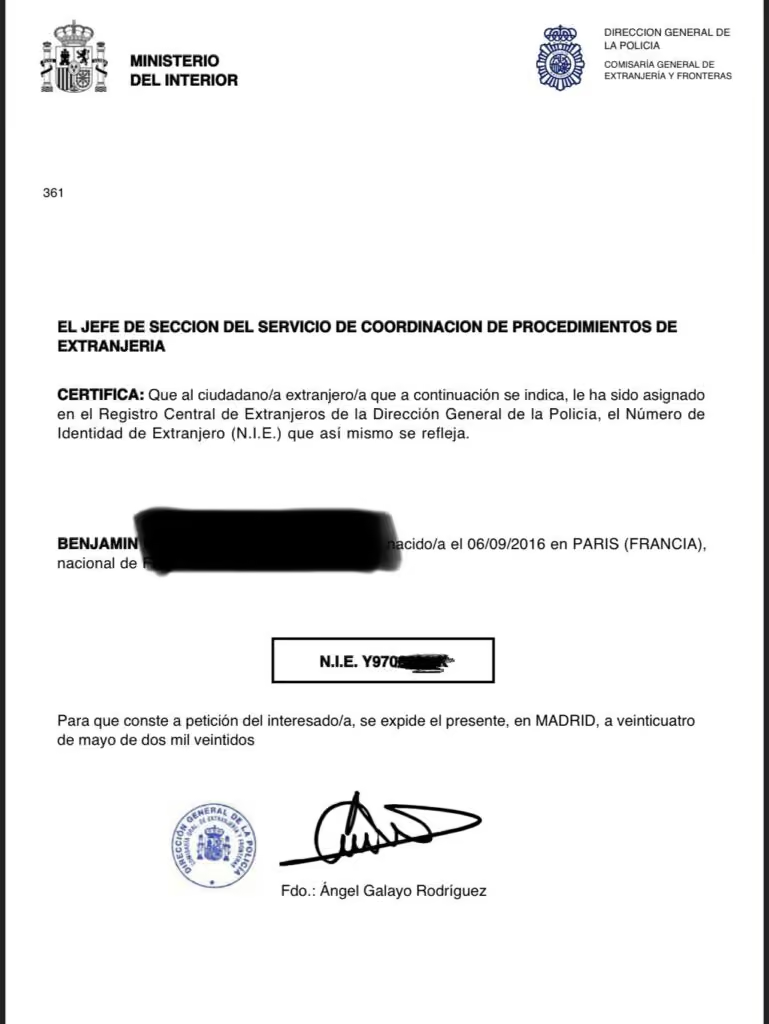
What do you need a (white) NIE for?
Almost everything except a trip of less than 3 months. For that, your usual travel documents are enough. A few examples show why you will need it once in Spain. You will need it to:
- Look for a job
- Buy or rent an apartment
- Set up a company
- Connect gas or the internet
- Receive a parcel
- Take your driving test or register a vehicle
- Enrol your children at school
- Take your driving test or register a vehicle
- Enrol your children at school
- Access Spanish social security or keep your health cover from home. Your health insurer may ask for your NIE as proof.
Where and how to get it
There are several ways to get your NIE. From your home country:
- You can apply by booking an appointment at the Spanish consulate that covers your address. Find yours on this official link: https://www.exteriores.gob.es/es/EmbajadasConsulados/Paginas/index.aspx then request your appointment directly on the consulate's website or by email.
- From Spain: you can also apply directly in Spain by booking an appointment at a police station of the Policía Nacional. Here is the link to book this appointment: https://icp.administracionelectronica.gob.es/icpplus/index.html
- You can get help from a lawyer, but it will cost more because they will charge fees.
- If you need one for a purchase, Alveo Search takes care of it for you. You won't have to worry about it and can simply dream about your future home in Spain.
In every case, you will be asked for the reason for your application and a number of documents. We have listed them below, and you can also find them in our practical guide.
Documents required
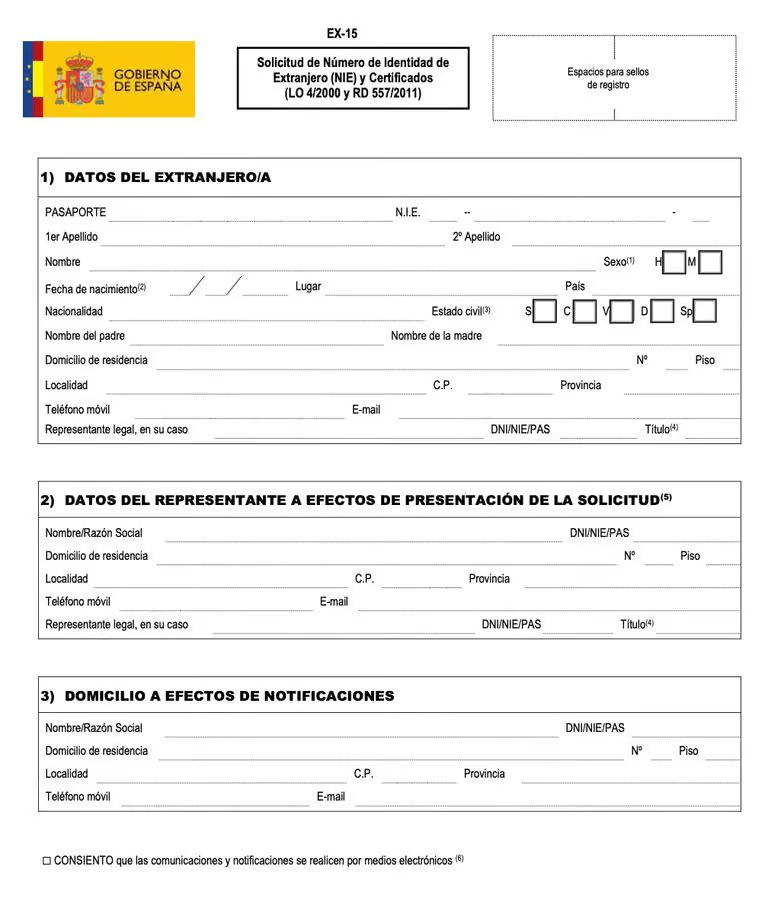
- The EX-15 form is simply the official NIE application form. Fill in one form per applicant.
- Your ID card or passport for EU citizens, the original and a copy of every page. Non-EU applicants can only use a passport.
- A passport photo.
- A document showing the reason for your NIE application (employment contract, internship agreement or other).
- If someone applies on your behalf, remember to set up a notarised power of attorney. This person will need to attend on the day with your documents and their own.
- If you are applying for a minor or for a person whose disability prevents them from applying themselves, bring a birth certificate or a document proving guardianship. You will be asked for a copy of the ID of each parent or of the guardian.
- This formality is very affordable: it currently costs only €9.84 for a first application and €7.31 for a later certificate (amounts set in June 2025). You pay this fee using form 790, then provide proof of payment. Note: payment methods vary from one consulate to another, but if you apply in Spain, it is best to bring cash. Also arrive a little before your appointment, as you will need to pay the fee at a bank.
The authorities provide a guide to filling in the form that makes everything clear and helps you avoid mistakes.
Processing times
Note that processing times have grown longer since the pandemic. They used to be quite short (5 to 8 working days). Now expect around 2 weeks for the Spanish police (Dirección General de la Policía) to issue your document. And you may still get a nasty surprise: it is not unusual to read about people who waited several months. Patience is key when you handle this kind of procedure yourself.
Our advice? If you are planning a purchase, get in touch. You can do so right here: our team of specialists will be happy to help.
In what form will you receive your NIE?
By email or by post, depending on where you apply. In Spain, practice varies from one police station to another, so ask at your appointment.
Take a look at our practical guide to the NIE. It covers everything you need to know, point by point, and has just been updated. It includes a directory of consulates and embassies and contacts for law firms.
If you are interested in buying property in Spain, contact us to talk about your project. We can give you all the information you need and would be happy to help you make it happen.
Book a call online Request a callback
Thomas Rouer is the founder of Alveo Search and the CEO of the Alveo group. Based in Spain for almost ten years, he develops property services designed for the specific needs of foreign buyers.
His expertise covers every aspect of buying property in Spain: understanding the market, searching for and selecting properties, negotiation, financing, paperwork, tax and securing the purchase process.


Our resources for buying in Spain