Français
 English
5 mistakes to avoid when buying a house in Menorca

- Financial feasibility: do your sums before spending the first euro: decide whether the mortgage will come from your home country or from Spain, tell your bank adviser that the property is in Spain, and include notary fees, administrative costs and agency fees if you are buying in cash.
- Tourist rentals: example given: a two-bedroom apartment in Punta Prima bought for €100,000, with an €80,000 loan at 1.5% over 10 years, meaning a monthly repayment of €718. At 70% occupancy and €60 a night, average monthly income before costs reaches €1,302, compared with about €450 a month on a standard long-term let.
- Licence and planning: check the expiry date of the tourist licence and whether it is individual. The PGOU, issued by the town hall, classifies land; since 2003, Menorca, the largest biosphere reserve in Spain, has restricted building outside areas that are already built up.
- Legal status: without a Cédula de habitabilidad, you cannot apply for water or electricity connections, or start renovation work.
- Key point: buying on your own exposes you to the paperwork, the language barrier and Menorca's island setting: professional support, with checks by a lawyer, limits these risks.
A property project in Spain needs careful planning, even more so on the island of Menorca, in the Balearic Islands, where Alveo Search operates as a buyer's agency.
Buying a house or an apartment in Spain is an exciting project and a chance for a change of scenery.
However, our agents tell us about cases where buyers from abroad who had already started the buying process on their own called them in a panic. To avoid similar situations when buying a house in Menorca, here are 5 mistakes to avoid, from the Alveo Search team.
1. Not checking the financial feasibility of your property project first
It may sound obvious, but the first thing to do when buying a house in Menorca, and in Spain in general, is to do your sums before you start! From the moment you spend the first euro on this project, you need to know that it is financially feasible and that you can see it through.
Two points to check:
- If I am buying with a mortgage:
- Is the mortgage from a lender in my home country or in Spain?
- If it is from my home country, have I told my bank adviser that the property I want to buy is in Spain?
- What are the pros and cons of each option (read about them here in another article)?
- If I am buying in cash:
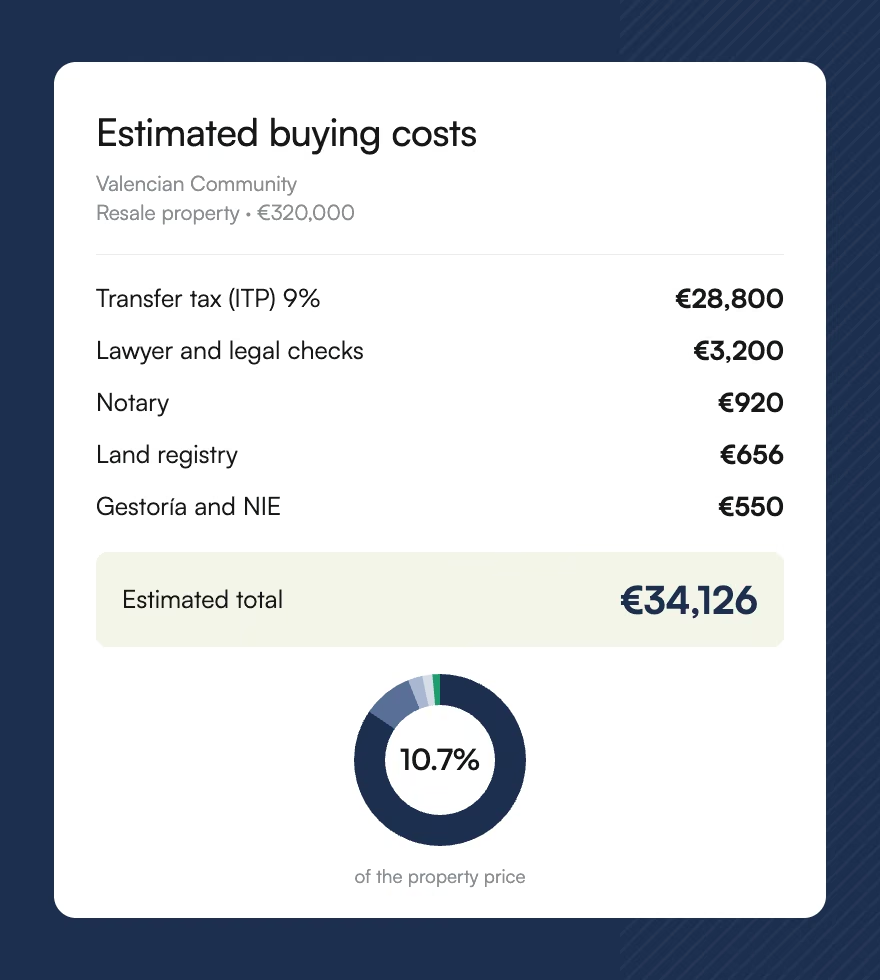
- Have I included the notary fees, administrative costs and agency fees in the total budget I want to spend?
2. Relying entirely on income from tourist rentals
Tourist rentals are obviously more attractive than long-term rentals for the returns they generate. However, be careful: we advise you not to base all your calculations on this type of rental and to keep a safety margin. Holiday rental legislation changes and the figures quoted are sometimes very optimistic. Also check the expiry date of the tourist licence and get advice on whether it is individual rather than granted to the complex where you want to buy.
Example:
Antoine buys a two-bedroom apartment in Punta Prima, Menorca, for €100,000. The bank lends him €80,000 at 1.5% over 10 years. His monthly repayment is therefore €718.
Note: this does not include community fees or IBI (Impuesto sobre Bienes Inmuebles, the annual local property tax).
Antoine expects an occupancy rate of 70% at an average of €60 a night, giving an average monthly income, before deducting charges, cleaning costs, agency commissions and taxes, of €1,302. Savvy investors call this a “cash-flow positive investment”.
But imagine Antoine can no longer run his holiday rental. He would then have to let his property on a standard long-term lease. The rent would be about €450 a month and would not cover his repayments. He might be forced to sell his apartment.
3. Ignoring Menorca's planning rules
The PGOU (Plan General de Ordenación Urbanística) is defined by Wikipedia as:
“A general planning instrument defined in Spain's planning regulations as the basic instrument for the overall planning of the territory of one or more municipalities, through which land is classified, the rules applying to each class of land are set, and the fundamental elements of the municipality's facilities are defined.”
These documents are issued by the town hall and everyone is expected to know them (hence the value of proper support when buying property). They set out future construction of neighbourhoods, buildings, car parks and so on. You need to make sure, for example, that the land opposite your villa will remain non-buildable and protected by the Coastal Law (Ley de Costas).
Spain is the country with the most biosphere reserves in the world. In the Balearic archipelago, Menorca's approach, on land and at sea, makes it the largest biosphere reserve in Spain. Since 2003, the island has had very protective land-use planning. A law restricts new housing outside areas that are already built up, to limit tourist numbers and preserve the wild landscapes over time.
4. Not checking the legal status of the villa
The same planning documents also set out rules to follow for renovation or restoration work. Today they are enforced, but 30 years ago they were much more permissive. Many fincas and country houses were once allowed to build outbuildings and were not connected to the water or electricity networks.
Today, if you buy one of these properties for its authentic charm, be aware that if it does not have a Cédula de habitabilidad (certificate of habitability), you will not be able to apply for utility connections or plan attractive renovation work.
5. Buying a house in Menorca on your own
Finally, we will never stop saying it: do not buy on your own in Spain. Your purchase could of course go perfectly well, and we hope it does. However, we have met many “reckless” buyers who went it alone when buying property in Menorca and bitterly regretted it afterwards.
Whether it is the administrative steps, the language barrier or simply Menorca's island setting, there are many reasons to lose heart.
Thomas Rouer is the founder of Alveo Search and the CEO of the Alveo group. Based in Spain for almost ten years, he develops property services designed for the specific needs of foreign buyers.
His expertise covers every aspect of buying property in Spain: understanding the market, searching for and selecting properties, negotiation, financing, paperwork, tax and securing the purchase process.


Our resources for buying in Spain