Français
 English
Spain's housing law (Ley de Vivienda) explained

- Timeline: approved by the Senate on 17 May 2023, the Ley de Vivienda (Law 12/2023) came into force on 26 May 2023. Each of the 17 autonomous communities decides whether to apply its stressed-area measures.
- Social housing: social housing makes up 1.6% of the housing stock, or 290,000 homes, far less than in many other European countries. Land reserved for protected housing (VPO) rises from 30% to 40% in new developments, and from 10% to 20% in urban renewal areas.
- Rent controls: annual increases were capped at 2% in 2023 and 3% in 2024, and since 2025 they follow a new INE index, the IRAV. In stressed areas, a new contract cannot exceed the previous rent, with a 10% rise allowed after renovation. Housing counts as affordable up to 30% of income.
- Landlords: large landlords own more than 10 homes or 1,500 m², or 5 homes in stressed areas if the region decides. Since 1 January 2024, tax reductions on rental income are 90%, 70%, 60% or 50%. Town councils can raise the IBI on empty homes by up to 150%.
- Key point: agency fees are paid by the landlord, evictions take longer and vulnerable tenants are better protected.
Spain's housing law, the Ley de Vivienda, has applied since 26 May 2023: rent caps, stressed areas, tax breaks for landlords and stronger tenant rights.
After many months of negotiation with the radical left party Podemos, Spain's new housing law (the Ley de Vivienda), drawn up by Pedro Sánchez's government (Spanish Socialist Workers' Party), was finally approved by the Senate on Wednesday 17 May 2023. It came into force on 26 May 2023, the day after its publication in the Boletín Oficial del Estado (BOE).
Its aim? To restore fairness between tenants and landlords and make affordable housing easier to find, by expanding social housing, taxing empty homes, setting up stressed areas and, above all, capping rents.
Note that, despite what many people said at the time, the law is not designed to punish landlords. They do face new constraints, but they also get significant tax advantages.
Some saw it as a disaster. At Alveo Search, we see it as a regulation of the market. The Ley de Vivienda also takes up many rules that already apply to property in other European countries, so it is hardly revolutionary.
Here is what it changes.
Spain's new housing law and the autonomous communities
The Ley de Vivienda is a law with national scope. It aims to regulate the rental market and help all Spaniards access housing, wherever they live. However, each autonomous community decides whether to apply its measures.
Catalonia was the first region to declare stressed areas, in March 2024, starting with some 140 municipalities including Barcelona. The Basque Country, Navarre, Galicia and Asturias have since done the same for some towns. By July 2026, the Madrid region, Andalusia and the Valencian Community had declared none.
So keep an eye on the news for the city or region where you want to invest or rent. The rules keep changing: two decree-laws of 6 October 2026 (28/2026 and 29/2026) amend several of them and were still awaiting a vote in Congress on 24 October 2026.
Our team of professionals can give you the information you need when you start your property project in Spain. You can contact them directly.
When did Spain's new housing law come into force?
In Spain, the new housing law has applied since 26 May 2023.
- It therefore covers all rental contracts signed since that date.
- Tenants who signed a lease before that date can also benefit from it if they reach an agreement with their landlord.
Goal no. 1 of Spain's new housing law: make housing more affordable
Spain's social housing stock is too small
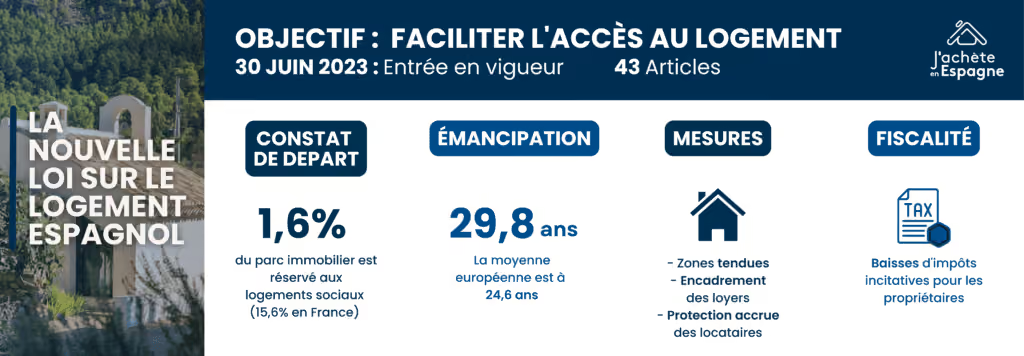
The first finding behind the bill: Spain's social housing stock is in a worrying state. “It currently makes up only 1.6% of the total housing stock, or 290,000 homes”, Thomas Rouer, founder of Alveo Search, told us. “That is very little compared with many of its neighbours in Europe”.
So what does the law do to expand the public housing stock?
- The share of land reserved for VPO (Vivienda de Protección Oficial, state-protected housing) rises from 30% to 40% of the residential floor space planned in new developments.
- With the Ley de Vivienda, protected housing was to keep its status permanently, but the Constitutional Court struck down this article in May 2024 (ruling 79/2024).
- In urban areas undergoing renewal, the reserve for protected housing rises from 10% to 20%.
Young people in Spain leave home too late
Another striking point, which also showed the need for a new law: the average age at which young people leave home in Spain is much higher than in the rest of the European Union.
“While most young Europeans leave the family home at around 24.6, young Spaniards have to wait until they are 30”, Thomas Rouer continues.
So the law includes measures to help young people leave the parental home. Expanding social housing is one of them; rent controls, taxes on empty homes and tax cuts for landlords who rent to young people complete the range. We look at them below.
The housing law sets a 30% benchmark for household housing costs
Spain's housing law also defines the share of their income that households should have to spend on decent housing and its running costs.
The law sets an affordability benchmark: the mortgage or rent, plus basic bills, should not as a general rule exceed 30% of household income.
Up to this level, housing counts as affordable. The figure guides public housing policy and the declaration of stressed areas. It sets no legal limit on what a household can spend or borrow.
Banks still apply their own limits when you apply for a mortgage, so check them early if you plan to buy.

The Ley de Vivienda and large landlords
To understand the Ley de Vivienda and its impact, you need to look at a distinction it introduced. The law divides landlords into 3 categories:
- Large landlords (grandes tenedores): individuals or companies that own more than 10 homes or 1,500 m² of residential floor space, excluding garages and storage rooms.
- Large landlords in stressed areas (a lower threshold the region can set): owners of 5 homes or more in so-called “stressed” areas, if the region justifies it. We explain this concept in the next section.
- Other landlords are individuals or companies below these thresholds, such as owners of fewer than 5 homes.
Under the Ley de Vivienda, Spain's new housing law, each category of landlord has new obligations.
Goal no. 2 of Spain's new housing law: cap rents
The law's second aim is to limit the cost of housing. To do this, Pedro Sánchez's government capped rent increases across the country and introduced the concept of stressed areas, a concept already used in other European countries, such as France and Germany.
What are the criteria for stressed areas in Spain?
As we have said, the law is national, but each autonomous community decides how to apply it. So declaring a neighbourhood or municipality a stressed area is up to each of the 17 autonomous communities.
However, there are of course criteria to meet:
To declare an area a stressed rental market, at least one of these two conditions must be met:
- The average cost of a mortgage or rent, plus bills, exceeds 30% of average household income in the area. Example: if the average income in an area is €3,000 net per household (family, flatshare…), total housing costs and bills should not exceed €900. If they do, the area can be declared stressed.
- The purchase price or rent has risen by at least 3 percentage points more than the CPI (consumer price index) over the previous 5 years. For example: if a home cost €200,000 in January 2020, by January 2023 its price should have risen by no more than the CPI for January 2020 to January 2023 (12.9%) plus 3 percentage points (15.9% in total), so up to €231,800. If it costs more, the area where it is located can be declared stressed.
Good to know: stressed-area status is not permanent. “It is reviewed every 3 years”, says Thomas Rouer, founder of Alveo Search. A declaration lasts 3 years and can then be extended year by year. It is also possible to challenge it. In short, being classed as a stressed area is not set in stone.
If you have questions about stressed areas or any other aspect of Spain's new housing law, our team can answer them in a call.
Rent caps across Spain
Since March 2022, to contain the impact of the war in Ukraine, the consumer price index (CPI) has no longer been the benchmark for updating rents. The housing law kept this approach.
Annual rent updates, based on the rent in force, could not exceed 2% in 2023 and 3% in 2024. Since 2025, they must follow the new rent update index (IRAV) published monthly by the INE, Spain's National Statistics Institute, to avoid disproportionate rises.
“Take this example, says Thomas Rouer, a specialist in Spanish property: if a rent was set at €1,000 a month, the updated rent could not exceed €1,030 in 2024.”
Landlords also cannot raise the rent by adding new charges (community fees, rubbish collection tax, etc.)
The rent cap is THE most controversial measure of Spain's new housing law. Landlords call it unfair, and the property sector fears a slowdown in the market.
Rent caps in stressed areas in Spain
In stressed areas, rents are controlled more strictly than elsewhere. You could even call it a rent freeze, with some exceptions.
The rent of a new contract cannot exceed the last rent of the previous contract on the same home, after its annual update. Large landlords are also capped by the State reference rent index.
Note that an exceptional increase of up to 10% of the rent can be applied in certain cases, such as:
- Major renovation work.
- Significant energy improvements.
- Better accessibility.
- A rental contract of more than 10 years.

Length of rental contracts under Spain's new housing law
The “Ley de Vivienda” also includes measures to encourage longer rental contracts, but most landlords are not affected by them.
The main aim here is to protect tenants who are considered “vulnerable”.
Most rental contracts did not change with the new law
The law did not change the following contract terms (a decree-law of October 2026, still awaiting a vote in Congress, would change some of them from 15 November 2026):
- Contracts with individual landlords still run for a minimum of 5 years.
- Companies still sign for 7 years.
- If neither party gives notice, the contract is then extended year by year for up to 3 more years.
- The tenant can end the contract at each yearly renewal date with 1 month's notice.
- If the landlord does not want to extend the contract, they must still give the tenant 4 months' notice.
- The tenant can end the extension period with 2 months' notice.
The new housing law and the protection of “vulnerable” tenants
The real change concerns tenants in a vulnerable situation:
- If the tenant is socially or economically vulnerable, large landlords must extend the contract by 1 more year, and up to 3 years if the home is in a stressed area.
- Note that this vulnerability must be proven and certified by social services, at municipal or regional level.
The tax advantages of Spain's new housing law
Tax incentives for individuals
“Tax incentives”, according to Thomas Rouer, are “the most important point for landlords and potential buyers” in this new housing law.
Major measures were introduced to encourage lower rents or better quality and accessibility of homes.
These measures only apply to landlords who are tax resident in Spain. Non-residents pay non-resident income tax, which does not include these reductions.
Here is what you need to know about the tax side of the Ley de Vivienda:
From 1 January 2024, for contracts signed since 26 May 2023:
- Landlords who sign a new contract in a stressed area get a 90% reduction on their net rental income if the rent is cut by more than 5% compared with the previous contract.
- They get a 70% reduction if they rent out the home for the first time to tenants aged 18 to 35 in a stressed area, or let it for social housing through a public body or a non-profit.
- A 60% reduction applies if renovation work on the home was completed in the 2 years before the contract.
- A 50% reduction applies if none of these conditions is met, against 60% before the law (still applied to contracts signed before 26 May 2023). A decree-law of October 2026, awaiting a vote in Congress, plans a new scale from 1 December 2026.
Thomas Rouer gives us a telling example:
“If I rent out my property for €1,000 a month and earn €12,000 a year from it, I have two options: either I do not lower the rent, so I declare €6,000 (50% of my income), or I lower the rent by just 5%, earn €600 less over the year, but only have to declare 10% of my earnings, or €1,140.”
Interesting, isn't it? Note that the law requires a cut of more than 5%, and the 90% rate only applies in stressed areas.
If you are looking for information on property tax for non-residents, read our special report on the 5 taxes every non-resident owner must know.
Tax incentives for companies
Companies whose main activity is renting out housing and that own more than 8 properties rented out or available for rent for more than 3 years get a 40% tax reduction.
Why is Spain's new housing law controversial?
Ever since the bill for the Ley de Vivienda was first tabled, it has caused a lot of debate. The law worries landlords and unsettles property market specialists, who fear it will slow down a market that was already somewhat fragile.
When the law was passed, there were signs of a slowdown, according to the latest data from the INE (Spain's National Statistics Institute). Property sales fell by 6% in March 2023 compared with March 2022.
The new housing law penalises empty homes
Here too, Spain follows other European countries, and landlords are not happy about it.
Empty homes can be taxed more heavily to encourage owners to rent them out. Town councils can penalise owners by raising the IBI (Impuesto sobre Bienes Inmuebles, the annual property tax) by up to 150%!
- Up to a 50% surcharge if the home has been empty for more than 2 years and the owner has 4 or more homes
- Up to 100% if it has been empty for more than 3 years
- An extra surcharge of up to 50 percentage points if the owner has 2 or more empty homes in the same municipality.
Remedies for people facing eviction
Another part of Spain's 2023 housing law was particularly controversial for months: evictions.
In short: evictions are harder and must be scheduled in advance. Longer procedures delay the process.
It is now mandatory to:
- Set a date and time for the eviction.
- Eviction procedures are longer and can take more than 2 years.
- If the tenant applies to be declared vulnerable, the eviction can be suspended for 2 months if the landlord is an individual, or 4 months if it is a company or a large landlord.
- Vulnerable people also have access to mediation and/or alternative housing offered by their autonomous community.
- Large landlords must go through a conciliation or mediation procedure before they can evict a tenant.
Under Spain's new housing law, agency fees are paid by the landlord
Article 20 of the Tenancy Act (LAU), as amended by the housing law, states that “property management and contract formalisation costs are paid by the landlord”. The aim is to protect tenants, but the measure is seen as another penalty for landlords.
With this law, agencies must convince landlords to entrust them with their property while paying the fees once charged to tenants!
Squatters (okupas): what the new housing law left out
Squatting, known as the okupas phenomenon, is a hot topic in Spain. An estimated 100,000 homes are illegally occupied, and it is true that the new housing law sidesteps the issue. This gap adds to landlords' sense of injustice.
Key points of Spain's new housing law
- It came into force on 26 May 2023
- It aims to expand social housing
- It sets out the concept of stressed areas
- It caps rents across the country, and more strictly in stressed areas
- It aims to make housing easier to access for young people
- It protects people classed as vulnerable
- It confirms that estate agency fees are paid by landlords
- It complicates the eviction process
- It introduces a tax on empty homes through a higher property tax (IBI)
- It offers a wide range of tax incentives, in force since 1 January 2024.
Our advice: if you plan to buy in Spain, work with a professional. They can explain Spain's 2023 housing law and the points that concern you.
You can book a call directly with one of our team's specialists.
If you plan to buy in Catalonia, the Madrid region, the Valencian Community, the Canary Islands, the Balearic Islands or Andalusia, contact our specialist property advisers directly. Our English-speaking advisers know each of these regions inside out.
Planning to buy a property in Spain?
Get a call back from one of our experts on the ground.
Thomas Rouer is the founder of Alveo Search and the CEO of the Alveo group. Based in Spain for almost ten years, he develops property services designed for the specific needs of foreign buyers.
His expertise covers every aspect of buying property in Spain: understanding the market, searching for and selecting properties, negotiation, financing, paperwork, tax and securing the purchase process.


Our resources for buying in Spain