Français
 English

Nota Simple in Spain: the document to check before buying a property

- Definition: the nota simple is an extract from the Registro de la Propiedad, Spain's Land Registry. It shows the registered owner, the description of the property and any charges: mortgage, seizure (embargo), easement, ban on selling.
- When to request it: as early as possible, before any reservation, offer or arras contract, then again before the notary to check that it is up to date.
- How to get it: online from the Land Registry at registradores.org, at the competent registry office or through a professional. You identify the property (finca registral number, address, cadastral reference) and state a legitimate interest. Online, it costs €9.02 per property plus VAT (about €11).
- Warning signs: several owners, an inheritance or a usufruct call for further checks. A registered mortgage does not prevent the sale if it is repaid and cancelled at the notary's.
- Limits: it guarantees neither planning compliance, nor the absence of undeclared works, nor payment of IBI (local property tax) and community fees. Cross-check it with the cadastre, the town hall and the community of owners.
- Rule: if something looks wrong, do not sign until you understand it. A problem can sometimes be solved before you commit.
Before buying a property in Spain, many buyers naturally focus on price, location, condition, negotiation or financing. Yet another step is essential before committing: checking the legal status of the property. That is precisely the role of the Nota Simple.
The Nota Simple in Spain is a document issued by the Spanish Land Registry (Registro de la Propiedad). It shows the information officially recorded about a property: the owner's identity, the description of the home, any charges, mortgage, easement, seizure or restriction that may affect the property. In principle, the owner or the estate agent should provide it to you.
For a foreign buyer, this document is particularly important. It lets you check that the seller really owns the property, that the home matches what the listing shows, and that no registered charge could complicate the sale. It is therefore one of the first documents to ask for when you want to make a property purchase in Spain secure.
Keep in mind that the Nota Simple is essential but not enough on its own. It does not replace the other legal, cadastral, planning or administrative checks. It must be read methodically, compared with the other documents and, if in doubt, analysed with the help of a professional.
What is a Nota Simple in Spain?
The Nota Simple is an information extract from the Registro de la Propiedad, Spain's Land Registry. This registry records the legal information on properties: ownership, registered rights, charges, mortgages and certain limitations.
In practice, the Nota Simple answers several key questions before a purchase:
- Who is officially registered as the owner of the property?
- Is the seller really the person authorised to sell?
- What is the registered description of the home?
- Is there a mortgage, a seizure, an easement or a charge?
- Does the property shown match the property in the Land Registry?
- Do you need to ask for further documents before signing?
The Nota Simple usually relates to a finca registral, meaning the property unit as it is recorded in the Land Registry. This finca can be an apartment, a house, a plot of land, commercial premises, a garage or an annex registered separately.
This is an important nuance: an apartment and a parking space can sometimes have two separate entries. A house can also be registered with some annexes, but not necessarily with every change made over the years. That is why you should not only get the Nota Simple but also compare it with the property you visited.
The Nota Simple is therefore a first filter. It identifies the main warning signs, but does not on its own guarantee that the property is fully compliant. To understand its role, it helps to see it within all the procedures relating to the Spanish Land Registry (Registro de la Propiedad).
The best approach is to ask for this document as early as possible, ideally before signing a reservation, a binding offer or a contrato de arras in Spain. The earlier the checks are done, the easier it is to renegotiate, ask for explanations or walk away if a serious problem appears.
What does a Nota Simple contain and how do you read it?
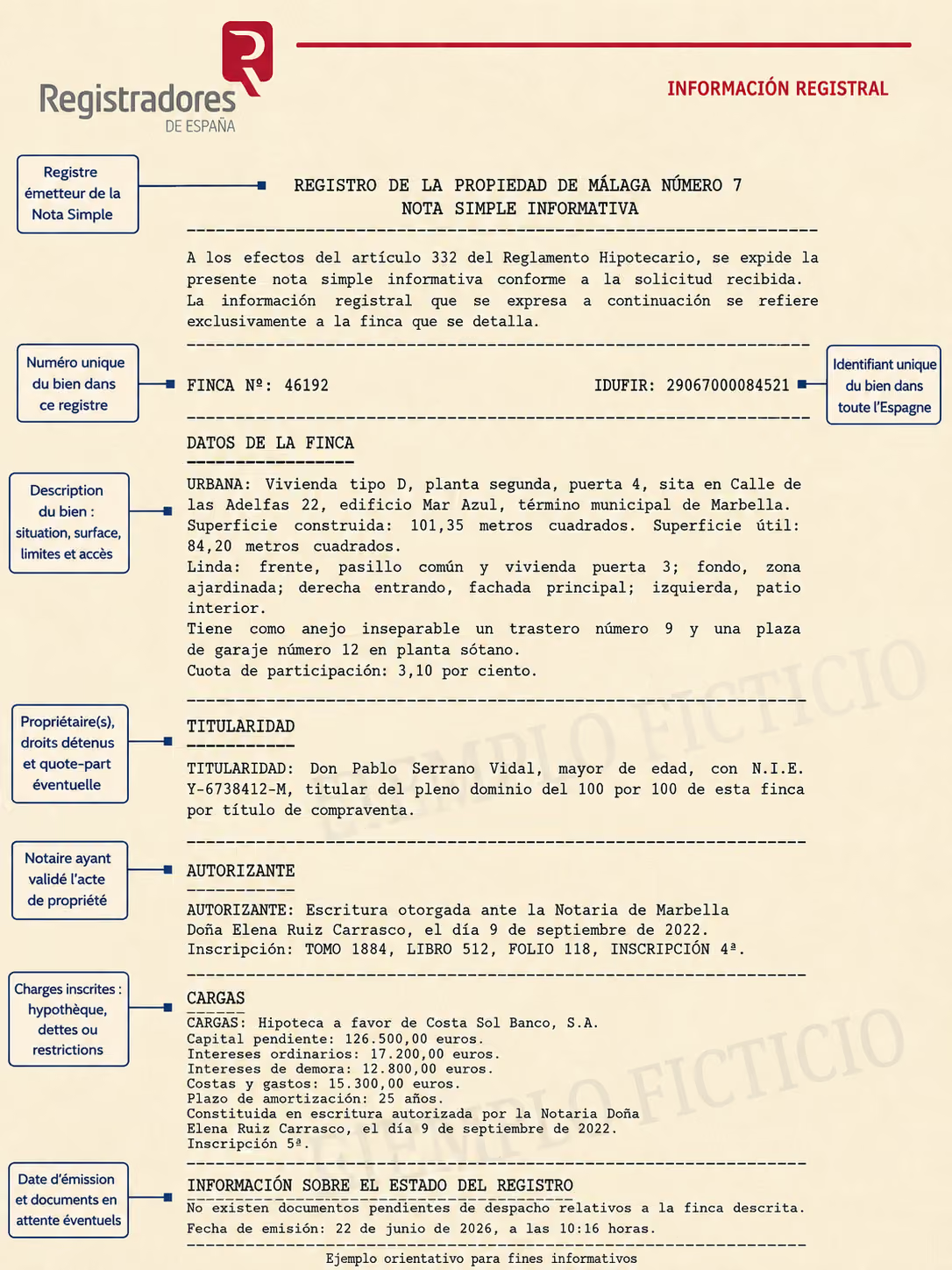
A Nota Simple can vary slightly from one registry to another, but it usually contains three main types of information: identification of the property, the identity of the registered owner and any charges or limitations.
Description of the property (location, dimensions, boundaries, etc.).
The first part identifies the property. It often includes the finca registral number, the address or location, the municipality, the description of the home, the registered area, the property's use and sometimes the cadastral reference (referencia catastral).
Check this part carefully. If the listing mentions a terrace, a garage, a storage room, a pool, land or an annex, check whether these appear clearly in the documents. A feature may be sold as part of the property while not being registered the same way, or it may have a separate entry.
The area also needs careful reading. The area shown in the Nota Simple does not always match the listing, the cadastre or the actual size of the home. In Spain, there can be differences between built area, usable area, cadastral area and registered area. A difference is not necessarily abnormal, but you need to understand it.
Identification of the owners
The second key part concerns the registered owner. The Nota Simple shows who officially owns the property according to the Land Registry. This is central, because the person selling must be the owner or have the legal power to sell.
Several situations should catch your attention:
- the property belongs to several people;
- the seller is not the only registered owner;
- the property is part of an inheritance;
- a usufruct (a right to use the property) is registered;
- the owner is a company;
- the seller is acting on behalf of someone else;
- the ownership situation seems different from what you were told.
These situations do not always block the sale. However, they call for further checks. If several owners appear, all of them generally need to take part in the sale or be properly represented. In an inheritance, you need to make sure the transfer to the heirs has been properly completed. If there is a usufruct, you need to understand who holds which rights over the property.
Identification of all charges on the property
The third part covers charges, mortgages and restrictions. This is often where the Nota Simple reveals the most sensitive information.
You may find:
- a mortgage still registered;
- a seizure (embargo);
- an easement;
- a ban on selling;
- a right of use;
- an administrative restriction;
- legal proceedings affecting the property;
- an old charge that has not been cancelled.
A registered mortgage does not necessarily prevent the sale. In many cases, it is repaid and cancelled when the deed is signed at the notary's. However, it must be clearly identified and dealt with in the transaction. The buyer must understand how and when the charge will be cancelled.
So the Nota Simple should never be read in isolation. Compare it with the property you visited, the listing, the seller's information and the other relevant documents.

When should you request a Nota Simple?
The Nota Simple is best known for property purchases, but its use goes beyond buying a home. You can request it whenever you need to check the legal status of a property in Spain, identify its owner or confirm whether charges are registered.
In a purchase, ideally request it as early as possible. In principle, the owner or the estate agent should provide it. If they do not, you can request it yourself, directly or through a professional.
Before buying a property in Spain
This is the most common case. Before buying a house, an apartment, land or commercial premises in Spain, the Nota Simple lets you check that the seller really owns the property and that no major charge is registered against it in the Land Registry.
Check it before committing, especially before signing a reservation, a firm offer or an arras contract. This avoids discovering a mortgage, a seizure, an easement or a mismatch between the property visited and the registered property too late.
Before selling a property
The Nota Simple can also help the seller. It lets them anticipate the buyer's questions and check that the property's situation is clear before putting it on the market.
If an old mortgage still appears in the registry, if an area does not match or if several owners are registered, it is better to know before receiving an offer. This leaves time to regularise the situation or prepare the necessary explanations.
To apply for a mortgage
When a buyer applies for financing in Spain, the bank may need a recent Nota Simple. It lets the bank check the legal status of the property offered as security: ownership, existing charges, a mortgage already registered or specific restrictions.
In this case, the Nota Simple is one of the documents used to assess the risk of the transaction. It does not replace the bank's analysis, but it gives an official basis on the property concerned.
In an inheritance, divorce or separation
The Nota Simple can also help identify the properties a person owns in Spain. It can therefore be useful for an estate, an inheritance, a divorce or a separation.
It confirms that a property exists, its registered owner and any rights recorded. In these situations, it is mainly a starting point to clarify the property assets involved.
To check an owner or a legal situation
Finally, a Nota Simple can be requested when you need to check who really owns a property. This can be useful before a rental, a negotiation, a debt recovery procedure or any situation where you need to confirm the identity of the owner registered in the Land Registry.
For a buyer, this check avoids dealing with someone who is not the owner or who does not have the power to sell alone. It is a simple but essential precaution in a property transaction.
How do you get a Nota Simple in Spain?
There are several ways to get a Nota Simple. The most common is to apply online to the Spanish Land Registry, on the official website of the registrars (registradores.org). You can do it from abroad and you do not need to create an account. You can also apply directly at the competent registry office or go through a professional: a lawyer, property adviser, estate agency or buyer's agent.
To apply, you must be able to identify the property precisely enough. Useful information includes:
- the finca registral number (with the registry where it is recorded);
- the CRU (Código Registral Único, formerly IDUFIR) if available;
- the full address of the property;
- the cadastral reference (referencia catastral);
- the current owner's name;
- the municipality where the property is located.
In some cases, the address alone may not be enough, especially if the property is poorly identified, in a complex building or linked to several separate units. The more precise the request, the easier it is to get the right document.
You also need to state a legitimate interest. When buying a property, this interest is obvious: the potential buyer wants to check the legal status of the property before committing.
A Nota Simple costs little. On registradores.org, the registrar charges €9.02 per property, plus taxes (about €11 with 21% VAT). An English translation can be ordered for €30 plus taxes. Always check the fee when you apply, as it can differ if you go through an intermediary.
Delivery is generally quick, especially online: you receive an email with a link to download the document as a PDF. A request made in writing, in person or through a professional may take longer.
Above all, ask for a recent Nota Simple. An old one may no longer reflect the property's current situation. Between two stages of the sale, a charge may be registered, a mortgage may change or legal proceedings may appear. Before the final signing, it is wise to check that the document is up to date.
The right time to request the Nota Simple is before any significant commitment. Ideally, check it before you reserve a property in Spain, before paying a deposit or before signing a reservation contract (contrato de reserva).
If the transaction moves forward, a new check can be useful before going to the notary. It makes sure nothing new has changed the property's situation.
The limits of the Nota Simple: the checks to add
The Nota Simple is an essential document, but it should not be seen as a full guarantee. It shows the situation recorded in the Land Registry, but it does not answer every question.
It does not always guarantee:
- the full planning compliance of the home;
- the absence of undeclared works;
- that an extension is legal;
- the compliance of a pool, an enclosed terrace or a converted garage;
- that there are no unpaid community fees;
- that IBI is paid up to date;
- the validity of an occupancy or habitability licence;
- perfect consistency between the registry, the cadastre and the physical property.
This is one of the most important points to understand. A property can be registered in the Land Registry without all its changes being fully regularised. For example, a house may have an extension built later, an enclosed terrace, an added annex or a pool that was not properly declared. The Nota Simple can give a first indication, but it is not always enough to confirm that these features comply.
That is why you need to cross-check the Nota Simple with the Spanish cadastre (Catastro). The cadastre has an administrative and tax function. It shows the cadastral reference, the cadastral area, the property's use and some of the data used to calculate local taxes such as IBI.
But the cadastre does not replace the Nota Simple either. On its own, it does not prove who legally owns the property. The two documents complement each other.
Here is a table to clarify the differences:
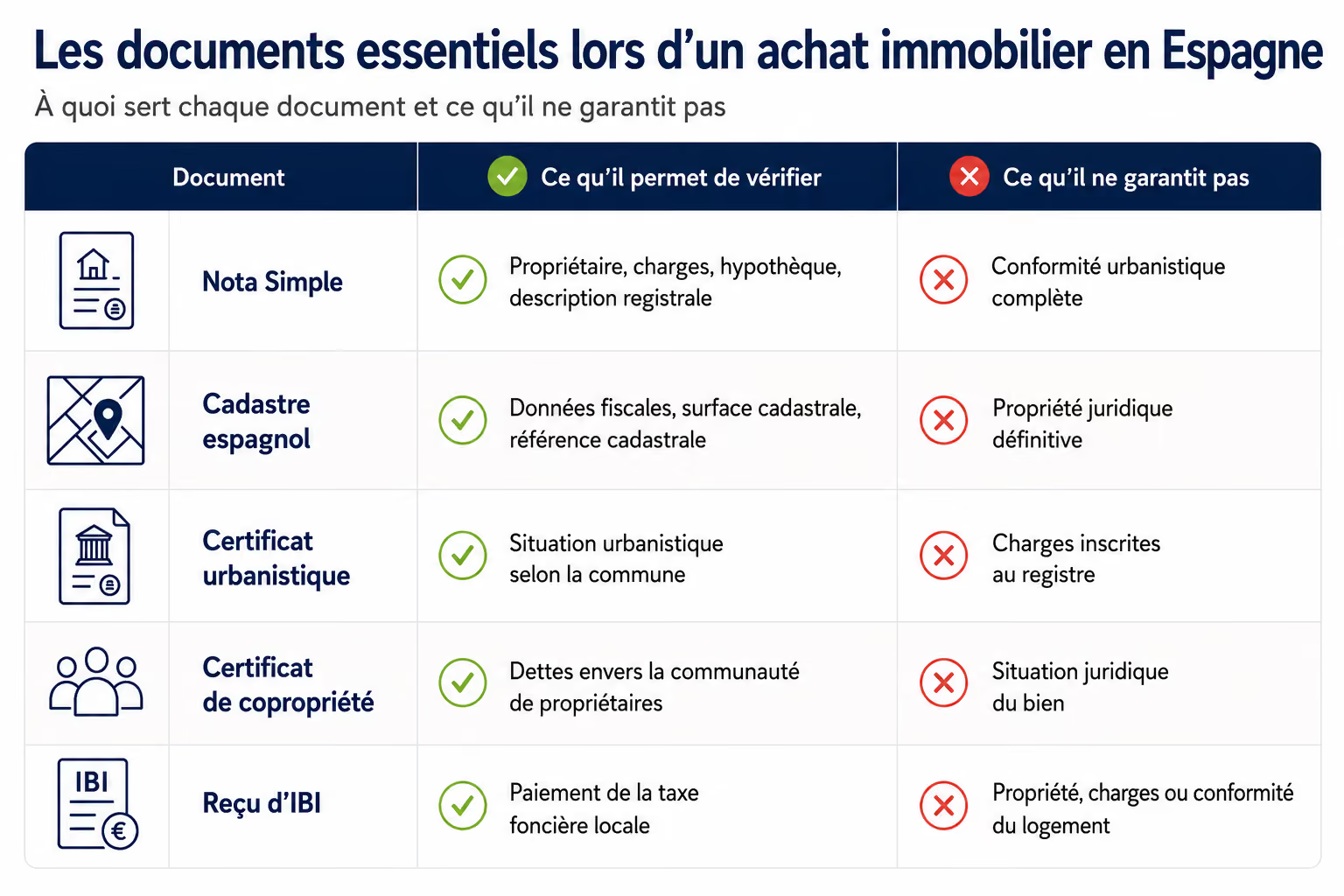
To secure a purchase, you should therefore look for consistency between several sources:
- what is recorded in the Land Registry;
- what appears in the cadastre;
- what actually exists on site;
- what the town hall can confirm;
- what the seller declares;
- what the community of owners' documents show.
If these sources tell the same story, that is reassuring. If the information differs, you need to understand why before signing.
Nor does the Nota Simple replace checks on current debts. For example, it is not always enough to check unpaid community fees, some bills or IBI. These points must be checked with specific documents.
In other words, a “clean” Nota Simple is good news, but not an automatic green light. It helps you ask the right questions; it does not remove the need for other checks.
What should you do if the Nota Simple reveals a problem?
An irregularity in a Nota Simple does not necessarily mean you should give up the purchase. However, it means slowing down, understanding the situation and asking for supporting documents before signing.
- If a mortgage appears, check how it will be cancelled. In a standard sale, the mortgage can be repaid when the deed is signed at the notary's, then removed from the registry. But this must be organised clearly. The buyer should not settle for a verbal explanation.
- If a seizure or legal proceedings appear, be even more careful. You need to understand the exact nature of the charge, its amount, its origin and its impact on the sale. In some cases, the problem can be resolved. In others, it can make the purchase risky.
- If several owners are registered, check that each of them agrees to the sale. In Spain as elsewhere, one owner cannot freely sell a property that also belongs to other people. In an inheritance, make sure the heirs are correctly identified and the necessary steps have been completed.
- If an easement is registered, understand its practical effect. A right of way, for example, may have little impact or, on the contrary, severely limit the use of a plot. It all depends on its nature, location and practical consequences.
- If the description of the property does not match reality, identify the source of the gap. It may be an update that was never made, but also an undeclared construction, an unregistered annex or a planning problem.
In every case, the rule is simple: do not sign while things are unclear. A problem can sometimes be solved, but it must be understood before you commit. To sum up, the Nota Simple is one of the most useful documents for buying carefully in Spain. It lets you check the legal basis of the property, identify obvious risks and ask the right questions before committing. But it must always be cross-checked with the other documents in the transaction. To buy with peace of mind, rely on the consistency of all the checks rather than on any single document.
Example of a nota simple
Thomas Rouer is the founder of Alveo Search and the CEO of the Alveo group. Based in Spain for almost ten years, he develops property services designed for the specific needs of foreign buyers.
His expertise covers every aspect of buying property in Spain: understanding the market, searching for and selecting properties, negotiation, financing, paperwork, tax and securing the purchase process.
FAQ on the Nota Simple in Spain
Is a Nota Simple compulsory to buy in Spain?
It is not always presented as an administrative obligation for the buyer, but in practice it is essential. Buying without checking the Nota Simple means going ahead without checking the property's legal status.
Who can request a Nota Simple?
Anyone with a legitimate interest can request it. A potential buyer, a lawyer, an agency or an authorised professional can therefore request this document as part of a property purchase.
How long is a Nota Simple valid?
There is no single validity period to treat as an absolute rule. In practice, ask for a recent Nota Simple, especially before a major commitment or before signing at the notary's.
Can you buy if a mortgage appears on the Nota Simple?
Yes, it is possible, but the situation must be clearly dealt with. The mortgage must be repaid, cancelled or properly handled as part of the sale. This point must be confirmed before signing.
Is a Nota Simple enough to make a property purchase secure?
No. It is essential, but not enough. It must be completed by other checks: cadastre, planning documents, community fees, IBI, the property's administrative status and consistency between the documents.