Français
 English
8 little-known facts about the Giralda in Seville

- Origin of the name: the Giralda is the bell tower of the cathedral of Santa María de la Sede, built in the 12th century during the Muslim period. Its name comes from the Giraldillo, the bronze statue at the top that serves as a weather vane. It replaced the name Triunfo de la Fe Victoriosa given by Fernando III after the reconquest of Seville in 1248.
- Height: the tower reaches 101 metres with the Giraldillo, compared with 96 metres for Big Ben and 55.8 metres for the Leaning Tower of Pisa. In the city, it comes second to the Torre Sevilla, a 178-metre skyscraper.
- Inspiration: its upper part was completed by the Christians, and the tower was inspired by the 79-metre minaret of the Koutoubia mosque in Marrakesh.
- Details: the bell tower has 24 named bells, including Santa María Mayor, the largest, and Santa Cruz, the oldest. A Latin inscription runs along all four sides, and 35 ramps replace stairs so that riders could go up on horseback.
- Key point: the Lizard Gate displays a crocodile, an elephant tusk, a bridle bit and a staff.
One of Seville's most famous monuments is undoubtedly the Giralda. It is the popular name of the bell tower of the cathedral of Santa María de la Sede. The tower was built in the 12th century, during the Muslim period. Here are 8 little-known facts about the Giralda in Seville.
1. Where does the name Giralda come from?
Why is it called that when the cathedral is Santa María de la Sede? The reason is that at its top there is a jar holding the Giraldillo. It is a bronze statue that served as a weather vane, turning with the wind, hence its name.
The famous Giraldillo gradually gave the tower its name. It replaced the name Triunfo de la Fe Victoriosa (Triumph of the Victorious Faith) given by Fernando III after the reconquest of Seville in 1248.
2. The Giralda's height
The tower is 101 metres tall if you count the Giraldillo. For several centuries, it was the tallest tower in Spain and one of the tallest in Europe. Although it may not look it, the Giralda is taller than London's Big Ben, which is 96 metres high. It is almost twice as tall as the Leaning Tower of Pisa, at 55.8 metres.
In the city, it is the second-tallest building after the Torre Sevilla, a 178-metre skyscraper that is one of the tallest in Spain.
3. An important model for other cultures
The Giralda was built during the Muslim period, although its upper part was completed by the Christians. It was inspired by the minaret of the Koutoubia mosque in Marrakesh (Morocco), built in the same century. That minaret is 79 metres high and is one of the great works of Hispano-Moorish art.
The Giralda was so admired that it has served as a model all over the world.
4. The Giralda has 24 bells
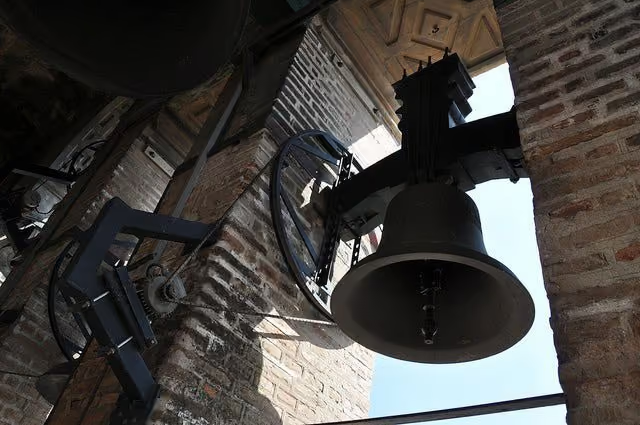
The Giralda's bell tower has 24 bells and each one has a name. The largest is the Santa María Mayor bell. In short, it is the cathedral in Spain with the most bells.
Here are some of their names: Santa Cecilia, Santa Justa, Santa Rufina, Santa Lucía, San José, San Sebastián and Santa Cruz (the oldest of all), Santiago, Santa Catalina, San Miguel and Omnium Sanctorum.
Bell: Iñaki Martínez de Marigorta Díaz / Flickr.com
5. A very special Latin inscription on the tower
Along the four sides of the tower runs an inscription in Latin:
“Turris fortissima nomen DNI Proverb. 18”
which means “the strongest tower is the name of the Lord”.
It is verse 10 of chapter 18 of the Book of Proverbs, in the Old Testament, and it was added on the orders of Ferdinand III.
6. The legend of Alfonso X and the Giralda
Legend has it that when Seville was about to surrender during the Reconquista, the Muslims asked for the tower to be demolished so that it would not fall into Christian hands. Alfonso X then decided to step in, threatening the Muslims that he would cut off as many heads as there are bricks in the Giralda.
The Muslims then decided not to pull the tower down, and left the city with the Giralda intact, writing it into the city's history.
7. Controversial appearances in literature
Dan Brown, author of The Da Vinci Code, painted a controversial portrait of Seville, and not a very accurate one, in his novel Digital Fortress. So inaccurate that he replaced the ramps of the Giralda with stairs (yes, for the people of Seville that is a major difference…). The Giralda has 35 ramps so that the sultan could ride up on horseback and admire the view from the bell tower.
8. The Lizard Gate
It is one of the most striking curiosities of the Giralda. It gets its name from the crocodile hanging there, next to an elephant tusk, a horse's bit and a staff.
The legend says it was a gift from the Sultan of Egypt to King Alfonso X to ask for his daughter's hand in marriage. When he refused the request, the gifts were given to the cathedral. Each item is said to stand for a virtue: the crocodile for prudence, the tusk for strength, the bit for moderation and the staff for justice.
To buy a flat or a house in Seville, contact us!
Source: Miviaje
Thomas Rouer is the founder of Alveo Search and the CEO of the Alveo group. Based in Spain for almost ten years, he develops property services designed for the specific needs of foreign buyers.
His expertise covers every aspect of buying property in Spain: understanding the market, searching for and selecting properties, negotiation, financing, paperwork, tax and securing the purchase process.


Our resources for buying in Spain