Français
 English
Healthcare in Spain: how the system works for expats

- Financing: the Ministry of Health budget represents 7.8% of GDP, or €94 billion. Spending has risen by more than 25% since 2016, to just over €2,000 per inhabitant.
- Organisation: funded by taxes, it covers Spain's 47 million inhabitants and is run by the 17 autonomous communities. More than 13,000 centros de salud provide primary care, with a médico de cabecera (family doctor) and a tarjeta sanitaria (SIP). Emergency services can be reached free of charge on 112 and 061.
- Steps: for a short stay, a European Health Insurance Card (EHIC) or, for UK residents, a GHIC is enough, one per person. Visitors from the US need travel insurance. To settle: NIE, empadronamiento, S1 form or TA-1 form, then registration with Social Security.
- Limits: out-of-pocket costs (copago) are among the highest in the EU, and medicines are only partly covered, sometimes at 50%. The wait for non-urgent surgery reached 113 days in 2022, with more than 819,000 patients on waiting lists in mid-2023.
- Key point: public cover is broad, but waiting times, dental care and eye care push many people towards private insurance, at €50 to €100 a month. If you settle without working, you also need health insurance for your residence application.
You have decided to move to Spain. Before you make the move for good, with your children or on your own, to work or to retire, you need to know how the Spanish healthcare system works.
So does it offer good quality care? How does it work? What steps do you need to take to use it? Which regions are best equipped from a medical point of view?
Our complete guide to healthcare in Spain answers all these questions.
The Spanish healthcare system at a glance: principles, management and performance
An overview of health in Spain
Overall, Spain and its people are in good health. According to the latest official data published on the Ministry of Health website, women have a life expectancy at birth of just over 85 years, and men of just over 80. On this measure, it is the European country where women live longest, and the 3rd for men.
Since 2012, the death rate has fallen by 7%. Obesity figures are also good: the population is fairly active and eats rather well.
All inhabitants (47 million people) can use a public healthcare system that is still robust, and 57% of them have a positive or very positive view of healthcare in Spain.
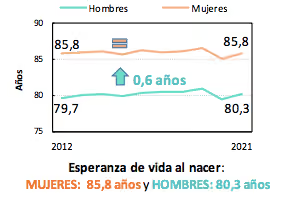
Source: Ministry of Health
The Covid-19 crisis put healthcare systems around the world to the test, but Spain's held up rather better than others.
In spring 2023, the Minister of Health was José Manuel Miñones Conde. Mónica García has held the post since November 2023. The ministry's budget represents 7.8% of the country's GDP, or €94 billion. Spending has risen sharply since 2016 (by more than 25%), to just over €2,000 per inhabitant.
Alongside the public system, there is a private sector, which accounts for nearly €37 billion of investment.
The founding principles of the Spanish healthcare system
As with the NHS in the UK, the main pillar of the system is universality (equal access to care). As it is funded by taxes, it covers all residents, including foreign nationals.
If you would also like to move to Spain, contact us: our English-speaking advisers are based in Spain. They will answer your questions and support you with your property project in Spain.
A decentralised healthcare system
The Ministry of Health runs the national health service by overseeing health and social protection laws, funding and pharmaceutical policy. It is also responsible for drawing up social policies and coordinating all health services.
But the system is highly decentralised in Spain. As with some taxes, for example, Spain's 17 autonomous communities run healthcare in their own territory. This decentralisation aims to make the system more efficient and fair, but it is controversial. To find out more, read this article (in Spanish) published in the newspaper elmundo.es.
Performance
As we have said, according to a Ministry of Health survey, 60% of respondents think the Spanish healthcare system performs well. To look more closely at this perception, we examined the latest results of the Legatum Prosperity Index. This annual ranking, produced by a private organisation in London, assesses prosperity worldwide using various criteria and publishes a yearly ranking of countries, including an assessment of their healthcare systems. In 2023, 167 countries were analysed.
Spain's healthcare sector ranks 26th in the world in this ranking. So it is effective, but not among the very best. Singapore, Japan and South Korea have the best-performing systems.
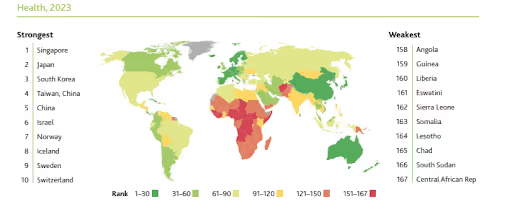
Key: the best-performing countries for health are in dark green, the weakest in red.
Source: Legatum Prosperity Index
In August 2023, CEOWorld magazine also assessed the healthcare systems of 110 countries, giving each a score out of 100 based on criteria such as the skills of health professionals, infant mortality, vaccination coverage, the cost of care for patients and the availability of medicines. In this ranking, Spain is also 26th. In other words, the results match.
Looking for a property in Spain to settle there? Book a call online with our team. The call is free and comes with no obligation.
How healthcare is organised in Spain
Public health in Spain covers a range of government initiatives to protect and improve the health of the population. It includes managing epidemics, responding to emergencies, preventing disease, promoting healthy lifestyles, occupational and environmental health, and food safety.
How is healthcare organised in Spain?
- Primary and preventive outpatient care is organised around basic health areas and can be reached within 15 minutes anywhere. Health centres (centros de salud) are the main providers of this care (medical consultations, tests and treatments, prevention). They are often the first point of contact and provide comprehensive, continuous care. As we will see below, they are the cornerstone of residents' everyday healthcare.
- Specialist outpatient or hospital care is provided by hospitals and clinics, which offer inpatient and outpatient services in various medical specialities. Patients usually access it on referral from their family doctor (médico de cabecera), who sees them at their health centre.
- Emergency care is available 24/7 and includes telephone assistance, risk assessment, treatment of medical and surgical emergencies, and medical transport.
- Long-term care in the Spanish system includes a range of services to support older and dependent people, such as telecare, home help, day centres, care homes and other adapted services. There is financial help for home support or for improving living conditions. Technology plays a growing role in these long-term services.
Which areas of care perform best in Spain?
In practice, the Spanish public system is effective for general care and chronic conditions. For serious illnesses such as cancer, the public sector offers excellent free care.
Key points:
- Primary care: Spain is known for its wide and effective primary care network, with easy access to GPs and basic health services.
- Organ transplants: the country is a world leader in organ transplants. Spain has the highest rate of organ donors per million inhabitants in the world.
- Cardiovascular treatment: Spain has made significant progress in treating and preventing cardiovascular disease.
- Digital health and innovation: the Spanish State is investing in digital health and technological innovation to improve healthcare.
- Cancer prevention and treatment: Spain is also known for its cancer screening programmes and innovative treatments in this field.
- According to the latest official Ministry of Health report, Spain has the most doctors per 1,000 inhabitants of any European country.
Emergency numbers to know
We have just mentioned emergency services. If you move to Spain, or even if you are only spending a few days there, you absolutely need to know these two free numbers:
- 112 is the general European emergency number, which you can call for any emergency, including medical ones. It is free from any phone, landline or mobile.
- 061: this number is specifically for medical emergencies in Spain. It connects you to emergency health services. It can also be called from a mobile or a landline.
Note that these numbers are increasingly busy (8.7 million calls received in 2021, see the chart below). Do not call them unless you really need to.
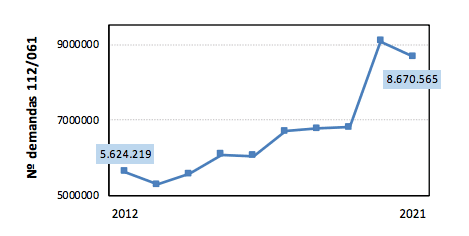
Key: the rise in the number of calls to Spanish emergency numbers. The peak corresponds to the Covid-19 crisis.
Source: Spanish Ministry of Health
You have just moved to Spain and want to invest? Contact us. Our team of advisers will guide you and find the property that matches your criteria.
Expats: how to access the Spanish healthcare system
There are two situations to consider:
- A short-term stay.
- A long-term move.
How you access care depends on how long you stay.
Short stays: the EHIC or the UK GHIC
If you are planning a Spanish interlude, do not worry. Once there, you can get medical care without complicated paperwork.
If you live in the EU, all you need is your European Health Insurance Card (EHIC). If you live in the UK, the equivalent is the UK Global Health Insurance Card (GHIC). It gives you state healthcare on the same terms as local residents, usually free of charge, for work, study or simply to enjoy the Spanish sun and culture. Visitors from the US are not covered and need travel insurance.
It covers medical care that cannot wait until you are back home, including emergencies, treatment for chronic conditions and pregnancy care. It also simplifies paperwork and makes it easier to be reimbursed for the care you receive.
Important:
- Your EHIC or GHIC does not replace full travel insurance, as it does not cover repatriation or private healthcare.
- Also note that a UK GHIC is valid for up to 5 years. Whatever your card, check that it will still be valid for your whole stay.
- Each card is personal: every member of your family needs their own, children included.
How to apply for a UK GHIC:
- Go to the official NHS website.
- The card is free: avoid unofficial websites that charge a fee.
- Fill in the online form with your full name, address, date of birth and National Insurance number. You can add your partner and children to the same application.
- For questions about your application, contact NHS Overseas Healthcare Services.
- If you live in an EU country such as Germany, the Netherlands or Ireland, you get your EHIC from your health insurer or national health service.
- Timing: once your application is approved, the card should arrive by post within 15 working days.
Useful tip:
- If you need treatment before your card arrives, you can apply for a Provisional Replacement Certificate (PRC), which covers you in the meantime.
Long-term moves: registering with Spanish Social Security
If you are moving for a long period or for good, alone or with your family, you will need to take a number of steps to use health services legally.
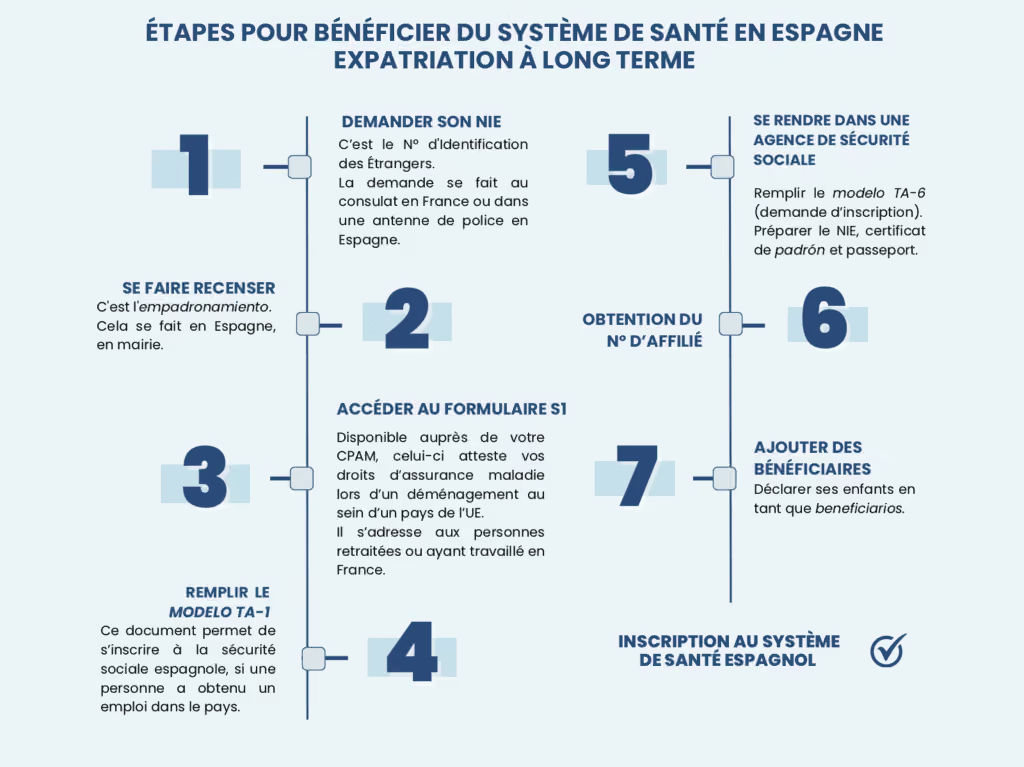
Here are the steps to access Spanish Social Security:
- Apply for your Número de Identificación de Extranjero (NIE), the foreigners' identification number, from the authorities. If you are a regular reader of the Alveo Search blog, you know that the NIE is the most important formality in Spain. To find out how to get your number, read our dedicated guide: “How to get an NIE”.
- Register on the padrón to access care. You need a certificado de empadronamiento, the certificate of registration with your town hall. It determines which health centre you will be assigned to. To find out how to get it, read our practical guide: “What is the empadronamiento?”.
- Get an S1 form from your home country if you receive a state pension there. UK State Pension recipients request it by phone from NHS Overseas Healthcare Services, then register it with the INSS in Spain. The S1 is an official document that proves your right to state healthcare when you move from one EU country to another, or from the UK to an EU country.
- Fill in the TA-1 form if you have just got a job in Spain. Use the TA-1 form directly to register with Spanish Social Security.
- Go to an office once you have all these documents. Visit the Social Security office nearest your home with the relevant form, your NIE (original and copy), your padrón certificate (original and copy), and your national ID card (EU citizens) or valid passport (original and copy).
- Get your affiliation number once you are registered: it is issued by Spanish Social Security.
- Add dependants so that your children can access care. They can do so as soon as you have declared them as beneficiarios (beneficiaries) with Social Security. They will still get their own health card.
Important:
- Having a Social Security affiliation number does not automatically give you access to healthcare.
- Once registered, you need to go to the health centre (centro de salud) nearest your home, with all the documents listed above and your affiliation number. You will be given a temporary health card (known as the Tarjeta Sanitaria or SIP) at the desk. Some centres can give you the permanent card straight away.
Healthcare day to day
As you will have understood, in Spain your healthcare depends on a specific centre, the centro de salud. There are more than 13,000 of them.
Each family member with a tarjeta sanitaria (SIP) can book an appointment with the médico de cabecera (family doctor) assigned to them by phone or even sometimes directly in an app, which is very convenient.
You will also find your prescriptions there.
Your centre will have an emergency desk, which saves you going straight to hospital. If needed, you will be transferred to the hospital you are assigned to. It works by catchment area, as with the allocation of your health centre.
As a general rule, you will be seen fairly quickly at your health centre.
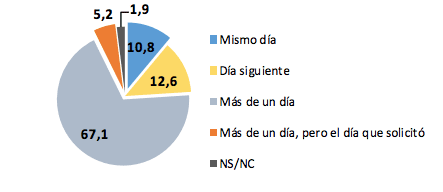
Key: waiting times for appointments at health centres.
- 10.8% of patients are seen the same day.
- 12.6% are seen the next day.
- 67% are seen more than a day after requesting an appointment.
- 5.2% get an appointment on the date they chose.
Source: Ministry of Health
Emergencies
If you do not have time to go to your health centre, if you feel unwell in the street, or if you have not yet applied for your health card, do not worry: Spanish hospital emergency departments will always treat you.
- In the public sector, you will not have to pay anything with your EHIC or GHIC (or with your travel insurance if you are on a short stay).
- In the private sector, you will have to pay, but you will also be seen, and very quickly.
Access to care in the Spanish healthcare system
Medical cover and reimbursements
In the public sector, most services are free for the country's 47 million inhabitants. So you will pay nothing for consultations, tests or hospital care for your family. However, you will often have to pay part of the cost of medicines (sometimes 50%), even when they are prescribed by your doctor. The basic cover provided by Social Security is therefore fairly limited. But a WHO/Europe report states that, compared with other European countries, healthcare costs in Spain are not a barrier to accessing care.
Useful tips:
- If you can afford it, seriously consider taking out private health insurance for better cover. These policies generally cost between €50 and €100 a month, depending on the options chosen.
- Note that Spanish private health insurers may work differently from what you are used to at home: they have their own networks of doctors and hospitals. To be fully covered, you must only use the professionals and facilities affiliated with your insurer.
- Another good option is international health insurance that also covers you in your home country, which is useful if you often travel back.
Moving to Spain: health insurance and your residence application
Non-EU citizens (from the UK or the US, for example) who apply for a visa to live in Spain without working, such as the non-lucrative visa, must have health insurance with an insurer authorised in Spain, with cover similar to the public system's basic services, for their whole stay.
EU citizens (from Germany, the Netherlands or Ireland, for example) who settle in Spain for more than three months without working there also need health insurance covering all risks in Spain to register as residents. Check the exact requirements with the Spanish consulate or the immigration office before you apply.
The best hospitals in Spain
The 2023 ranking of the best public hospitals in Spain
Spain has 468 public hospitals.
In 2023, Madrid and Barcelona led the way for the quality of their public hospitals, according to the latest ranking of the Monitor de Reputación Sanitaria (Health Reputation Monitor) by Merco. This tool measures the reputation of companies in Spain and Latin America. It is one of the world's leading tools for measuring corporate reputation.
Here is the top 5:
- Hospital Universitario La Paz, in the capital:
- Address: P.º de la Castellana, 261, Fuencarral-El Pardo, 28046 Madrid.
- Website: https://www.comunidad.madrid/hospital/lapaz/
- Phone: +34 917 27 70 00
- Hospital Clínic, in Barcelona:
- Address: C. de Villarroel, 170, L’Eixample, 08036 Barcelona.
- Website: https://www.clinicbarcelona.org/
- Phone: +34 932 27 54 00
- Hospital General Universitario Gregorio Marañón, in Madrid:
- Address: C. del Dr. Esquerdo, 46, Retiro, 28007 Madrid.
- Website: https://www.comunidad.madrid/hospital/gregoriomaranon/
- Phone: +34 915 86 80 00
- Hospital Universitario 12 de Octubre, also in the capital:
- Address: Av. de Córdoba, s/n, Usera, 28041 Madrid.
- Website: https://www.comunidad.madrid/hospital/12octubre/
- Phone: +34 913 90 80 00
- Hospital Universitario Vall d’Hebron, in Barcelona:
- Address: Pg. de la Vall d’Hebron, 119, Horta-Guinardó, 08035 Barcelona.
- Website: https://www.vallhebron.com/es
- Phone: +34 93 489 30 00
Spain's third-largest city, Valencia, is home to the country's 6th best hospital: the Hospital Universitario y Politécnico La Fe:
- Address: Av. de Fernando Abril Martorell, 106, Quatre Carreres, 46026 Valencia
- Website: http://www.hospital-lafe.com/
- Phone: +34 961 24 40 00
Seville, for its part, can count on the excellence of the Hospital Universitario Virgen del Rocío, 8th on the list.
- Address: Av. Manuel Siurot, S/n, 41013 Sevilla
- Website: https://hospitaluvrocio.es/
- Phone: +34 955 01 20 00
The rest of the top 10 is also concentrated in Madrid.
The full ranking is available here.
If you are moving to Spain with young children, if you are older or have chronic health problems, it can be important to choose a city with good healthcare facilities.
To buy a property in Madrid, in Barcelona or invest in Valencia, contact us. Our specialists based in Spain will advise you and support you with your property project.
We also think it is important to share the official national catalogue of hospitals of the Ministry of Health. It lists every facility in the country. To access it, click on this link.
The best private hospitals and clinics in Spain
For those who prefer to go private to avoid waiting times, here are the 3 best facilities in 2023:
- The Clínica Universidad de Navarra, with one site in Madrid and the other in Pamplona (in Navarre, in the north):
- Pamplona address: Av. de Pío XII, 36, 31008 Pamplona, Navarra.
- Madrid address: Calle Marquesado de Santa Marta 1. 28027. Madrid.
- Website (both sites): https://www.cun.es/
- Pamplona phone: +34 948 25 54 00
- Madrid phone: +34 91 353 19 20
- Hospital Universitario Quirónsalud, in Madrid.
- Address: c/ Diego de Velázquez, 1, 28223 Pozuelo de Alarcón Madrid.
- Website: https://www.quironsalud.com/hospital-madrid
- Phone: +34 914 521 900
- Hospital Universitario HM Sanchinarro, also in Madrid.
- Address: C. de Oña, 10, Hortaleza, 28050 Madrid
- Website: https://www.hmsanchinarro.com/
- Phone: +34 919 37 00 00

The weaknesses of the Spanish healthcare system
Weaknesses
This will surprise no one: the Spanish healthcare system is not perfect. It has weaknesses you need to be aware of.
- Dental care, eye care, psychiatry are the weak spots most often cited. The Ministry of Health confirms that more than 9% of patients find dental care too expensive. Psychiatry is also said to be one of the poor relations of Spanish healthcare.
- Out-of-pocket costs are called copago in Spanish. They are among the highest in the EU. The latest official data date from 2020.
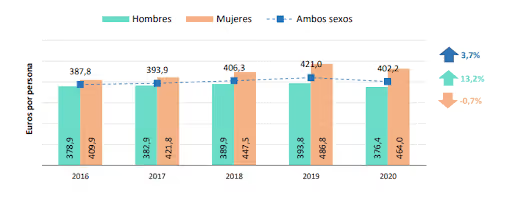
Key: out-of-pocket healthcare costs in Spain, in euros spent per year. Green shows spending by men, salmon spending by women.
Source: Ministry of Health
The average wait for non-urgent surgery was 113 days in 2022. It has risen by 74% over the last ten years. Allow an average of 226 days for plastic surgery, 193 days for neurosurgery and 134 days for trauma surgery, the three specialities with the longest waiting lists.
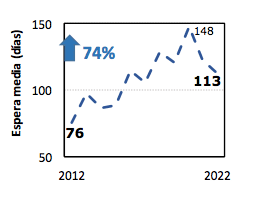
Key: waiting times for non-urgent operations. The peak of 148 days corresponds to the Covid-19 crisis.
Source: Ministry of Health
At the end of the first half of 2023, more than 819,000 patients were on a waiting list for surgery.
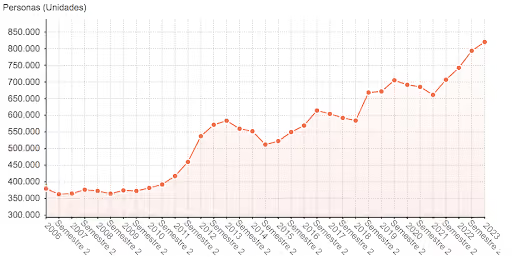
Key: change in the number of people on a waiting list for surgery.
Source: Epdata
Note that waiting times vary considerably from one region to another. Patients wait longest in the Canary Islands, and shortest in Madrid, as the chart below shows.
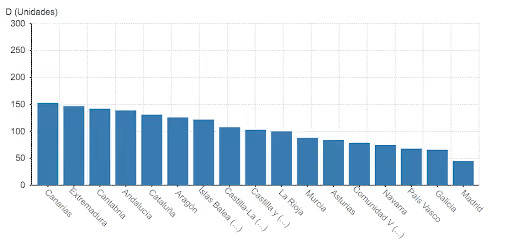
Key: waiting times (in days) by autonomous community.
Source: Epdata
The need to reform Spain's healthcare system
In Spain, as elsewhere, Covid-19 made existing problems worse and acted as a wake-up call. More and more voices are calling for an in-depth reform of a system facing several controversies and major challenges.
- One of the main concerns, as we have mentioned, is the long wait for appointments in the public sector. As a result, the number of people taking out private insurance has risen, with nearly one and a half million more Spaniards covered since the start of the pandemic.
- The decline of the public system has also affected some private centres, where waiting times have increased.
Large demonstrations took place in Madrid in early 2023, bringing together between 250,000 and one million people, depending on the estimates. Their aim: to demand more resources for public healthcare. Strikes by doctors in public facilities are also increasing, for better working conditions and higher pay.
FAQ: healthcare in Spain for expats
How does the Spanish healthcare system work for expats?
Spain's public healthcare is universal and funded by taxes, much like the NHS in the UK. Expats must register with Spanish Social Security to use it: with an S1 form if they receive a state pension from the UK or an EU country, or with the TA-1 form (available on the Spanish Social Security website) if they start a job in Spain. If you settle without working and without an S1, you need health insurance for your residence application.
Do I need private health insurance in Spain?
Although the Spanish public healthcare system is fairly comprehensive, private health insurance can offer extra benefits, such as shorter waiting times for some treatments and wider medical services. It costs between €50 and €100 a month, depending on the options. You also need health insurance for a non-lucrative residence visa, if you will not be working in Spain.
How do I get my health card in Spain?
After registering with Social Security, go to your nearest health centre with your affiliation number and the required documents. You will receive a temporary health card (Tarjeta Sanitaria or SIP), and in some cases the permanent card can be issued straight away.
As a foreign resident, can I use all health services in Spain?
Once registered with Spanish Social Security, you have access to basic healthcare like any Spanish citizen. However, for specific services or specialist care, you may need additional health insurance or have to pay extra fees.
What should I do in a medical emergency in Spain?
In an emergency, you can go to any public hospital. Make sure you have your Tarjeta Sanitaria, an EHIC or GHIC, or any relevant identity document. For minor emergencies, you can also go to local health centres (centros de salud).
112 (the general European number) and 061 (medical emergencies) are the numbers to call if you need urgent help. You can dial them from your mobile or any other phone. They are free.
Are there regional differences in Spanish healthcare?
Yes, healthcare is decentralised in Spain, which means each autonomous community can run its health services slightly differently. It is a good idea to find out about regional specifics when you settle.
Thomas Rouer is the founder of Alveo Search and the CEO of the Alveo group. Based in Spain for almost ten years, he develops property services designed for the specific needs of foreign buyers.
His expertise covers every aspect of buying property in Spain: understanding the market, searching for and selecting properties, negotiation, financing, paperwork, tax and securing the purchase process.


Our resources for buying in Spain