Français
 English
Holy Week in Spain (Semana Santa): what to know

- 2027 dates: Semana Santa runs from Palm Sunday, 21 March 2027, to Easter Sunday, 28 March 2027, with Holy Thursday on 25 March and Good Friday on 26 March as the most intense days.
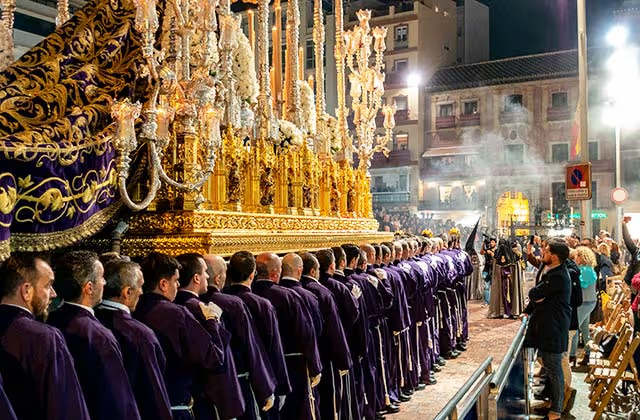
- Organisation: the brotherhoods, or cofradías, represent a neighbourhood or a parish and set how the processions run. Each has its own colours, emblems and pasos, statues carried by costaleros, often around thirty per paso, accompanied by penitents in tunics and conical hoods.
- Cities: Seville has more than 60 brotherhoods and the Madrugá between Holy Thursday and Good Friday; in Malaga the Spanish Legion parades as it escorts the Christ of the Good Death; Valladolid showcases pasos by Gregorio Fernández. Zamora, León, Granada and Cordoba offer more intimate celebrations.
- Regional differences: the Andalusian south favours music and fervour, the Castilian north sobriety and silence; in Andalusia, the processions are punctuated by saetas, flamenco songs improvised from a balcony.
- Key point: book your accommodation early and arrive the day before Palm Sunday, as the big cities are fully booked.
Imagine silent streets in perfect harmony with the soft light, the captivating scent of incense drifting through the air, the spectacular processions in every street and the rumble of drums with a solemn beat echoing in the distance. Welcome to Spain during Semana Santa! During Holy Week, Spain welcomes thousands of foreigners who come to celebrate this sacred festival. If the country draws so many people, it is both for its history, which left its mark on the Catholic world, and for its idyllic setting.
In Spain, every town celebrates Semana Santa. This religious event is the fruit of a centuries-old tradition. Catholics gather in one place where faith, art, music and emotions are shared. Everywhere, from Seville to Valladolid, via Málaga or Zamora, you will witness an unusual transformation that fits perfectly with the country's charm.
For Holy Week 2027, the atmosphere promises to be as remarkable as ever. This time, it runs from 21 to 28 March 2027, and as every year, the programme follows the same pattern: processions in many neighbourhoods of towns and cities, large and small, singing performances and theatre as well as times of prayer, etc. In any case, it is the perfect time to step back, away from everyday life, in a setting that lends itself to discovery and reflection.
In this article, find out everything you need to know about Holy Week in Spain, from its origins to the main cities that celebrate it. You will also find the 2027 calendar with the key dates and the rituals not to miss. Finally, you will find some practical tips to make the most of the event, while using your time in the country to discover all its sides.
Origins and meaning of Holy Week in Spain
A religious tradition rooted for centuries
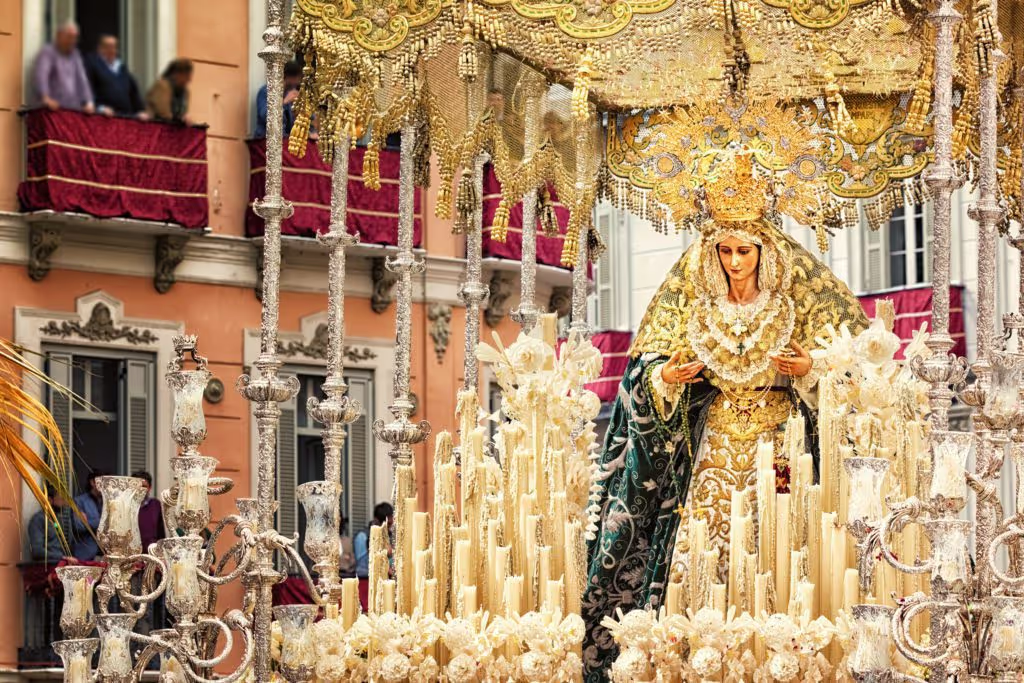
The religious roots of Semana Santa
Semana Santa is a religious event whose origins go back to the time of Jesus, the source of the Christian faith. The festival commemorates the last days of the life of Jesus Christ. The key sacred moments of this period run from Christ's triumphant entry into Jerusalem, “Palm Sunday”, up to his resurrection on Easter Sunday. The event was largely shaped by the Council of Trent (16th century).
The role of the brotherhoods (cofradías) and their symbols
The organisation of the event as a whole is in the hands of a cofradía, or brotherhood. Each brotherhood represents a neighbourhood, a parish, a community. Their role is to decide how the processions run while preserving the main lines of Spanish religious traditions. Some of these principles go back several hundred years, and Spaniards are proud of and deeply attached to their spiritual and artistic heritage.
Each cofradía can be told apart by its own colours, emblems, and above all its pasos. These are carved, individually designed religious statues depicting scenes from the Passion. Carried by the costaleros, the pasos move slowly to the rhythm of sacred music, sometimes in a moving silence. The procession also includes the penitents, often dressed in tunics and conical hoods. The procession means a great deal to the faithful, as it is a way to atone for sins or fulfil a vow.
How it evolved: faith, art and popular spectacle
Admittedly, the religious side remains concentrated in Spain's big cities. Over time, Holy Week has grown bigger and bigger, reaching even the most remote towns. The importance of Holy Week in Spain can be seen in the atmosphere across the country during this period. It is a real show in itself, with every detail reflecting artistic work: the candles and their golden glow, the music calling people to communion and prayer in solemn tones, and the sculptures and embroidery you see everywhere.
Over time, Semana Santa has managed to evolve without losing its essence: today it is a meeting point of faith, the old traditions and the local culture. Even non-believing tourists are not left unmoved by the power of this event and the atmosphere it brings, from the emotion of the residents to the beauty of the setting.
Where to experience Holy Week in 2027? The must-see cities
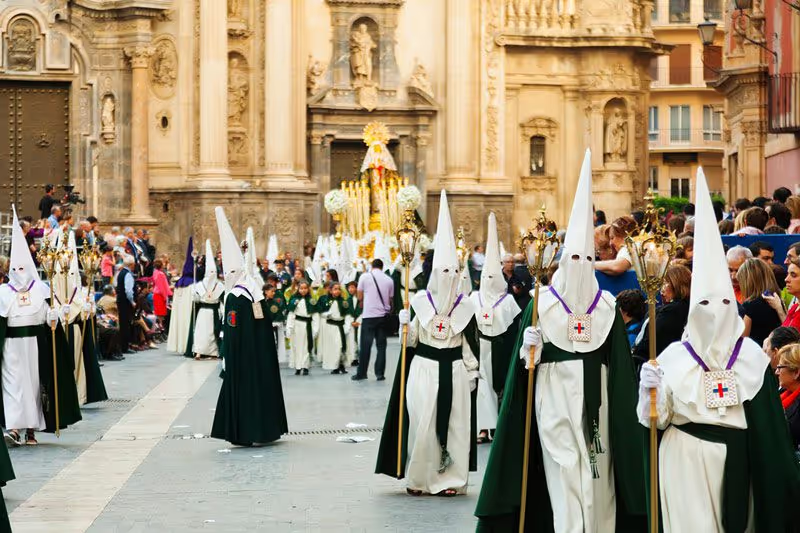
The most beautiful processions in Spain
Throughout Holy Week in Spain, every place, town and village takes part in its own way, with its own traditions. However, some destinations stand out for their remarkable contribution, both in how the place is decorated and in the rituals themselves. If you want to experience Holy Week in Spain at its fullest in 2027, here are the places not to miss.
Seville: the most famous and spectacular
It is almost impossible to think of Holy Week in Seville in 2027 without feeling a shiver. The Andalusian capital is a city where most of the population are devout Catholics. Throughout the festival, Seville lives to the rhythm of processions and religious songs. Day and night, more than 60 brotherhoods parade through the streets, some in absolute silence, others singing solemnly to the accompaniment of local bands. The pasos are even more remarkable, carried gracefully and proudly through the narrow streets of the city centre.
If you plan to spend Holy Week in Seville, don't miss key processions such as the Macarena or the Gran Poder. During La Madrugá, between Holy Thursday night and Good Friday, the processions are spellbinding, perfect for an unmatched emotional experience.
Malaga: emotion and Andalusian traditions
Not far from Seville, Málaga is also one of the great Semana Santa cities in Spain, celebrating the event in a different way, with more festivity. It is the city where the brotherhoods are most masterful and the processions most impressive. Among the highlights, you will be surprised by the parade of the Spanish Legion, a unit of the Spanish army, proud to escort the Christ of the Good Death. The atmosphere is lively, with the stirring sound of applause and the fervour of the crowds. In Málaga, people attach great importance to the processions, which makes the atmosphere even warmer. Everyone, young and old, takes an active part in all the activities linked to the event.
Valladolid: Castilian sobriety and sacred art
While Andalusia charms with the scale of its celebrations, Holy Week in Valladolid is marked by deep silence, contemplation and the elegant display of its pasos. Their artistic beauty draws the eye: several of them are by the Spanish Baroque sculptor Gregorio Fernández. If you love sacred art, Valladolid is the ideal destination for you.
The processions move slowly and in silence, like a meditation, inviting you to turn inwards in an atmosphere of perfect reflection. If you are looking for a place to spend Semana Santa in Spain in a spiritual atmosphere, I recommend Valladolid.
Zamora, León, Granada, Cordoba… lesser-known gems
Although these smaller towns are often less crowded, they let you experience Holy Week in Spain in an intimate atmosphere that is open to everyone.
Zamora, León, Granada, Cordoba… lesser-known gems
Although these smaller towns are often less crowded, they let you experience Holy Week in Spain in an intimate atmosphere that is open to everyone.
In Zamora, Semana Santa is celebrated with great respect for tradition. The processions are authentic, with a monastic atmosphere, in the glow of candles. In León, the processions are very solemn, and you can truly feel the unity of the faithful taking part. Granada, with the Alhambra as a backdrop, offers a magical atmosphere with processions held in the middle of the night, while Cordoba combines its architectural beauty with its ancient traditions.
Regional differences (north vs south)
Semana Santa also varies from region to region. In the south, in Andalusia and the surrounding area, the processions have more rhythm, and the music and religious scenes create a spectacle that is spellbinding. Every heart speaks: some cry, others sing, others applaud. The public takes part as much as it watches.
In the north, for example in Castile and León, the celebration has a different spirit, both austere and silent, marked by a certain restraint. The faithful walk together with slow steps, the music is solemn, and everyone holds back their emotions in calm.
Holy Week calendar 2027
Key dates in 2027
From Palm Sunday (21 March 2027) to Easter Sunday (28 March 2027)
The Semana Santa dates for 2027 are already known: Holy Week in Spain begins on Palm Sunday, the 21st of March 2027, and ends on Easter Sunday, the 28th of March 2027. During this period, each day has its own religious meaning and rituals. If you plan a stay in Spain between these two dates, be sure to check the local programme for Semana Santa so you don't miss anything.
As a reminder, Palm Sunday marks the triumphant entry of Jesus into Jerusalem. Palm Sunday sees the start of the processions in many cities, with rather joyful parades, and also children carrying palm leaves or olive branches.
Key days: Holy Thursday and Good Friday
The 25th of March, Holy Thursday, and the 26th of March, Good Friday, are among the most iconic days of the Semana Santa calendar. On these two days, the processions become more intense and full of emotion.
The Holy Thursday celebration is a very important moment for Christians all over the world, when the Last Supper of Christ is commemorated. In big cities such as Seville, the processions begin in the late afternoon and continue all night, especially during the famous Madrugá (or “early morning” in Spanish). Good Friday, the day of the Crucifixion, is a time set aside for prayer, a solemn moment when the processions are silent, sometimes lit only by candlelight. Holy Saturday is quieter, a time of rest and waiting. Finally, Easter Sunday (28 March 2027), the day of the Resurrection, marks the end of Semana Santa. This time the processions are more joyful, as Christians celebrate the victory of life after Christ's death.
Tips for planning your stay
If you want to experience Semana Santa 2027 in Spain to the full, it is best to arrive at least the day before Palm Sunday, especially if you plan to stay in big cities such as Seville or Málaga. Be sure to book your accommodation early, as it is often fully booked during the festivities.
You can then plan to leave just after Easter Sunday to make the most of the festive week. Remember to check the posters and announcements in each city, as each has its own times and rituals. And a good tip: bring light, comfortable shoes.
Atmosphere and rituals: what to see, what to feel?
A sensory and spiritual immersion
The processions: pasos, penitents, music
If you get the chance to attend a Semana Santa procession, you will live an experience that reaches all your senses, with the many Holy Week rituals of Spain. You will discover another side of the country, one of the events that touches the whole population most deeply.
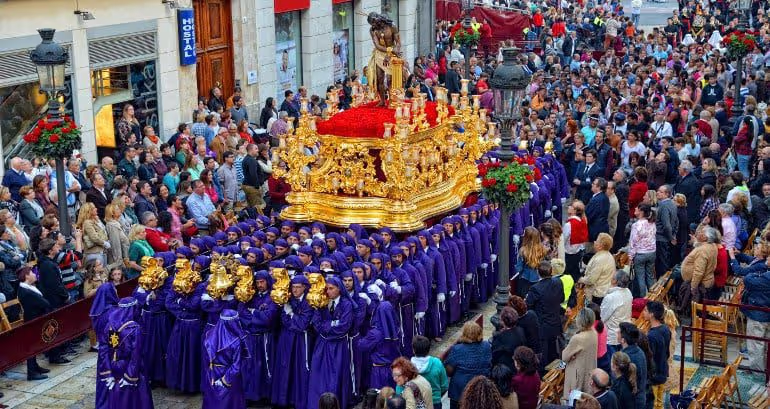
At the centre of these processions are the pasos, from the Latin word passus (suffering). They are carved religious statues whose special feature is their striking realism and flawless finish. The pasos are often decorated with gilding, with vases of fresh flowers in bright colours placed at their feet, and real fabrics of great richness. Each group of pasos depicts key scenes from the Passion of Christ or the sorrows felt by the Virgin Mary.
In the procession, the pasos move forward slowly, carried on the shoulders of costaleros, led by the capataz. The pasos are heavy, and a paso often needs around thirty costaleros. To support their efforts, the crowd cheers them on, like the crowd encouraging Jesus on his way to Golgotha, the hill of Calvary. Around them, the nazarenos, dressed in long tunics and cone-shaped hoods, form a silent procession. As a sign of penance, several of them walk barefoot.
During the procession, music also plays an important role, not only adding meaning to the event but also illustrating the scenes depicted. It is played by professional bands, accompanying the processions with funeral marches, dramatic fanfares. However, there are also silent processions.
Incense, silence and a crowd in awe
During the processions, several objects symbolise the sacred event:
- Incense;
- Candles;
- Rosaries;
- Scapulars;
- Medals;
- Cords, or cíngulo;
- Flowers;
- Etc.
But what surprises people most is the air filled with the scent of incense, wrapping the streets and lanes. In this mysterious atmosphere there is also total silence. At that moment, everyone present and everyone living nearby respects this silence. Despite the crowds, thousands of people stand still. Not a voice can be heard, no more conversations, phones are switched off, and only the creaking of the floats and the beating of the drums can break the calm.
Saetas: improvised flamenco songs
In some Andalusian cities, such as Seville or Jerez, you can witness a unique moment: a saeta. It is a melody with the rhythm of flamenco. It is sung by a believer who suddenly appears on a balcony or at a street corner. The words are addressed to the Virgin or to Christ. The melody is a mix of heart-rending cries and wails evoking the pain, the prayer and the emotion.
When a saeta breaks the silence, everything stops. The costaleros stop in their tracks, the crowd falls silent to listen, and many burst into tears. It is like a moment frozen in time, considered the most powerful of the whole Semana Santa.
The emotional impact on spectators
The true power of Holy Week lies in its emotional impact. Watching it means taking part, far beyond a show, whether you are a believer or not, curious or simply visiting. The feeling is collective, and the respect is shared.
Many travellers lucky enough to attend a procession in Spain say they were deeply moved by this unique Holy Week atmosphere. This is surely what makes Holy Week in Spain unforgettable and unlike anything else.
Between religious fervour and tourist attraction
A typically Spanish duality
How Spaniards see it: religious or cultural
Holy Week in Spain is perceived differently, even among Spaniards.
First, there are the devout who remain faithful to their religious principles. For them, celebrating Semana Santa means living an act of faith, penance or gratitude. They take an active part in the processions, often since childhood, with a very strong emotional and spiritual commitment.
For others, it is a cultural tradition, a witness to history and a true treasure of their city's heritage. They see Holy Week as a sacred event, but also as an artistic, social, identity-defining and festive one. Even if they hold no religious beliefs, many are keen to celebrate these rituals handed down from generation to generation.
The economic and tourist impact
Beyond all these considerations, spiritual or cultural, Holy Week is also a real economic driver today. Every year, thousands upon thousands of visitors from Spain and around the world come to the country for the event. Of course, this creates intense tourist activity: the hotels are fully booked, the restaurants are packed, the souvenir shops see their sales rise, and so on. Semana Santa tourism in Spain is at its peak.
In big cities such as Seville, Málaga or Valladolid, the Semana Santa period is one of the tourist peaks of the year. Special arrangements are even put in place to manage the crowds. The tourist offices also help by informing and guiding visitors. This economic impact is a key factor in the development of many towns. The restoration of the pasos, the costumes and the overall organisation are all prepared throughout the year.
The place of foreigners in the festivities
Spain is already known for the hospitality of its people. During Holy Week, foreigners are warmly welcomed. Even though the processions are deeply rooted in Spanish Holy Week culture, they are open to everyone. Locals are welcoming too: they enjoy explaining the symbols, sharing stories about Spain's religious traditions or inviting visitors to watch a procession from their balcony.
What is the difference between Holy Week in Seville and in Malaga?
In Seville, Holy Week is very solemn and codified. The processions are silent with great emotional intensity, especially during the Madrugá. In Málaga, the atmosphere is more festive and rhythmic, with spectacular processions, bands and huge statues. The experience is different in each city, with its own rituals.
Is it a good time to visit Spain with children?
Yes, absolutely! Holy Week can amaze children with its costumes, music and imposing pasos. In some cities such as Cordoba or Valladolid, the processions are shorter and less crowded, ideal for families travelling together.
Do you need to be a believer to enjoy Holy Week in Spain?
Not at all. Even if you are not Christian, or Catholic in particular, it is impossible to stay indifferent to the beauty, emotion and intensity of the event. Holy Week is also a cultural experience that goes beyond religion. It is another way to discover and experience Spanish culture. And Spanish hospitality will soon put you in the mood.
Thomas Rouer is the founder of Alveo Search and the CEO of the Alveo group. Based in Spain for almost ten years, he develops property services designed for the specific needs of foreign buyers.
His expertise covers every aspect of buying property in Spain: understanding the market, searching for and selecting properties, negotiation, financing, paperwork, tax and securing the purchase process.

Our resources for buying in Spain