Français
 English
Spanish property prices in 2026: regions and trends

- Nationwide: the average price reached about €2,750/m² in April 2026 according to Idealista, up about 17% in a year. Spain keeps a price advantage over much of northern Europe.
- Fewer sales, higher prices: in January 2026, home sales fell 11.4% year on year, with about 49,700 homes sold. The housing shortfall has passed 730,000 homes since 2021 and could reach 900,000 by 2029.
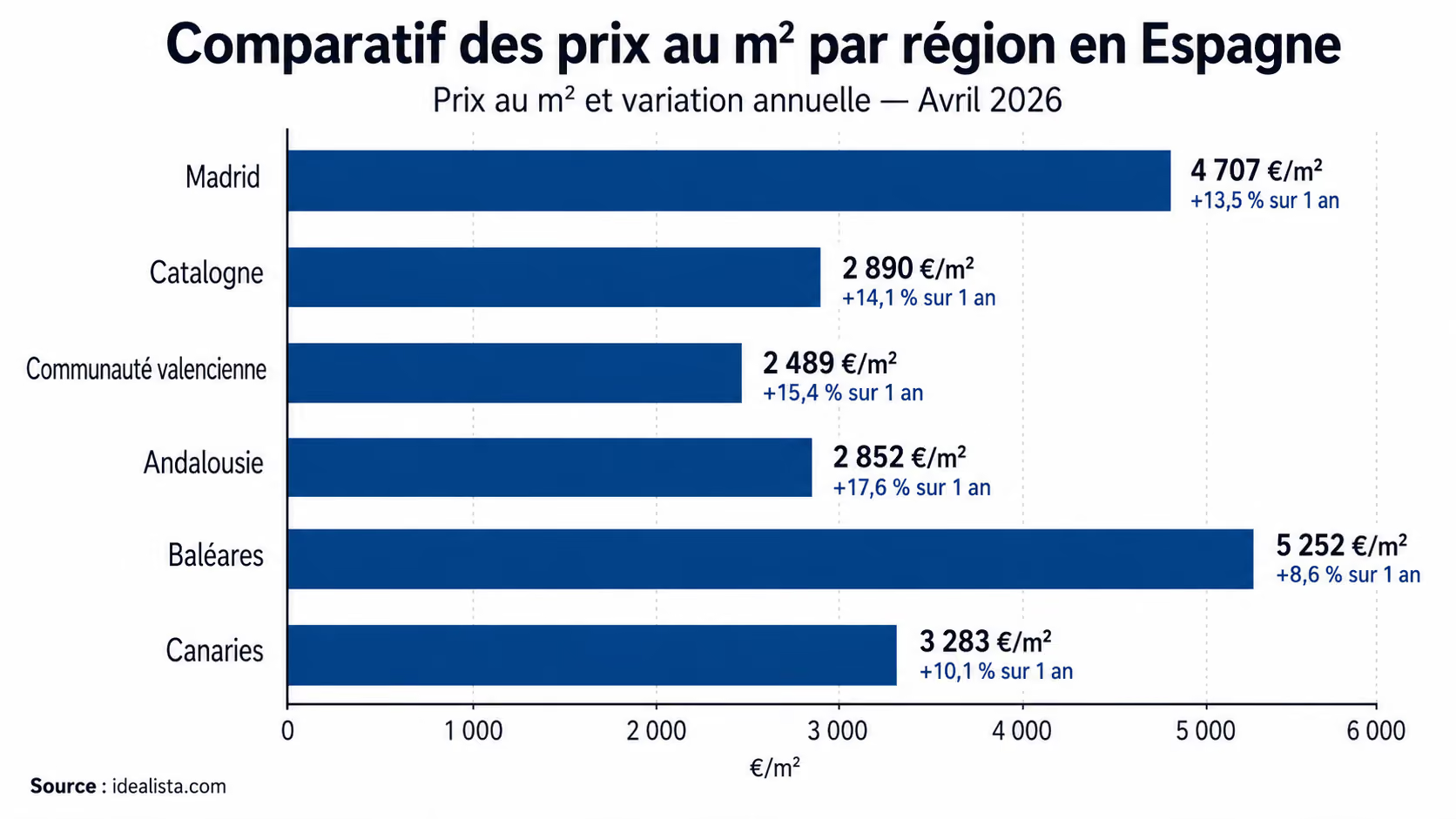
- Expensive regions: the Community of Madrid stands at €4,707/m² (+13.5%), the Balearic Islands at €5,252/m² (+8.6%) and the Canary Islands at €3,283/m² (+10.1%). In Andalusia (€2,852/m², +17.6%), Marbella reaches about €5,600/m².
- More affordable markets: Catalonia stands at €2,890/m² (+14.1%), with Girona at €2,672/m². The Valencian Community is at €2,489/m² (+15.4%). Extremadura (€1,071/m²), Castilla-La Mancha (€1,091/m²) and Castilla y León (€1,323/m²) remain the cheapest.
- Key point: buying requires an NIE, a contrato de arras with a deposit of around 10%, and buying costs of 8 to 13% of the price. Non-residents can borrow 60 to 70% of the price.
Thinking of buying property in Spain in 2026, but wondering whether the market is still attractive despite rising prices? With an average price of around €2,750/m² in April 2026 according to Idealista, Spanish property keeps rising fast, driven by strong demand and limited supply.
For international buyers, Spain still has many strengths: prices often lower than in much of northern Europe, a sought-after quality of life, strong rental potential and a wide range of markets from one region to another. Madrid, Barcelona, Valencia, Alicante, Málaga, the Costa Brava and the Balearic Islands do not all offer the same opportunities, though.
In this article, we review property prices in Spain in 2026, region by region, to help you find the areas best suited to your budget and your plans.
Understanding property prices in Spain in 2026
Spain property prices 2026: a market still rising fast
The price of property in Spain in 2026 keeps rising, driven by solid demand and insufficient supply in the most sought-after areas. According to Idealista data for April 2026, the average property price in Spain is around €2,750/m², an increase of about 17% in a year.
This rise makes home ownership harder for Spanish households. For international buyers, however, Spain remains attractive, especially for a second home, a flat near the sea or a buy-to-let investment.
But the Spanish market is not uniform. Buying in Madrid, Barcelona, Valencia, Alicante, Málaga or an inland region does not follow the same logic. Proximity to the sea, tourist appeal, transport, the local economy and scarcity of land can all have a strong effect on prices.
Some central or coastal areas are well above the national average, while inland regions remain more affordable. To buy well in Spain in 2026, you need to analyse the market locally: region, town, neighbourhood, type of property and resale potential.
Why are property prices rising in Spain in 2026?
The rise in property prices in Spain is mainly due to an imbalance between supply and demand. The country lacks housing, especially in the big cities, on the coast and in towns that attract workers, retirees and foreign investors.
Since 2021, Spain is estimated to have built up a shortfall of more than 730,000 homes, with a risk of exceeding 900,000 missing homes by 2029. This shortage keeps prices under lasting pressure.
Foreign demand also plays an important role. Buyers from France, Belgium, Germany and the Netherlands remain very active on the Spanish market. Many are looking for a second home, a buy-to-let investment or a new life in the sun.
Remote working also strengthens this trend. Cities such as Valencia, Alicante, Málaga and Barcelona attract new profiles looking for a better quality of life, a pleasant climate and good urban services.
At the same time, new construction is not keeping up. Scarce land, slow administration, rising building costs and energy requirements limit the supply of new homes. As a result, well-located properties are becoming rarer, which supports prices even when the market slows.
Sales are falling but prices are rising
One of the striking features of the Spanish property market in 2026 is the gap between falling sales and rising prices. In January 2026, home sales fell by 11.4% year on year, with about 49,700 homes sold.
In detail, sales of flats fell by 12.6%, while sales of houses fell by 7.8%. Yet prices keep rising.
This paradox comes from the shortage of supply. There are fewer properties on the market, few new homes in sought-after areas and demand that remains strong, especially in big cities, coastal regions and markets popular with foreign buyers.
In other words, the market is slowing in volume, but prices are not really easing. Buyers are more selective, but well-located properties remain in high demand, especially in Madrid, Barcelona, Valencia, Málaga, Alicante, the Balearic Islands, the Costa Brava and the Costa del Sol.
For an international buyer, this means there are still opportunities, but you should not rely on national averages alone. A good purchase depends on a precise analysis of the local price, rental potential, the condition of the property, the regulations and the quality of the location.
Spanish property prices: is Spain still good value?
How Spanish prices compare
Despite the sharp rise in the Spanish market in 2026, Spain remains more affordable than much of northern Europe for many buyers, especially when you compare average prices per square metre. According to available data, the average price in Spain is around €2,650/m², below the levels of many northern European countries.
This comparison shows that Spain keeps a clear advantage for buyers who want a property in a big city, on the coast or in a tourist area. For the same budget, you can often get more space, a better location or a home closer to the sea in Spain than in much of northern Europe.
This is one of the great strengths of the Spanish market: it still makes possible projects that are hard to achieve elsewhere. A buyer whose budget does not stretch to the French Riviera or a major northern European city can find interesting alternatives in Spain, notably in Alicante, Valencia, Seville, Murcia or some smaller coastal towns.
Spain remains particularly attractive for anyone who wants to buy cheap property by the sea. In many coastal areas, prices have risen sharply, but they often remain lower than on the most sought-after stretches of the Mediterranean coast elsewhere in Europe. For a second home, this lets you combine personal use, quality of life and long-term growth potential.
The country also appeals to buy-to-let investors. Tourist demand, the expat population, remote working and pressure on the rental market keep interest high in some Spanish cities. Valencia, Alicante, Málaga and Seville still offer interesting profiles, with purchase prices sometimes more reasonable than in comparable cities in northern Europe.
You do, however, need to factor in buying costs. In Spain, buying costs usually amount to 8 to 13% of the property price, depending on the region and type of property. These costs can be higher than in your home country, but a lower price per square metre can make up for them. For an international buyer, the analysis must therefore cover the total cost of the project: purchase price, costs, tax, running costs, financing and rental potential.
What the average price does not tell you
The national average price shows a trend, but it is not enough to make a buying decision. The Spanish property market is very varied. Some areas have become expensive, even very expensive, while others remain affordable.
Madrid, the Balearic Islands, Marbella and some districts of Barcelona have high prices. In Madrid, the average price is about €4,700/m² according to Idealista, and some premium districts are well above this average. In Barcelona, the province stays at around €3,123/m², but the city's most sought-after districts can be far above this level. On the Costa del Sol, Marbella is a high-end market, with very high prices for properties near the sea or in the most prestigious areas.
By contrast, Alicante, Murcia, some parts of Andalusia and inland regions still offer more affordable opportunities. These markets can suit buyers with a smaller budget, provided they study local demand, resale liquidity and real rental potential carefully.
A good purchase does not depend only on the price per square metre. It depends above all on your goal: second home, buy-to-let, retirement, long-term investment or a new life. A cheaper property is not always a better deal if it is hard to rent out or resell. Conversely, a more expensive property can make sense if it has a rare location, strong demand and a stable market.
In 2026, Spain therefore remains good value compared with much of northern Europe, but selectively. The best opportunities are in areas where the price stays in line with quality of life, rental demand and growth potential.
Spain property prices by region in 2026
Property prices in Catalonia: Barcelona, Girona, Costa Brava
Catalonia remains one of the most sought-after property markets in Spain, notably with buyers from neighbouring France. According to Idealista data for April 2026, the average price in Catalonia reaches €2,890/m², up 14.1% year on year. This level confirms the strong pressure on the Catalan market, especially near Barcelona and on the coast.
In the province of Barcelona, the average price was about €3,123/m² in January 2026, with premium districts of the city easily exceeding €6,000/m². Barcelona therefore remains a safe bet for a long-term purchase, but the potential for strong capital gains is more limited than a few years ago, because prices are already high.
The Costa Brava remains very popular with buyers from neighbouring France, thanks to its closeness to the border, its lifestyle and its second-home potential. In Girona, the average price is around €2,672/m², while Roses reaches about €3,289/m². These markets remain dynamic, but you need to pay attention to Catalan rental regulations and the strong pressure on supply.
Property prices in the Valencian Community: Valencia and Alicante
The Valencian Community is one of the big winners of the Spanish property market in 2026. In April 2026, the regional average price reached €2,489/m² according to Idealista, up 15.4% year on year. Other data even point to a regional rise of +17% to +19.1% depending on the areas studied.
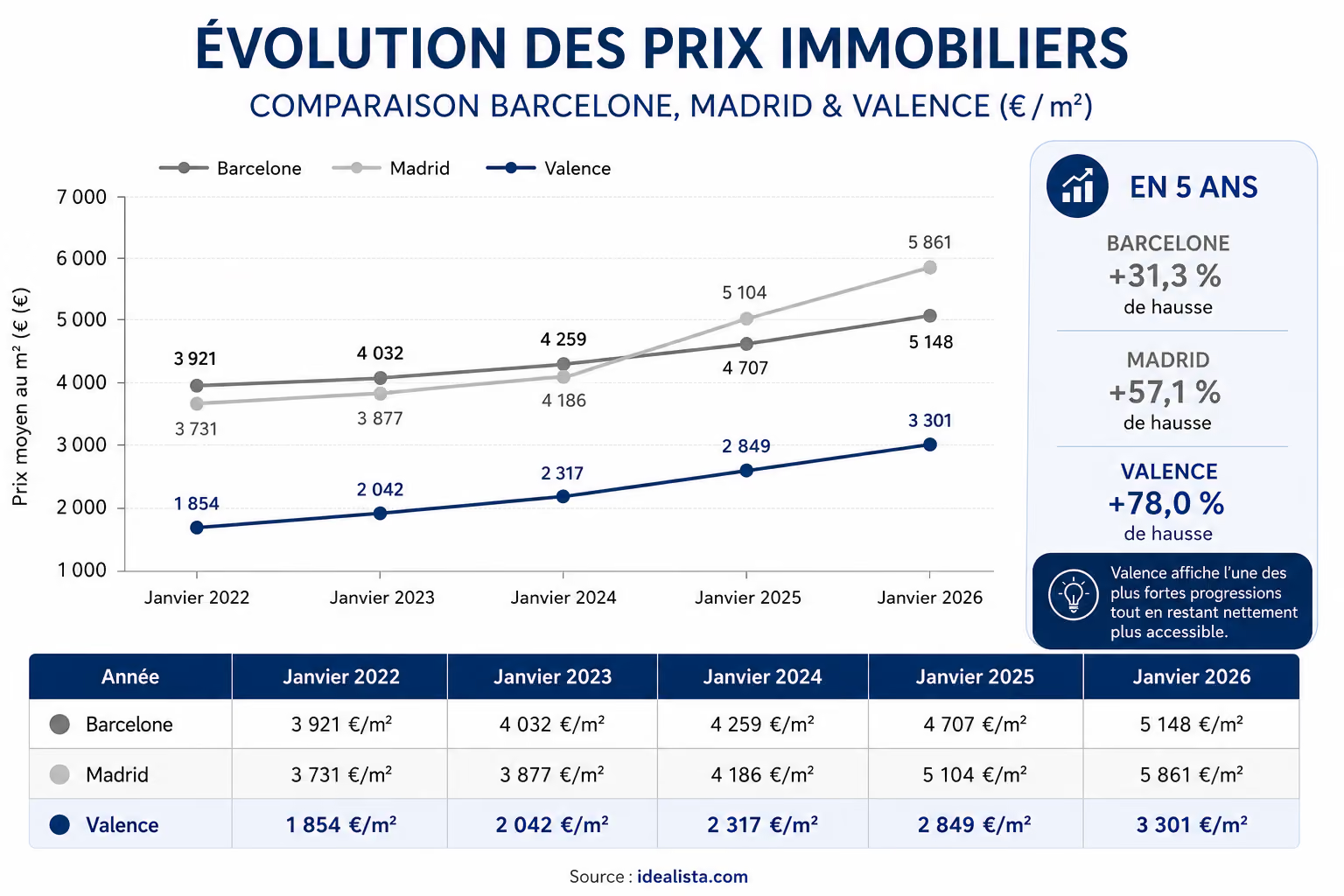
The province of Valencia is at around €2,422/m², while the city of Valencia reaches about €3,301/m². The Valencian capital attracts more and more foreign buyers thanks to its climate, quality of life, dynamic economy and prices still lower than in Madrid or Barcelona.
Further south, Alicante remains a strategic option for more modest budgets. The province reaches about €2,707/m², while the city of Alicante is at around €2,499/m². For an international buyer, the area offers a good balance between affordability, rental demand, tourist appeal and growth potential.
Property prices in Andalusia: Seville, Málaga, Marbella
Andalusia is also rising strongly. In April 2026, the regional average price reached €2,852/m² according to Idealista, up 17.6% year on year. But there are big differences within the region between Seville, Málaga, inland towns and the most sought-after areas of the Costa del Sol.
In Seville, the province remains relatively affordable, at around €1,839/m², while the city reaches about €2,703/m². Seville still offers moderate prices for a large city rich in heritage, culture and tourism.
Málaga, by contrast, has become one of the most sought-after markets in Spain. The province reaches about €4,082/m², and the city of Málaga about €3,632/m². Marbella is even higher, at around €5,600/m², with ultra-luxury properties reaching up to €20,000/m² on the Costa del Sol. Andalusia combines sunshine, tourism, international demand and rental potential, but the best locations are already highly priced.
Property prices in Madrid: long-term security and a tight market
Madrid remains one of the most solid markets in Spain. According to Idealista, the Community of Madrid reached €4,707/m² in April 2026, up 13.5% year on year. Earlier data put the province at around €4,585/m², while other sources gave about €3,800/m² based on notarial transactions.
Madrid attracts investors for its economic stability, liquidity and depth of market. It is a place to build long-term wealth rather than to speculate. The Salamanca district shows the pressure on the luxury segment, with values close to €19,000/m².
Property prices in the Balearic and Canary Islands
Island markets remain among the most constrained in the country. In the Balearic Islands, the average price reached €5,252/m² in April 2026 according to Idealista, up 8.6% year on year. Other data mentioned about €4,070/m², but the recent trend confirms a very expensive market, where buying a home can take more than 50% of income.
In the Canary Islands, the average price reached €3,283/m², up 10.1% year on year. These islands benefit from strong foreign and tourist demand, but limited supply, land constraints and rental regulations need to be studied carefully.
The cheapest regions in Spain
The most affordable regions are mainly inland. In April 2026, Extremadura stood at €1,071/m², Castilla-La Mancha at €1,091/m² and Castilla y León at €1,323/m² according to Idealista. These levels remain far below the big cities and coastal areas.
These markets offer opportunities for small budgets, sometimes with the chance to buy a house for under €120,000. On the other hand, rental potential is lower, markets are less liquid and resale can be slower. They mainly suit a new life, a retirement or a main home at a controlled price.

Where to buy in Spain in 2026, depending on your profile
The best place to buy in Spain in 2026 depends above all on your goal: investing, preparing a second home, buying on a limited budget or making a secure long-term investment. The Spanish market remains attractive, but it has become more selective. Differences in price and potential are large from one region to another.
For a dynamic buy-to-let investment in Spain
For a buy-to-let investment, the most interesting cities remain Valencia, Alicante, Málaga, Seville, some areas of Madrid and up-and-coming districts of Barcelona.
These markets combine several strengths: strong rental demand, tourist appeal, tight housing supply and rising rents. Valencia attracts more and more expats, remote workers and students. Alicante remains very popular with foreign buyers thanks to its climate and prices still lower than in other large coastal cities.
Málaga has become one of the most dynamic markets in Spain, driven by tourism, international companies and new residents. Seville offers a good balance between purchase price, cultural heritage and rental demand. In Madrid and Barcelona, the entry price is higher, but resale liquidity remains very strong, especially in well-connected or regenerating districts.
For a second home in Spain that is easy to reach
For buyers looking for a second home that is easy to reach, the Costa Brava, Roses, Girona, the north of Catalonia and parts of the Valencian Community remain natural choices.
The Costa Brava appeals with its beaches, coastal villages and Mediterranean lifestyle, close to the French border. Girona also offers a good balance between quality of life, heritage and quick access to the coast, and its airport has international flights.
These areas also have interesting seasonal potential. A well-located property can be used as a second home for part of the year and earn rental income during peak periods, provided you comply with local regulations.
For a smaller budget
Buyers with a more modest budget can look at Alicante outside the most expensive areas, Murcia, Seville outside the historic centre, Castilla-La Mancha, Extremadura or Castilla y León.
These areas offer lower prices per m² and a more affordable entry price. You can sometimes buy a house or a flat there for much less than you would need in Madrid, Barcelona or Málaga. There may also be more room to negotiate in less tight markets.
However, be careful: a low price does not guarantee a good deal. Rental demand may be weaker, resale slower and growth potential more limited.
For a secure long-term investment
For a long-term investment, the most solid markets remain Madrid, Barcelona, Valencia, Málaga and Palma de Mallorca for larger budgets.
These cities benefit from structural demand, a strong economy, international appeal and good resale liquidity. Madrid offers great long-term security, Barcelona keeps its global appeal, Valencia is growing fast, Málaga attracts international investors and Palma remains a high-end benchmark.
To make your purchase safe, the most important thing is to choose a location that will stay in demand, rather than looking only for the lowest price.
Buying in Spain in 2026: steps, costs and support
Buying property in Spain as a foreigner is quite straightforward, but it requires real preparation. The market is open to foreign buyers, resident or not, but the rules, costs and checks are not always the same as in your home country. To avoid mistakes, it is often better to work with an English-speaking property agency in Spain, able to explain each step and make the project safe.
The essential steps to buy in Spain
The first step is to get an NIE, the foreigner identification number (Número de Identidad de Extranjero). You need it to buy a property, sign at the notary, pay taxes or open a Spanish bank account.
It is also advisable to open a bank account in Spain, especially to pay property-related costs: community fees, local taxes, insurance, works or mortgage payments.
Once your budget is set, you can start looking for a property. At this stage, do not look only at the price per square metre. You also need to analyse the location, the condition of the property, rental demand, local regulations and resale potential.
The preliminary contract and signing at the notary
When the buyer and the seller reach an agreement, they usually sign a contrato de arras, the Spanish preliminary sale contract. The buyer then pays a deposit, often around 10% of the property price.
The final sale is then signed before a notary. Before this step, it is essential to check that the property has no debts, that its planning status is in order and that the community fees are up to date.
Buying costs to budget for
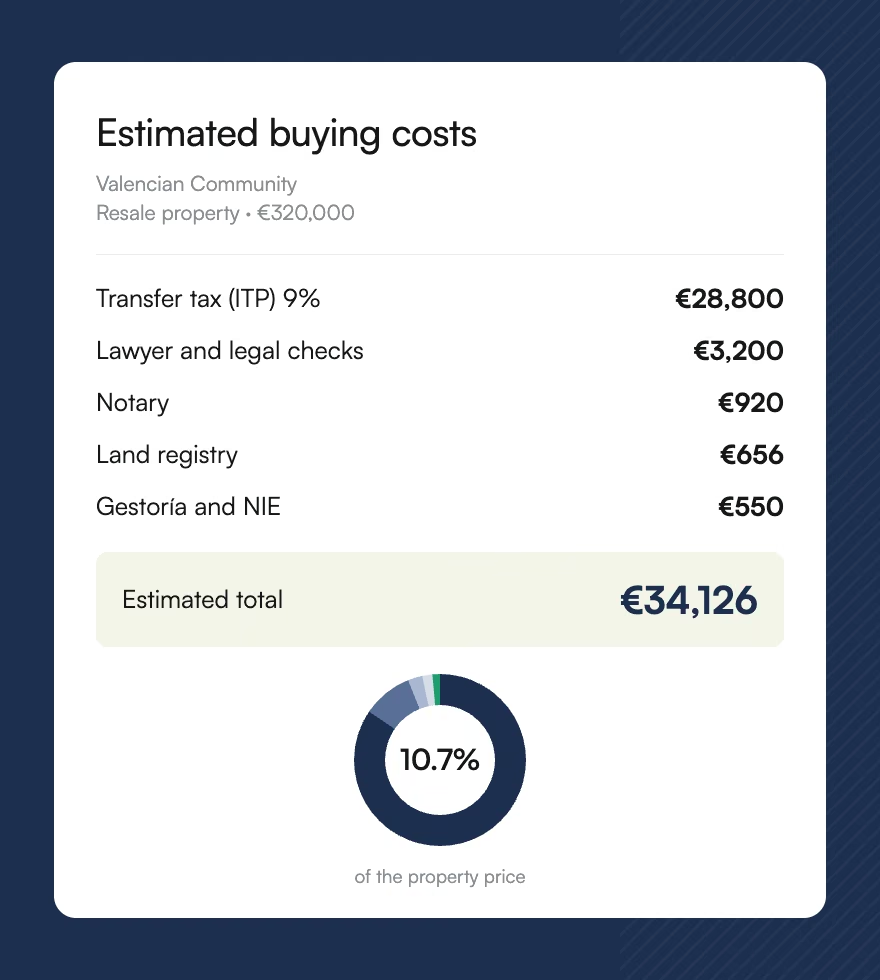
The costs of buying property in Spain usually amount to 8 to 13% of the property price, depending on the region and type of property. They include taxes, notary fees, registration at the Land Registry, any lawyer's fees and bank fees if you take out a mortgage.
For a non-resident buyer, Spanish banks often lend up to 60 to 70% of the property price, depending on the buyer's profile, income and the quality of the application.
Why work with an English-speaking property agency?
Working with an English-speaking property agency in Spain saves time, avoids nasty surprises and helps you understand the local market. An agency used to working with international buyers can help you compare prices, choose the right neighbourhoods, check that the property is sound, organise viewings and coordinate with lawyers, notaries and banks.
This is especially useful in tight markets such as Madrid, Barcelona, Valencia, Alicante, Málaga or the Costa Brava, where good properties sell fast. English-speaking support also makes the purchase safer, especially for a second home or a buy-to-let bought from abroad.
Arnaud Attencia is head of Alveo Finance. He supports residents and non-residents with the financing of their property purchase in Spain. He shares his advice on assessing borrowing capacity, planning for the deposit and buying costs, and preparing a mortgage application.


Our resources for buying in Spain