Français
 English
Cheapest places to buy a beach property in Spain

- Price levels: according to Idealista, the average price in Spain was around €2,650/m² in January 2026, up 18.4% in a year, which is still lower than in many other European countries.
- Costa Blanca: the province of Alicante is around €2,400/m². Torrevieja and Punta Prima sell for €2,200 to €2,600/m², Guardamar del Segura for around €2,700/m².
- Cheaper areas: Murcia ranges from €1,800 to €2,400/m², with €1,600 to €1,700/m² in Mazarrón. The Costa del Azahar is around €1,500/m², with Benicarló at €1,350/m², for estimated yields of 6.5% to over 7%. Almería drops to around €1,200/m².
- Towns mentioned: Cadiz reaches around €3,000/m², or €200,000 for 70 m². Cartagena and Huelva are between €1,300 and €1,400/m², and Roquetas de Mar has flats for under €100,000.
- Key point: buying requires a NIE, a Spanish bank account and buying costs of 8% to 13% of the price in 2026.
Waking up to the sunrise over the beach, walking along sunny paths lined with pine trees or feeling the gentle sea breeze on your skin… you have probably enjoyed this before. What if you made these moments last by investing in a house on the Mediterranean coast?
With their quality of life, rental potential and prices that are still affordable, some parts of Spain offer real opportunities to seize now.
Yes, there are still places in Europe where you can buy a few minutes from the beach for less than €150,000. But these areas are not always the ones everyone talks about. And they will not stay that way forever.
👉 The reality is simple: some Spanish towns have already risen by 20 to 30% in a few years. Others are still catching up.
This is exactly where a purchase for pleasure and a smart investment part ways.
Why buying beach property in Spain in 2026 is still a real opportunity
The Spanish property market has entered a phase of gradual growth, but it is still very affordable compared with other European countries.
According to the latest data from the Idealista portal, in January 2026 the average property price in Spain stood at around €2,650/m², up 18.4% on the previous year, with coastal areas still well below this average (source: idealista.com). This figure matters. In many other European countries, seaside property costs far more, often without a sea view.
👉 In other words: for the same budget, Spain offers more space, a better location… and room for capital growth.
Rental demand that supports the market
What makes Spain even more attractive is demand.
The country is one of the most visited destinations in the world, with more than 85 million tourists a year. And most of these visitors head for the coast.
The result:
- holiday rentals in high demand
- good returns over several months
- properties that are relatively easy to resell
It is a market where you can both enjoy the property… and make it pay.
An unbeatable climate and tourist appeal
Spain's success does not rest on prices alone. The lifestyle plays a decisive role.
With more than 300 days of sunshine a year in some regions, direct access to the sea and a renowned quality of life, the country attracts tourists and second-home owners alike.
This favourable climate means you can enjoy the property all year round, and it also lengthens the tourist season. Unlike other destinations, rental demand is not limited to July and August.
👉 The result: a beach property in Spain can be rented out over a much longer period, which improves its yield.
Practical advantages for foreign buyers
Spain also has a major advantage for foreign buyers: simplicity.
Unlike some countries, there are no particular restrictions on foreigners buying property. The steps are relatively quick and accessible, even from abroad.
On top of that, settling in is made easier by:
- a language that is relatively easy to pick up
- a large English-speaking community on the coast
- support from specialist agencies
Many British, German and Dutch buyers now choose Spain for a holiday home… or even to live there all year round.
Easy access: transport and infrastructure
Finally, one factor often underestimated but essential in a property project: accessibility.
Spain has a particularly well-developed transport network:
- international airports in every major coastal region
- frequent direct flights to the UK and northern Europe
- a modern motorway network
Cities such as Alicante, Málaga or Murcia are within about three hours' flight of London. This makes it easier both to use the property yourself… and to rent it out.
All in all, when you combine these factors (prices that are still affordable, strong demand, quality of life and easy access), it is clear why buying beach property in Spain in 2026 remains a particularly sound opportunity.
The regions where you can still buy cheap beach property in Spain
When you are looking for cheap beach property in Spain, not all regions are equal. Some areas have already matured, with high prices and little room for growth. Others still offer an affordable entry point with real potential to grow.
Cross-checking market data, local momentum and demand, three regions clearly stand out today. They have one thing in common: a good balance between price, appeal and prospects for capital growth.
The Costa Blanca: a solid market, but already well valued
The Costa Blanca, around Alicante, remains one of the areas most sought after by foreign investors, especially the British. That is no accident. It is probably the best compromise today between affordability and a secure investment.
The area has particularly well-developed infrastructure. Alicante international airport serves the whole of Europe, the roads are modern and local services are geared to an international population. This easy access plays a key role, both for your own use and for renting out.
What really sets the Costa Blanca apart is its balance. Rental demand is strong, driven by steady tourism and a large foreign community living there all year round. The stable, sunny climate adds to its appeal.
Prices remain reasonable for the coast. The average price in the province of Alicante is around €2,400/m². But within the region, there are still attractive entry points.
In Torrevieja and Punta Prima, prices are generally between €2,200 and €2,600/m², which is still relatively affordable for the coast. In Guardamar del Segura, prices are around €2,700/m², with steady rental demand.
Today the Costa Blanca stands out above all for its liquidity. It is a market that is:
- very active
- with constant demand
- and easy to resell
In short: the lowest prices are now elsewhere, yet it remains a safe bet for a secure investment.
If you want to buy cheap beach property on the Costa Blanca while keeping your project secure, local support makes a real difference. The market moves fast, so good advice is essential to spot the right opportunities. We have a property agency in Alicante, in the heart of the Costa Blanca, to support you on the ground at every step of your purchase.
Murcia (Costa Cálida): buying ahead of the market
Less well known than the Costa Blanca, the Murcia region is often missing from first-time investors' shortlists. Yet that is exactly what makes it a strategic opportunity today.
On price, Murcia sits clearly below the most popular areas. You can find properties at around €1,800 to €2,400/m² depending on the area, sometimes even lower depending on the town and the distance to the coast (source: idealista.com).
Above all, prices vary in interesting ways from town to town:
- Mazarrón: €1,600 to €1,700/m²
- San Pedro del Pinatar: around €2,300/m²
- Los Alcázares: around €2,400/m²
But Murcia's appeal goes beyond affordability. Above all, look at where it is heading.
The region is changing gradually. It is attracting more and more:
- foreign investors looking for yield
- retirees who want to settle somewhere quieter
- second-home buyers
This growing interest is still moderate, which means the market has not yet peaked. Infrastructure is developing, the tourist offer is improving and the region is becoming better known. In practice, you can still buy:
- small flats for around €130,000 to €150,000
- sometimes less, depending on condition and location
👉 In other words, Murcia is about buying ahead of the market: investing today in an area that is still undervalued, with the aim of benefiting from its growth in the years to come.
Costa del Azahar (Castellón): the most underrated area
This is probably the surprise for many investors. The Costa del Azahar is still one of the most affordable coastlines in Spain, with prices at around €1,500/m² on average.
But the most interesting part is the smaller towns:
- Benicarló: ~€1,350/m²
- Vinaròs: ~€1,500/m²
- Alcossebre: ~€1,700/m²
- Peñíscola: ~€2,000/m²
These prices still let you buy on the coast with a limited budget. And rental yields are attractive, with estimates of around 6.5% to over 7% depending on the town.
This market is very attractive for:
- smaller budgets
- buy-to-let investors
- buyers looking for growth potential
It is a typical example of an area still under the radar… but starting to rise.
Almería (Andalusia): the market that is still undervalued
For investors who want the lowest possible price on the coast, Almería is the obvious choice.
This Andalusian province is still one of the most affordable markets on the Spanish coast. In some towns, prices are around €1,200/m², or even less in areas that are still little developed.
But looking only at price would be a mistake. What makes Almería particularly interesting is the gap between its current value and its real potential.
The region has many strengths:
- an exceptional climate, among the sunniest in Europe
- a unique natural setting, between the sea and desert landscapes
- a stable economy, built largely on agriculture
Despite this, it is still little developed for tourism compared with other Spanish coasts. This creates a rare opportunity: a market that is still affordable, with plenty of room to grow in the medium term.
👉 This is an opportunistic investment: getting into a quiet market early, before it becomes better known.
Our top 5 cheapest coastal towns to buy in Spain
Let's get specific. Some towns illustrate these opportunities perfectly.
When you ask yourself where to buy cheap beach property in Spain, the answer comes down to very specific towns rather than whole regions. These towns concentrate the best opportunities today, with a good balance between price, location and rental potential.
Some are already well established, others still underrated. But they all have one thing in common: they still let you buy beach property in Spain on good terms. Here are our top 5 cheapest coastal towns to buy in Spain:
Cadiz: affordable Andalusian charm… but already well valued
Cadiz is often one of the cities that win people over straight away. And it is easy to see why.
It is a historic city with real character, a unique atmosphere and Seville close by, which adds to its appeal. It is also popular with Spanish and international visitors. But this appeal comes at a price.
Today, to buy by the sea in a city like Cadiz, expect to pay around €200,000 for a 70 m² flat, with prices around €3,000/m².
👉 So Cadiz is now less of a “cheap” city and more a place for protecting your capital, with moderate but steady growth.
Torrevieja: an active market with opportunities left
Torrevieja remains a reference when it comes to buying a beach flat in Spain. The town is well known, in high demand and attracts a great many foreign buyers. As a result, prices have risen. Even so, there are still attractive opportunities.
You can still find properties for around €120,000 to €140,000, especially resale properties or a little back from the seafront.
With an average price today of around €2,400/m², the town is still affordable compared with other European seaside resorts. What makes the difference here is rental demand: Torrevieja is a town where properties rent easily.
Cartagena: the real bargain for smaller budgets
Cartagena is the kind of city many investors discover too late. On paper, it is exactly what buyers are looking for: the seaside, a real city and prices that are still low.
Today, prices are around €1,300 to €1,400/m², which still lets you buy a property for around €100,000. Yes, a seaside flat in Spain at this price still exists.
And that is not all. Cartagena also offers:
- a real local life
- tourist appeal
- an authentic atmosphere. It is probably one of the best value-for-money options right now.
Huelva: a lesser-known alternative in high demand
Huelva is often compared with Cadiz… with one major difference: price.
Prices here are around €1,300 to €1,400/m², with far more affordable properties.
The city is attracting more and more:
- investors
- retirees
- second-home buyers
Roquetas de Mar: the last real seaside “bargain”
If you had to name just one town in answer to the question where to buy cheap beach property in Spain, this would probably be it.
In Roquetas de Mar, you can still find flats for under €100,000 a few minutes from the beach.
This kind of opportunity is becoming extremely rare. The town is next to Almería, in an area that is not yet saturated. It has an exceptional climate, a pleasant setting and growing appeal. It is a typical early-stage market.
These towns stand out today for good reason.
They share several features:
- direct access to the sea
- prices that are still affordable
- existing rental demand
- and above all, room for growth
👉 This is exactly what to look for when you want to buy beach property in Spain wisely.
How to buy beach property in Spain: key steps and tips
Buying beach property in Spain can seem complex at first, especially if you do not know the local market. In practice, the process is fairly simple, provided you understand the steps and avoid a few classic mistakes.
Whether you want to buy a beach flat in Spain to live in, to invest or as a holiday home, good preparation makes all the difference.
The key steps to buy beach property in Spain
The buying process in Spain is well structured and generally quite quick. It rests on a few essential steps.
The first is to get a NIE number (Número de Identidad de Extranjero, the foreigner identification number), which you need for any property transaction. Next, it is a good idea to open a bank account in Spain to make the process easier.
Then comes the property search, followed by the signing of a reservation contract. This document takes the property off the market in exchange for a deposit.
After the legal checks on the property (planning, possible debts, compliance), you sign the private purchase contract, then the final deed before the notary.
👉 To see the process in detail, read our practical guide on the buying process in Spain.
Extra costs to plan for
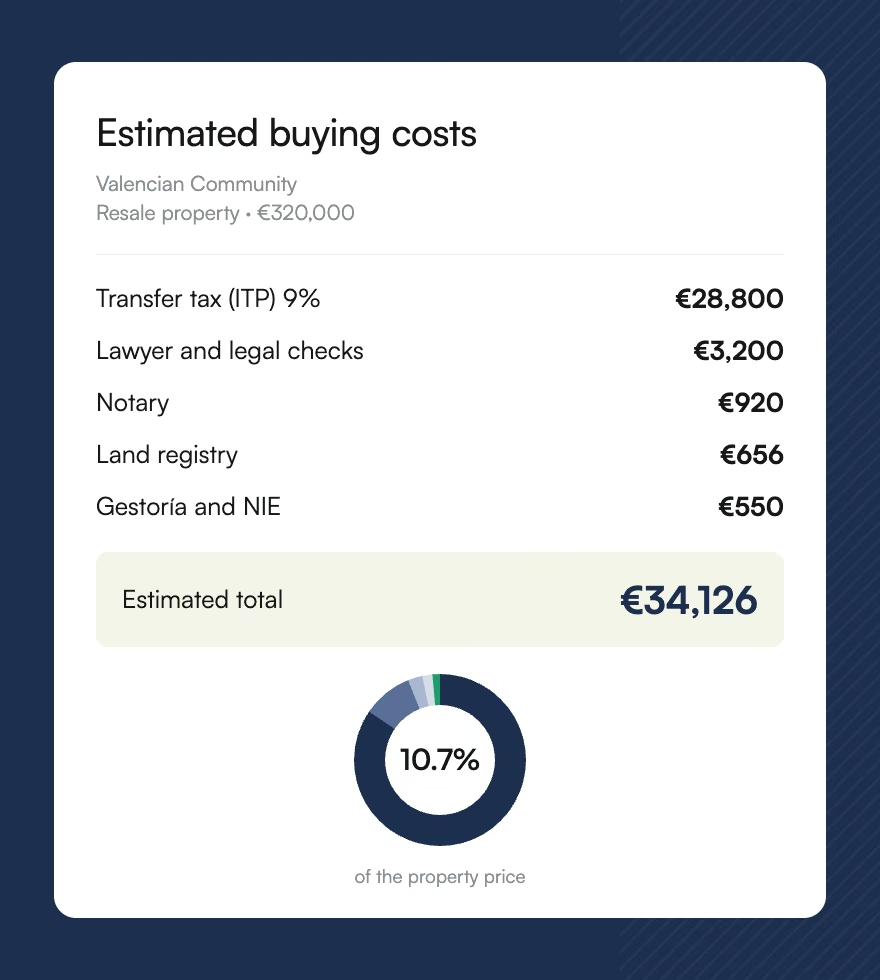
On top of the property price, you need to budget for buying costs. In 2026, buying costs in Spain generally amount to between 8% and 13% of the property price. The amount depends mainly on three things: the type of property (new build or resale), the autonomous community where it is located and whether you take out a mortgage. Differences between regions can be large, especially for ITP (transfer tax). There are generally three main categories of buying costs:
- taxes, which make up the largest share of the total cost;
- costs linked to the deed of sale, such as the notary, the land registry and administrative handling;
- advisory and other costs, such as legal support, the property valuation or some bank fees.
To find out more about the costs of buying a house or flat in Spain, read our practical guide on the subject.
Pitfalls to avoid at all costs
Buying beach property in Spain can be an excellent move… but some mistakes can be costly. The first is buying on price alone. A “cheap” property is not necessarily a good investment if it is badly located or hard to rent out. Another frequent mistake is not checking the property's legal status. Some properties may have planning irregularities or debts attached to them.
Finally, many buyers underestimate the importance of the actual location: distance to the sea, access, surroundings… all factors that directly affect the property's value.
👉 In short: it is better to buy in the right place than simply to buy at the lowest price.
Why use a specialist agency to buy by the sea in Spain
This is probably the most important point. Buying from a distance, in a foreign country, without knowing the local market, can quickly become risky.
Working with an English-speaking property agency in Spain lets you:
- access a selection of properties
- avoid legal mistakes
- get support at every step
- and above all, save time
It also helps you buy beach property in Spain on good terms, with a real strategy. The Alveo Search teams (part of the Alveo group) work in several key cities in Spain, with detailed local knowledge of each market.
Whether you want to buy a beach flat in Spain to invest, to move abroad or as a holiday home, support from a local team is essential. With its offices in Alicante for the Costa Blanca, Vinaròs for the Costa del Azahar, Valencia, Barcelona, Madrid and Málaga for Andalusia, Alveo gives you access to the best opportunities on the market while securing every step of your purchase.
👉 You can find our offices here: https://www.alveo.co/en/agences
Thomas Rouer is the founder of Alveo Search and the CEO of the Alveo group. Based in Spain for almost ten years, he develops property services designed for the specific needs of foreign buyers.
His expertise covers every aspect of buying property in Spain: understanding the market, searching for and selecting properties, negotiation, financing, paperwork, tax and securing the purchase process.


Our resources for buying in Spain