Français
 English
The Spanish school system explained for British and American parents
- Structure: school is compulsory and free from age 6 to 16. It covers six years of Educación Primaria (ages 6 to 12), then four years of Educación Secundaria Obligatoria, or ESO (ages 12 to 16). Educación Infantil, from 0 to 6, is optional, and its second cycle is free in state schools.
- After ESO: pupils can take the Bachillerato, two years leading to the Título de Bachiller, or vocational training (Formación Profesional) at Grado Básico, Medio or Superior level. University entrance is through the PAU, still known as Selectividad.
- UK and US equivalents: ESO roughly matches Years 8 to 11 in England and Wales (US grades 7 to 10), and Bachillerato Years 12 and 13 (grades 11 and 12). Marks go from 0 to 10, with 5 as the pass mark.
- Schools: in 2022-2023, 66.9% of pupils were in state schools, 24.6% in concertada schools and 8.5% in private schools. Expect €50 to €200 a month at a concertada school, €300 to €1,000 at a private school and €5,000 to €20,000 a year at an international school.
- Key point: the 17 autonomous communities set the calendar, admissions and language of teaching, and the empadronamiento (town hall registration) counts when places in state schools are allocated.
Thinking of moving to Spain with your children? Understanding how the Spanish school system works is essential to choose a school and prepare their enrolment. From nursery to the end of secondary school, it differs quite a lot from the British and American systems, especially in the names of the stages, the age for each year group and the role of the autonomous communities.
This guide covers the main stages of schooling in Spain, how Spanish school years compare with UK year groups and US grades, the different types of school and the steps to enrol a child from abroad. To prepare your move more broadly, see also our guide to the steps to a successful move to Spain.
An education system run by the autonomous communities
In Spain, the education system is regulated by the Ministry of Education and Vocational Training. However, it is the regional governments of the 17 autonomous communities that oversee schools in their territory.
This explains why the school calendar, enrolment periods, help for families and admission criteria can vary from one region to another. This decentralisation makes a real difference for families. A child at school in Catalonia or in Andalusia will not necessarily follow exactly the same curriculum or school calendar as a pupil in the Valencian Community. In Barcelona, Catalan plays a central role in teaching, while in Valencia schools can offer different balances between Spanish (Castilian) and Valencian. Start dates, holidays, enrolment procedures and some subjects can also vary between autonomous communities.
Public spending on education in Spain passed €71.3 billion in 2024 according to official figures, an increase of 4.8% on the previous year. [1]
Before choosing a school in Spain, it is therefore essential to check the rules set by the autonomous community concerned. The European Eurydice network explains how education powers are shared between the Spanish state and the regional governments.
What are the different levels of the Spanish school system?
The Spanish school system is made up of several successive stages, from Educación Infantil to higher education. As in the UK and the US, a child's age usually decides their year group, but Spain groups children by calendar year of birth (January to December). The match is not always exact: ESO, for example, roughly covers Years 8 to 11 in England and Wales (US grades 7 to 10).
Educación Infantil: nursery and early years in Spain (0 to 6)
The Educación Infantil stage takes children from birth to age 6. It is optional and has two cycles:
- the first cycle, from 0 to 3, is the equivalent of nursery or day care;
- the second cycle, from 3 to 6, roughly matches Nursery, Reception and Year 1 in England (preschool to kindergarten in the US).
Although this stage is not compulsory, the second cycle is free in state schools. It gradually prepares children for reading, writing, numbers and life in a group.
Teaching may be in Spanish (Castilian), but also in the region's co-official language, such as Catalan, Valencian, Basque or Galician. Families should therefore check which language the school mainly uses before enrolling their child. The Spanish Ministry of Education explains how Educación Infantil is organised and what it aims to achieve.
Educación Primaria: primary school in Spain (6 to 12)
The Educación Primaria stage marks the start of compulsory schooling. It takes children aged 6 to 12 and has six years, called primero, segundo, tercero, cuarto, quinto and sexto de Primaria.
The curriculum includes Spanish language and literature, maths, science, art, PE and a foreign language. In regions with a co-official language, that language is also taught.
The six years are split into three two-year cycles. Assessment is continuous and repeating a year should remain exceptional. At the end of the sixth year, usually around age 12, pupils move straight on to ESO. The official curriculum for Educación Primaria is set at national level, then adapted by each autonomous community.
ESO: lower secondary school in Spain (12 to 16)
The Educación Secundaria Obligatoria, usually called ESO, is the second part of compulsory education. It lasts four years, from 12 to 16, and usually takes place in an Instituto de Educación Secundaria.
ESO does not match UK secondary school or US middle school exactly: its four years, from 1º de ESO to 4º de ESO, roughly cover Years 8 to 11 in England and Wales (US grades 7 to 10). Pupils study Spanish, maths, a foreign language, geography and history, science and PE, as well as art or technology subjects.
In the fourth year, some subjects let pupils start choosing a direction. At the end of ESO, those who meet the requirements are awarded the Título de Graduado en Educación Secundaria Obligatoria. They can then go on to Bachillerato, intermediate vocational training or start work. The ministry explains the organisation of ESO.
Bachillerato: the equivalent of sixth form or the last years of high school (16 to 18)
After ESO, pupils who want to continue in general education can go on to the Bachillerato. This optional stage lasts two years, usually from 16 to 18, and roughly matches Years 12 and 13 in England (sixth form) or US grades 11 and 12.
Pupils choose one of several tracks: Arts, Science and Technology, Humanities and Social Sciences, or General Bachillerato. Some subjects are common to all, while others depend on the track chosen.
At the end, pupils who have passed all their subjects are awarded the Título de Bachiller. Do not confuse this qualification with the PAU, still commonly called Selectividad, which is used for university entrance. How the Bachillerato works is explained on the Spanish Ministry of Education's website.
Families who want to keep a British, American or other foreign curriculum can turn to one of the British and international schools in Spain.
Formación Profesional: the vocational route
The Formación Profesional, or FP, is the main vocational route in Spain. It combines classroom learning with practical training in a company to prepare students for a job.
It has several levels:
- the Grado Básico, open to some pupils during ESO, under certain conditions;
- the Grado Medio, usually open after the ESO qualification;
- the Grado Superior, open in particular after Bachillerato or a Grado Medio qualification.
Courses cover many sectors, such as retail, IT, tourism, health, administration, industry and technical trades. Depending on the level reached, students can go straight into work or continue to higher-level training. The official TodoFP portal lets you search for vocational qualifications and the schools that offer them in Spain.
Higher education in Spain
After Bachillerato or higher vocational training, students can go on to a public or private university. Spanish university education is built around three main degrees:
- the Grado, the bachelor's degree, usually completed in four years;
- the Máster, which usually lasts one or two years;
- the Doctorado, the research doctorate.
To get into university after Bachillerato, students usually sit the Prueba de Acceso a la Universidad (PAU), still often called Selectividad. The admission mark takes into account Bachillerato results and the entrance exams. Some popular courses require a particularly high minimum mark.
The rules can differ for students with A levels, a US high school diploma or another foreign qualification. Check the requirements with the university and with the official UNEDasiss service, which accredits many international students.
| Spanish school year | Age | UK year (US grade) |
|---|---|---|
| Educación Infantil, 1st cycle | 0 to 3 | Nursery or day care |
| Educación Infantil, 2nd cycle | 3 to 6 | Nursery, Reception and Year 1 (preschool to kindergarten) |
| 1º de Primaria | 6 to 7 | Year 2 (1st grade) |
| 2º de Primaria | 7 to 8 | Year 3 (2nd grade) |
| 3º de Primaria | 8 to 9 | Year 4 (3rd grade) |
| 4º de Primaria | 9 to 10 | Year 5 (4th grade) |
| 5º de Primaria | 10 to 11 | Year 6 (5th grade) |
| 6º de Primaria | 11 to 12 | Year 7 (6th grade) |
| 1º de ESO | 12 to 13 | Year 8 (7th grade) |
| 2º de ESO | 13 to 14 | Year 9 (8th grade) |
| 3º de ESO | 14 to 15 | Year 10 (9th grade) |
| 4º de ESO | 15 to 16 | Year 11 (10th grade) |
| 1º de Bachillerato | 16 to 17 | Year 12 (11th grade) |
| 2º de Bachillerato | 17 to 18 | Year 13 (12th grade) |
State, concertada or private school: which to choose in Spain?
In Spain, families can choose between a state school, a concertada school, a private school or an international school. The choice mainly depends on your budget, where you live, the language of teaching and the kind of education you want. Compare schools early, as admission rules and the number of places vary between schools and autonomous communities.
State schools in Spain
State schools, called colegios públicos or institutos públicos, are funded and run by the public authorities. Compulsory schooling is free, but families still pay for some things, such as school meals, supplies, textbooks, transport and after-school activities.
Admission usually depends on where you live and on a points system set by the autonomous community. Distance from home, a brother or sister already at the school and the family situation may be taken into account. In some regions, a large share of lessons is taught in the local co-official language: Catalan, Valencian, Basque or Galician.
Concertada schools (state-funded private schools)
Schools known as concertadas are private schools that receive public funding under a contract with the authorities. They follow the official Spanish curriculum and must not charge tuition fees for the teaching covered by that public funding.
In practice, they may ask for voluntary contributions or charge for meals, activities, transport, uniforms or other extra services. So ask for the full cost before enrolling. Many concertada schools are also linked to a religious institution, although the way they run and their educational approach vary from one school to another.
As in state schools, places in the funded years are allocated using criteria set by the autonomous community. The Spanish Ministry of Education sets out the principles for admission to state and concertado schools.
Private schools
Private schools, or colegios privados, receive no state funding and set their own fees and admission rules. They may offer the Spanish curriculum, bilingual teaching or a particular teaching approach.
Fees vary widely depending on the city, the school year, the facilities and the services offered. On top of the monthly fee, there may be enrolment fees, meals, transport, uniforms, textbooks and activities. These schools usually give more freedom in choosing a school, since admission is not directly tied to catchment areas, but it depends on available places and each school's own criteria.
International and British schools
International schools mainly serve expat families who want to keep their home country's curriculum or prefer bilingual teaching. Spain has French, British, American, German and international schools, some of which prepare pupils for the International Baccalaureate.
For a British or American family, a school that teaches the home curriculum keeps continuity and makes it easier to continue schooling back home later. These schools charge fees, which can be high. There are British and international schools, notably in Madrid, Barcelona, Valencia, Alicante, Malaga and Seville. We have also written a guide to British and international schools in Spain.
According to the Spanish Ministry of Education, in the 2022-2023 school year, 66.9% of pupils attended a state school, 24.6% a concertada school and 8.5% a private school.
| Type of school | Typical fees | Curriculum |
|---|---|---|
| State school | Free, except meals, supplies, transport and activities | Official Spanish curriculum, adapted by the region and sometimes partly taught in the regional language |
| Concertada school | Free tuition in principle; contributions and extra services often between €50 and €200 a month | Official Spanish curriculum, sometimes with a religious, bilingual or specific teaching approach |
| Private school | About €300 to €1,000 a month | Spanish or bilingual curriculum, or the school's own approach |
| International school | About €5,000 to €20,000 a year, sometimes more | British, American, French or international curriculum, or the International Baccalaureate |
*These ranges are a guide and usually exclude enrolment fees, meals, transport, uniforms, textbooks and after-school activities.
How do schools in Spain differ from the UK and the US?
Spanish schools have a lot in common with British and American ones, but some differences can surprise families moving from abroad. The stages, timetables, holidays and language of teaching vary, sometimes widely from one autonomous community to another. So there is no single, uniform Spanish school model.
Year groups and stages organised differently
The stages do not match exactly. In the UK, primary school is followed by secondary school, then sixth form or college; in the US, by middle school and high school. In Spain, pupils do six years of Educación Primaria, then four years of Educación Secundaria Obligatoria (ESO). They can then spend two more years in Bachillerato or choose vocational training.
ESO therefore roughly covers Years 8 to 11 in England (US grades 7 to 10), while Bachillerato broadly matches Years 12 and 13 (US grades 11 and 12). Compulsory schooling ends at 16 in Spain. In England, young people must stay in education or training until 18; in the US, the age depends on the state.
Timetables and the school day
In the UK and the US, the school day usually runs from morning to mid-afternoon, with a short lunch break. In Spain, timetables depend more on the region and the school. Some schools have a jornada continua, with lessons grouped in the morning until early afternoon. Others keep a jornada partida, split by a longer lunch break.
Lessons usually start between 8am and 9am and can end between 2pm and 5pm, depending on the level and the timetable. Spanish pupils usually follow the same timetable every weekday.
The school calendar and holidays
The Spanish school year starts in September and ends in June, earlier than in the UK. The exact dates are set by each autonomous community, so the first and last days of term and some public holidays can differ between Catalonia, Andalusia, Madrid and the Valencian Community.
Summer holidays are usually longer in Spain than in the UK, while there are fewer breaks during the year. Spanish pupils mainly get holidays at Christmas and during Holy Week (Semana Santa), but do not always get a break in late October or in February, as UK pupils do at half-term. Each autonomous community sets out the dates in its official school calendar.
A bigger role for regional languages
Spanish (Castilian) is taught throughout Spain, but it is not always the main language used in class. In communities with a co-official language, some or most lessons may be taught in Catalan, Valencian, Basque or Galician.
In Barcelona, for example, Catalan plays a central role in state schools. In the Valencian Community, the balance between Valencian and Spanish depends on the regional framework and the school's language plan. This is very different from England or the US, where English is the main language of teaching.
Before choosing a school, it is therefore essential to check its language plan, especially if your child does not yet speak the regional language. Families who would rather keep their children's schooling in English can also read our guide to British and international schools in Spain.
Subjects, assessment and teaching methods
The main subjects are much the same as in the UK and the US: languages, maths, science, history and geography, arts, PE and foreign languages. In Spain, however, the exact content is adapted by the autonomous communities, which may add their own language, history and culture.
Grading systems also differ. In England, GCSEs are graded from 9 to 1, and US schools use letter grades from A to F. In Spain, results can be given as written assessments and, especially in secondary school, as marks usually ranging from 0 to 10, with 5 as the pass mark.
It would be too simple, though, to say that teaching in Spain is always more relaxed or more interactive than at home. Teaching practice varies mostly with the school, the level and the teachers.
School meals and after-school activities
In Spain, lunch is often later than in the UK or the US. In schools with a continuous day, children can have lunch in the canteen after lessons or go home. The canteen, called the comedor escolar, is usually paid for, even in state schools.
After-school activities also play a big part in family life. Sport, music, languages or tutoring are often offered by the school or a parents' association after lessons. They are usually charged separately.
School supplies and uniforms
In Spanish state schools, families usually have to buy supplies and sometimes textbooks, although some regions offer grants or book-lending schemes. In concertado and private schools, there may be other costs: digital equipment, school trips, transport or extra activities.
Uniforms are rare in Spanish state schools, unlike in the UK, but much more common in concertada, private and international schools. Their cost then needs to be part of the yearly school budget. As practices vary widely between schools, ask for the full list of costs before enrolling.
How do you enrol a foreign child in a Spanish school?
A foreign child living in Spain can go to school on the same terms as a Spanish child. For state and concertada schools, the process is handled by the autonomous community or the local council. The procedure, the timetable and the admission criteria therefore vary with where you live and the type of school.
When should you enrol your child?
For a September start, applications for state and concertada schools are usually made in spring. The exact dates are set each year by the autonomous communities, so check the education portal of the region where you plan to live well in advance.
Private and international schools handle admissions themselves. Admissions may open several months before the start of the year and stay open while places remain. Some popular schools have waiting lists.
Which documents do you need?
The list varies by region and school, but families usually need to provide:
- the passport or ID card of the child and of the parents or legal guardians;
- the birth certificate or family record book;
- proof of address;
- the town hall registration certificate, or certificate of empadronamiento;
- the latest school reports or a certificate of school attendance;
- the vaccination record or a medical document;
- the NIE, if you already have one.
An official translation of some school documents may be required, especially for the higher years. Check the exact list with the regional authority or the school before preparing your file.
Empadronamiento and places in state schools
The empadronamiento is the registration of the family on the local council's register of residents. It serves as proof of address and plays an important role in getting a place at a state or concertada school.
When there are more applications than places, a points scale may take into account the distance between home and school, a brother or sister at the school, household income or certain family situations. Buying or renting in a given area therefore does not always guarantee a place at the school you want. The Spanish ministry sets out the general principles for admission to state and concertado schools.
So the choice of school should be part of planning your move to Spain, as it can directly shape your choice of town, area and home.
How do you enrol your child during the school year?
You can still enrol after the start of the year or during it, for example after a move from abroad. Contact the regional school admissions service, the town hall or the school concerned.
The authorities look for a free place near your home, but your child may not get into the school you first wanted. The year group is usually set by age and previous schooling. Language support may also be offered if the child does not yet speak Spanish or the region's co-official language.
Does schooling from abroad need to be officially recognised?
No official recognition is normally needed to join Educación Primaria or ESO, up to a level that does not yet lead to a Spanish qualification. School reports and certificates from your home country usually let the school place the child in the year that fits their age and schooling.
However, a homologación or convalidación procedure may be needed to have secondary studies completed abroad officially recognised, in particular to join Bachillerato or vocational training, or to obtain an equivalent qualification. The steps and documents required are explained on the Spanish Ministry of Education's page on recognising foreign qualifications.
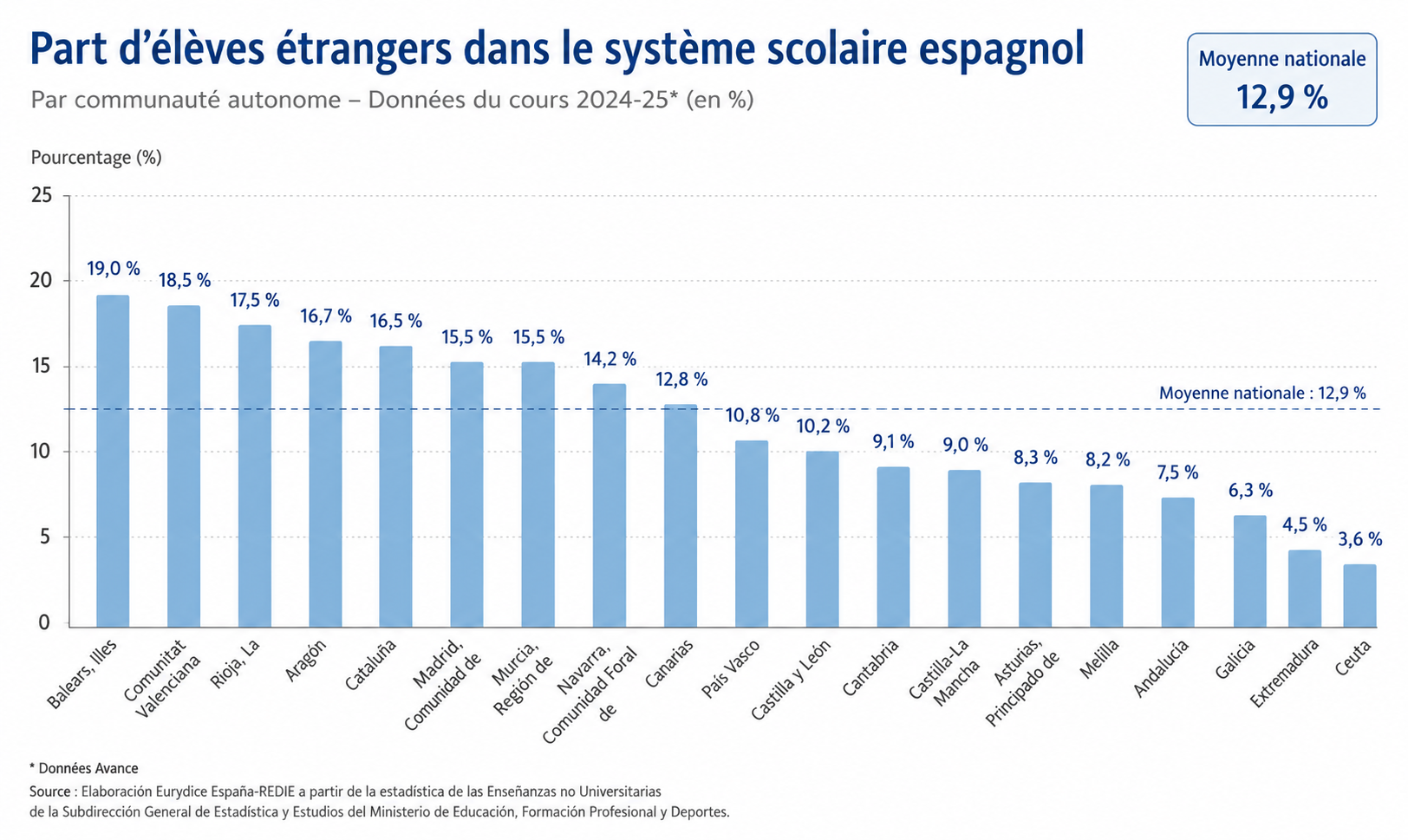
Are there many foreign pupils in Spanish schools?
How much does schooling cost in Spain?
The cost of schooling in Spain mainly depends on the type of school, but also on the region, the year group and the services you use. Even when teaching is free, families need to plan for several extra costs. According to a survey by OCU, the Spanish consumers' organisation, the average school budget is €2,390 per child for the 2025-2026 school year, across all types of school.
The cost of a state school in Spain
In state schools, compulsory education is free. Families pay no enrolment fees or monthly fees for lessons. They do, however, pay for supplies, textbooks, school meals, after-school activities and, where needed, school transport.
Taking all these costs into account, OCU puts the average cost of state schooling at €1,221 per child per year in 2025-2026. This can be reduced through regional grants, school meal grants and free or lending schemes for textbooks.
The cost of a concertada school
Concertada schools are private schools partly funded by the state. Teaching covered by this funding must be free. In practice, families may still be asked for contributions or to pay for extra services: meals, activities, transport, uniform or additional classes.
These costs are often between €50 and €200 a month, but can be higher depending on the school. Including all school costs, OCU puts the average budget at €3,444 per child per year at a concertada school.
The cost of a private or international school
Private schools set their own fees. A Spanish private school usually costs between €300 and €1,000 a month, plus enrolment fees and various services.
At an international school, fees are often between €5,000 and €20,000 a year, or even more at some schools. Fees vary with the city, the curriculum, the year group and the facilities. To see which schools are available, read our guide to British and international schools in Spain.
Extra costs to plan for
On top of school fees, the budget may include:
- school meals;
- textbooks and school supplies;
- transport;
- after-school activities;
- outings and school trips;
- a uniform at some schools;
- a tablet or a computer;
- enrolment or application fees at private schools.
In 2025-2026, families using these services spend an average of €119 a month on school meals and €65 on after-school activities. Costs also vary by region: OCU puts the average yearly spending at €3,188 per child in Madrid, €2,980 in Catalonia, €2,134 in the Valencian Community and €1,823 in Andalusia. These figures include all school costs and partly reflect how pupils are spread between state, concertado and private schools. Full details are in OCU's 2025 survey on the cost of schooling in Spain.
How do you choose a school before moving to Spain?
Choose the school before you even start looking for a home. The town, the area and your address can decide which state school your child can attend. Compare several schools, taking into account your family plans, your budget and your child's needs.
Decide on the type of school
The first step is to choose between a state, concertada, private, British or international school. A family planning to stay in Spain for the long term may prefer the Spanish system to help the child settle in. On the other hand, a British, American or international school may suit better if you plan to return home soon or move regularly between countries.
Check the language of teaching
In some autonomous communities, much of the teaching may be in a regional language. In Barcelona, Catalan plays a central role in state schools. In the Valencian Community, teaching may be split between Spanish and Valencian depending on the school.
So check each school's language plan and ask what support is offered to pupils who do not yet speak the local language.
Find out about admission rules
In state and concertada schools, places usually depend on a points scale that takes into account distance from home, a brother or sister at the school and certain family situations. The address of your future home can therefore directly affect which schools your child can attend.
In private, British and international schools, admission is usually based on an application, sometimes with an interview or a level test. Check availability early, as some schools have long waiting lists.
Compare the teaching approach and school life
Beyond exam results, compare teaching methods, language support, class sizes, facilities and activities. Timetables, a canteen, school transport, before- and after-school care and extra activities must also fit your family's routine.
If you can, visit several schools and talk to the head and to other parents. These meetings help you understand the atmosphere and how new pupils settle in.
Work out the real yearly cost
The budget is not always limited to school fees. Include meals, transport, supplies, textbooks, uniforms, trips and after-school activities. Ask each school for a full estimate of yearly costs before you decide.
For a British or international school, see our guide to British and international schools in Spain. More broadly, the choice of school should be built in from the start to the steps of your move to Spain.
British, international or Spanish school: which is right for your children?
| School system | Advantages | Disadvantages |
|---|---|---|
| British or international system |
|
|
| Spanish system |
|
|
Choosing a school is one of many things to weigh up before moving abroad. Like your budget, tax and the local property market, it helps make your move a success. If you are thinking of buying in Spain, taking time to study the school system will help you choose an area that suits your family and make settling in easier.
What is the history of the Spanish school system?
Origins and development of education in Spain
The foundations of Spain's modern education system were laid in the 19th century, when primary education became widespread. The Church's hold over schools, then their use by Francisco Franco during the dictatorship (1936-1977), left Spanish schools lagging behind other European countries.
In England, school attendance became compulsory in 1880 and elementary schooling free in 1891. The school leaving age was raised to 16 in 1972. In Spain, the right to completely free education for all children was granted in 1970. Before that, education was governed by the ley Moyano of 1857. At the time, schooling was compulsory for children aged 6 to 9 and free “for those who could not afford it”.
Let's look at the main reforms of the Spanish education system.
How education reforms shaped today's system
In all, Spain has had 8 major education reforms since the 1980s.
- In 1980, the country adopted its first democratic education law, the LOECE. You can read the text at this link. It aimed to regulate the Spanish education system and improve the quality of teaching. It focused on basic and primary education and on teaching civic values. It helped to give structure to the Spanish education system.
- In 1985, the LODE came into force. It sought to modernise the Spanish education system, based on the principles of freedom, tolerance and pluralism. It encouraged a balanced coexistence between state and private schools, making sure private schools met educational standards while keeping their freedom to teach. The text of the law is available here.
- In 1990, the LOGSE was passed, setting up the current education stages and reducing class sizes. This law extended compulsory schooling to the age of 16. The law included measures to promote the inclusion of pupils with disabilities and pupils with special needs. You can read the text of the law by clicking on this link
- In 2002, the LOCE introduced different educational pathways and end-of-stage exams. Its text is available on this page of the Official State Gazette (BOE) website.
- In 2006, the LOE kept compulsory education up to the age of 16, covering compulsory secondary education. Read its text in this PDF document.
- In 2013, the LOMCE, nicknamed the “Wert law” (after the then Education Minister, José Ignacio Wert), came into force. Its full text is available here. It was heavily criticised by the public. One of its most disputed points was the introduction of national exams seen as too selective for primary and secondary school pupils.
- In 2020, the LOMLOE, also known as the “Celaá law” (after the then Education Minister, Isabel Celaá), was passed. The LOMLOE made several changes to the Spanish education system, including less weight on national exams, stronger inclusive education for pupils with special needs, and more support for regional languages in teaching. You can find the text of the law on this link
A first-hand view of the Spanish school system
To shed more light on the Spanish school system, we interviewed several people living in Spain, in particular in the Canary Islands and in Madrid. Here is the view of one of them, a young Spanish woman.
A Spanish woman's view
Idoia agreed to give us her view of her country's school system. Here are the key points from our interview:
Alveo Search: What are the strengths and weaknesses of schooling in Spain?
Idoia: The education system in Spain is democratic and leaves no one behind. That is its first strength. It ensures attention to diversity, free schooling, qualified teachers, ongoing training for teachers, grants, a high enrolment rate, a balance between boys and girls, school autonomy and so on. Spanish schools have a lot going for them, even if there is room for improvement.
Underfunding, a structure and educational model dating from the 19th century, overcrowded classes, a shortage of teachers, a high dropout rate, too many pupils with gaps in their learning, inconsistent legal reforms, and so on. That is my view. In other words, the Spanish education system can still improve.
How do exams work up to the end of bachillerato?
Up to Selectividad (the university entrance exam in Spain), there are regular assessments in every subject throughout school, and at the end of each stage. They include written tests, oral and reading comprehension tests, and oral and written expression tests. Their aim is to check that pupils have gained the skills and knowledge they need.
In your view, what are the main differences between state and private schools?
State schools are open to everyone, intercultural and democratic, while private schools select pupils based on their families' finances and/or religious beliefs.
State schools have less autonomy than private schools. They offer free, good-quality, equal and diverse education. Private schools, on the other hand, may hold values that are not in line with the Constitution, lack diversity and hire untrained teachers. In my view, state schools ensure better learning.
Thank you for these insights, Idoia.
Thomas Rouer is the founder of Alveo Search and the CEO of the Alveo group. Based in Spain for almost ten years, he develops property services designed for the specific needs of foreign buyers.
His expertise covers every aspect of buying property in Spain: understanding the market, searching for and selecting properties, negotiation, financing, paperwork, tax and securing the purchase process.
Frequently asked questions about the Spanish school system
Is school compulsory in Spain?
Yes. In Spain, school is compulsory and free from 6 to 16. It covers Educación Primaria, from 6 to 12, then Educación Secundaria Obligatoria (ESO), from 12 to 16.
Are state schools free in Spain?
Yes, compulsory state education is free. Families still need to budget for extra costs such as supplies, textbooks, school meals, transport and after-school activities.
Can a foreign child go to a Spanish school?
Yes. A foreign child living in Spain can join a state, concertada or private school. The documents usually requested include an ID document, proof of address, the empadronamiento certificate and the latest school reports.
At what age do children start school in Spain?
Educación Infantil takes children from 0 to 6, but it is not compulsory. Compulsory schooling starts at 6, when the child enters Educación Primaria in the calendar year of their sixth birthday.
What is the difference between a state school and a concertada school?
A state school is fully funded and run by the public authorities. A concertada school is a private school partly funded by the state. Its compulsory teaching must be free, but families may be charged contributions and extra services.
What language is used in Spanish schools?
Spanish (Castilian) is taught throughout Spain. In some autonomous communities, some or most lessons may also be taught in Catalan, Valencian, Basque or Galician. So it is important to check the school's language plan before enrolling.
How much does a private school cost in Spain?
A Spanish private school usually costs between €300 and €1,000 a month. At an international school, fees are often between €5,000 and €20,000 a year, sometimes more. Meals, transport, uniform and activities may be charged separately.
Can you enrol your child in a Spanish school during the school year?
Yes, you can enrol during the year, especially after a move. Contact the regional school admissions service, the town hall or the school concerned. The place will then depend on availability.
Does my child need to speak Spanish to go to school in Spain?
No, speaking Spanish is not a requirement to go to school. An adjustment period may be needed, especially when lessons are also taught in a regional language. Some schools offer language support to new pupils.
Is it better to choose a British, international or Spanish school?
A British or international school makes it easier to keep the same curriculum and to return home later. The Spanish system does more for learning the language and fitting in locally. For a long-term move, a Spanish school is often the best fit; for a temporary stay, a British or international school can be more practical.

Our resources for buying in Spain