Français
 English
Squatters in Spain (Okupas): how to protect your property

- Definition: the word “okupa” refers to the illegal occupation of a home without the owner's consent, whether the property is lived in or abandoned. The Institut Cerdà counted 87,000 okupas in 2017, and nearly 10,000 cases of illegal occupation were recorded in 2024.
- Areas at risk: mainly Madrid, Barcelona, Valencia and Seville, with districts such as Eixample, Gràcia, Lavapiés and Tetuán, as well as the Canary Islands, the Balearic Islands, the Costa Brava and the Costa del Sol.
- Properties targeted: empty flats, poorly watched second homes, abandoned commercial buildings and repossessed homes held by banks.
- Prevention: reinforced doors and locks, metal shutters, fences and gates, motion-sensor lighting, connected alarms and cameras, regular occupation or a caretaker.
- Costs: professional monitoring from €30 to €150 a month, alarm and video surveillance from €100 to €1,500, specific insurance from €50 to €200 a year, a caretaker from €800 to €2,500 a month.
- Key point: the procedure can take two years or more: act in the first few days, call the police (091, Guardia Civil 062, emergencies 112), hire a lawyer and keep your title deed and proof of paid bills.
In Spain, the word “okupa” refers to the illegal occupation of a home by a third party. Owners are wary of it for several reasons: okupas can disturb the neighbours, damage the property and, worse still, create complex legal problems. Faced with this threat, it is essential to take preventive measures and find ways to protect your property.
In this complete guide, Alveo Search shows you the most effective ways to secure your house or flat against okupas. We also share our expert advice on preventing the illegal occupation of your property, whether you are a resident or a non-resident. In this article, you will see the areas of Spain most affected, the types of property most at risk, and the costs to plan for when putting security measures in place.
Understanding the okupa risk in Spain
What is an okupa?
An “okupa” is anyone who deliberately moves into a property illegally. The property may be a lived-in home or an abandoned building. Squatters count as okupas as soon as they occupy the premises without the owner's consent. Although the phenomenon has existed for decades, it is becoming more and more common in Spain. In 2017, the Institut Cerdà reported 87,000 okupas in Spain. The most common causes are the economic crisis, the lack of affordable housing and the growing number of empty buildings.
Okupas can get into a property by forcing doors or exploiting security weaknesses. Some owners even call them “home snatchers”. Once inside, they often change the fittings and live there without paying rent, which can have serious legal and financial consequences for owners.
The impact on owners

Owners are wary of okupas because the consequences can be serious. First, they lose control of their property, and it is often impossible to put things right without going through more or less complex legal steps. Very often, okupas refuse to leave, which makes it hard to recover the property.
Yet in Spain, legal fees are high and it can take several months to obtain a favourable ruling. Okupas also do not look after the property, so it can suffer physical damage. And if the owner plans to sell, this damage can lower its market value.
The legal risks
Spanish law above all protects the occupants of a property, at least for a limited time. This makes evicting okupas harder: once settled, they are treated like ordinary residents, with legal protections that let them stay in the home for several months, or even several years.
This is why some owners hit by okupas end up in a difficult situation, waiting months before they can recover their property and carry out their own plans. In general, they have to turn to the competent authorities or to specialist services.
The situation in 2024
Okupas: a clear rise in Spain
Source: https://proadmin.es/cuantos-okupas-hay-en-espana-2024/
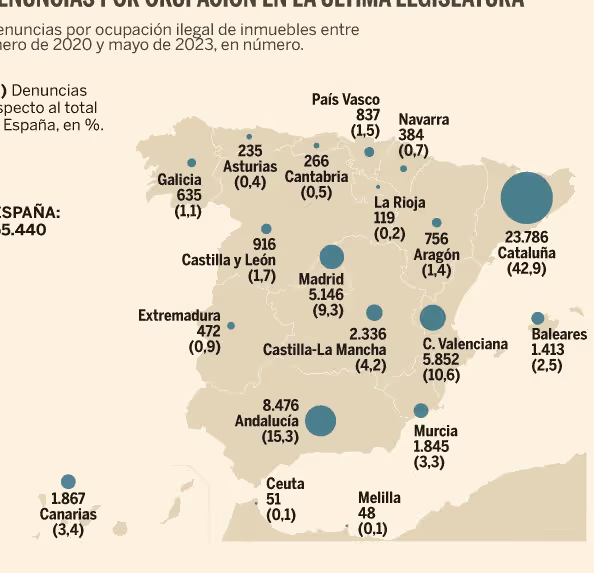
In 2024, Spain is one of the countries most affected by the illegal occupation of homes. According to the latest statistics, nearly 10,000 cases of illegal occupation were recorded last year, with an upward trend in some regions, especially in large cities such as Barcelona, Madrid and Valencia.
Faced with this situation, the Spanish government has introduced several laws to make evicting okupas easier. Even so, owners are left waiting, because the process remains slow and complex: they have to wait about 2 years or more for an outcome. Fortunately for them, autonomous communities such as Madrid have taken the initiative to tackle the problem with their own means. However, only national law can make the final decisions.
Private owners and banks: the main victims of okupas
The main victims of okupas in Spain are private owners with empty homes. However, banks and some financial institutions suffer the same fate, as they generally hold a large number of properties. For banks and private owners alike, the impact can be devastating, both financially and personally.
The areas of Spain most affected
Okupas in Spain's big cities
Okupas mainly target Spain's urban areas, notably Madrid, Barcelona, Valencia, and Seville. These cities attract okupas because of a number of features:
- A high population density;
- A tight property market;
- A large number of empty homes or homes whose owners are often away.
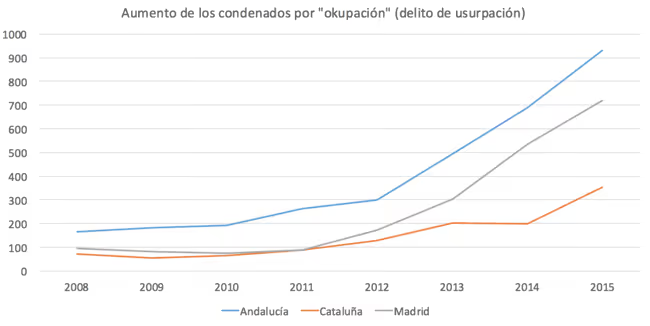
The most vulnerable districts are in Madrid and Barcelona, including Eixample, Gràcia, Lavapiés and Tetuán. These are very dense areas where many buildings are old, which makes them an obvious opportunity for okupas. They also know that this type of property is easier to break into.
Outlying districts, for their part, are less closely watched and have empty homes almost everywhere. For example, the Spanish capital has seen a rise in illegal occupation in its suburbs. There are also districts where property is cheaper, both to buy and to rent.
Source: https://www.libremercado.com/2016-12-17/la-okupacion-se-multiplica-por-mas-de-siete-en-madrid-1276588780/
Okupas in tourist areas
Okupas looking for temporary housing are very interested in regions with many tourists. The areas concerned are mainly the Canary Islands, the Balearic Islands and Mediterranean coastal areas such as the Costa Brava and the Costa del Sol. Empty properties there are often second homes, and some owners prefer to let them as holiday rentals.
Holiday homes and flats for rent are therefore particularly vulnerable, as they often stay empty for long periods. Okupas take advantage above all of the off-season.
Rural and less urbanised regions
Some okupas take advantage of abandoned or rarely used properties in rural areas. Inland regions such as Castilla-La Mancha or Andalusia, although less populated, often face illegal occupation. These areas have fewer people, but the risk is real when properties are left abandoned or poorly secured.
The types of property most targeted
Empty flats
Okupas prefer empty flats, especially those waiting to be sold or let. This type of property is common in Spain, where some homes stay empty for months or even years. They also target the least secure homes in outlying districts, which are easy to get into: sometimes windows are broken or doors are simply not locked.
Second homes and holiday homes
Second homes are also common targets. These properties are used now and then, rarely watched, and therefore easier to break into. Very often, the owners do not live in Spain and only come for holidays. When a house is left empty for a long time, it is an easy opportunity for okupas, especially in a tourist area.
Abandoned commercial buildings
Abandoned commercial or industrial buildings are also often in areas that are poorly watched, or not watched at all, and local authorities take little interest in them. This makes them prime targets for okupas. These properties are usually quite large and easy to turn into temporary housing. For example, factories or shops closed for a long time are easy to occupy discreetly.
Bank-owned properties
Banks hold properties recovered through repossessions. These homes are empty and often stay that way for a long time. People without housing see an opportunity to live there until the bank decides to sell or renovate. Banks are also slower to act because of complex administrative procedures, and okupas know how to take advantage of this.

Source: https://www.rtve.es/radio/20201209/okupas-epidemia-fantasma/2059520.shtml
Essential preventive measures against okupas
Securing the property physically
To prevent illegal occupation effectively, the first step is to secure your property properly, with measures that range from simple to more involved.
- Reinforce doors and windows: install solid doors and high-security locks, especially when your home is empty for a long time. Windows should also have security devices such as bars or metal shutters.
- Install fences and gates: solid fencing around your property is an effective deterrent against break-ins. Choose quality gates with reliable locking systems.
- Improve outdoor lighting: modern technology is always a good ally for the security of your property. Choose practical outdoor lighting with motion sensors.
Alarm systems and video surveillance
Alarm systems and video surveillance have become essential tools to protect a property against any kind of intrusion. There are many types of alarm, and the most modern can be connected to monitoring centres that react immediately to any attempt.
If you choose CCTV cameras, install them at the main access points of the property so that you can keep the home under constant watch.
The importance of regular occupation
If you own a home in Spain, it is strongly advised to use it regularly or to make sure a trusted person visits it as often as possible. This way you avoid attracting okupas. If you do not live in the country, consider hiring a caretaker and setting up a concierge service.
Legal and administrative solutions against illegal occupation
Source: Policía Nacional (Spanish National Police)
Documents to prepare in advance
Recovering an illegally occupied property can be very complicated. To avoid getting caught out, prepare your documents in advance and keep them close to hand. They are essential to prove that you own the property and to make any legal procedure easier if okupas move in.
- Your title deed: The main document proving that you are the rightful owner of the property is the title deed. Keep it somewhere safe, ideally also as a scanned copy.
- The rental contract: If your property is let, also keep your rental contract and all supporting documents. They are essential to establish legal responsibilities if okupas move in.
- Proof of payment of taxes and bills: Any document showing that you pay the bills can help prove that you really are the legal owner of the property, such as the property tax (IBI), water and electricity bills.
- Visit and management records: If you have entrusted the management of your property to an agency, you can show the related documents, such as the record of visits made and invoices for maintenance or repairs.
- Home insurance: Home insurance is always essential. If your property is occupied illegally, some policies can cover the costs of recovering it.
Emergency procedures to know
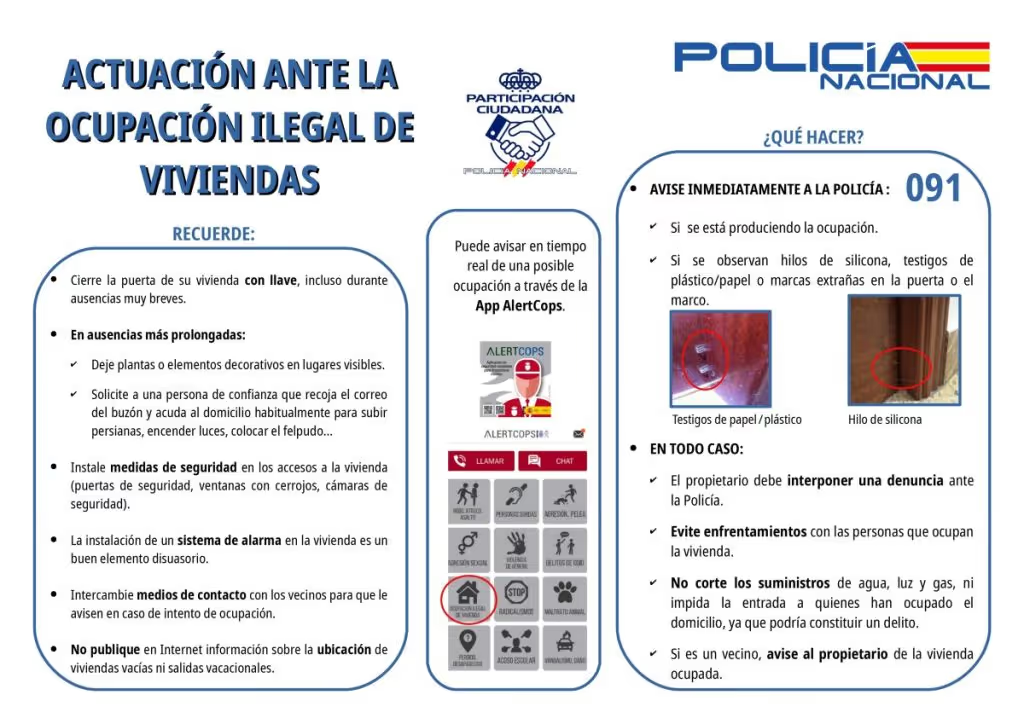
As soon as you find that someone has taken over your property without your consent, act quickly. Here are the key steps to follow in an emergency:
- Call the police immediately: As soon as you discover an illegal occupation of your property, report the intrusion to the local authorities without delay. The police will assess the situation and decide whether urgent action is needed. In Spain, the law allows the police to act quickly when the circumstances are serious.
- Hire a specialist lawyer: It is often more effective to call on a lawyer specialising in property law. They can advise you on the legal steps or on handling the conflict, and give you immediate guidance. Your lawyer will help you understand the legal steps to follow for any eviction procedure.
- Apply for an eviction order: If the okupas have already moved in, you cannot evict them without an eviction order from the competent court. In Spain, this process can be faster in the first days after the illegal entry, so act while the intrusion is still recent.
- Take emergency measures: While the situation is being resolved, you can take emergency measures to secure access to your property. Even if the squatters are already inside, you can hire a security company to stop the situation getting worse. Okupas sometimes gather for just a few hours and end up staying several days.
- Seek conciliation or mediation: In some cases, an amicable solution is possible. It is not a simple process: you will need the local authorities to act as mediators between you and the squatters, and the okupas must be open to an agreement.
Specific contracts and insurance
Fortunately for owners in Spain, there are now specific contracts and insurance policies designed to protect against okupas.
- Private security contracts: If you fear your property could become a target for okupas, specialist companies offer private security contracts. Their role is to keep your property under regular surveillance. Some also provide security guards 24/7.
- Insurance against illegal occupation: There are also insurers offering specific policies that cover owners against the risk of illegal occupation. Their cover generally includes legal fees, recovery costs and some compensation for damage to the property. Ask your insurance company whether these options are available.
Professional surveillance services
Specialist security companies
In most cases, private security companies are the most effective way to keep a property safe. They can provide a range of services, including:
- Patrol services: the service can include night-time surveillance, especially when the property is empty.
- Installing and managing alarm systems: These companies also install and manage sophisticated alarm systems, with response agents ready to act in case of intrusion.
- Physical security of entrances: Some companies offer advanced locking systems such as armoured doors or reinforced windows.
Concierge services
Concierge services include regular checks on your property, upkeep and repairs, and sometimes measures to prevent illegal occupation. The aim is to maintain and check your property regularly, which keeps okupas away.
Remote surveillance solutions
If you own a home in Spain but cannot be there, you will need remote surveillance. Popular devices such as connected cameras let you watch your property in real time from anywhere in the world through a mobile app. As soon as the camera detects suspicious movement or unauthorised access, it sends an alert to your phone.
Our expert advice for non-resident owners
How can you keep control of your home from a distance?
If you own a house or flat in Spain but do not live there, managing it can be a heavy task. And if the property is rarely used, okupas are more likely to take advantage of it. Our experts recommend these effective strategies to reduce the risk:
- Hire a local property manager: A professional property manager looks after the security and upkeep of your property. They also handle visits, maintenance and tenants.
- Use digital management tools: Many online platforms let you manage rental contracts, rent payments and maintenance remotely. These tools help you keep a constant eye on your property, even from afar.
- Set up a smart surveillance system: Modern technology lets you install remote surveillance systems, such as security cameras and motion detectors, that send real-time alerts to your phone or email. These systems are often linked to security companies or concierge services.
Local neighbourhood watch networks
To secure your property in Spain effectively, you can also join local neighbourhood watch networks or residents' committees. Nearby owners can then support each other in keeping an eye on their properties, especially when they are away. In Spain, groups of neighbours get together to report any suspicious activity and keep each other informed of break-in risks in the area.
These networks may, for example, organise joint security patrols or recommend security providers. Members share information through private channels. Non-resident owners can join these networks by signing up on local online platforms.
Suitable technology solutions
Advanced surveillance technology
As technology advances, surveillance systems are getting better too. Many new solutions can be used to protect a property against okupas. Here are some of the most effective options:
- Smart cameras: These cameras have advanced features such as motion detection, night vision and alerts. The most advanced have speakers to deter okupas before they even try to get in.
- Connected alarm systems: These systems connect the alarm to a mobile app, so you receive a real-time notification in case of intrusion. Modern systems can also tell false alarms apart and alert you only when there is a real threat.
- Glass-break and motion detectors: These devices can be fitted on windows or outside your property to detect any movement or broken glass. They are connected to alarm systems or other security devices for a quick response.
Remote monitoring apps
When you are away, monitoring apps help you manage the security of your property remotely. For example, some platforms let you connect all your security systems (cameras, alarms, sensors) to a single app.
The financial side of protection
The cost of the different solutions
Cost is always a major concern for owners. You can choose between different levels of protection, and prices vary with their scope and effectiveness.
Here is an estimate of the main investments:
- Professional surveillance: Monthly or annual contracts offered by security companies (patrols, video surveillance, call-outs when an alarm goes off). Approximate cost: €30 to €150 a month
- Alarm and video surveillance systems: Installation of connected cameras (€500 to €1,500) or alarm systems, from simple to sophisticated (€100 to €1,000). Approximate cost: €100 to €1,500 (depending on the system)
- Specific insurance: Adding cover against illegal occupation to your home insurance. Approximate cost: €50 to €200 a year
- Concierge and remote management: Services such as surveillance, maintenance and management of rental contracts. Approximate cost: €100 to €500 a month
- Security bars and armoured doors: Fitting armoured doors or extra locks to strengthen access. Approximate cost: €300 to €2,000 (depending on options)
- Secure windows and shutters: Adding grilles, motorised roller shutters or reinforced glass to prevent break-ins. Approximate cost: €200 to €1,500 per window
- Security lighting: Installing motion-sensor lights to deter intruders. Approximate cost: €50 to €300 per device
- Smart keys and locks: Connected lock systems that you can control remotely through an app. Approximate cost: €150 to €500
- Advanced anti-burglary systems: Vibration sensors or glass-break detectors built into windows and doors. Approximate cost: €200 to €800
- Local patrols: One-off or regular patrols by security guards in the neighbourhood. Approximate cost: €20 to €50 per visit
- Caretaker service: A caretaker who watches the property permanently or whenever you need. Approximate cost: €800 to €2,500 a month
- Presence simulators: Devices programmed to simulate activity in the home (lights, TV, etc.). Approximate cost: €30 to €150
- Neighbourhood watch networks: Setting up collaborative groups of neighbours for collective vigilance. Approximate cost: Free to low cost (tools)
- Surveillance drones: Using drones to monitor large properties. Approximate cost: €1,000 to €3,000 (purchase and management)
- Deterrent signs: Signs showing that security or surveillance systems are in place. Approximate cost: €10 to €50
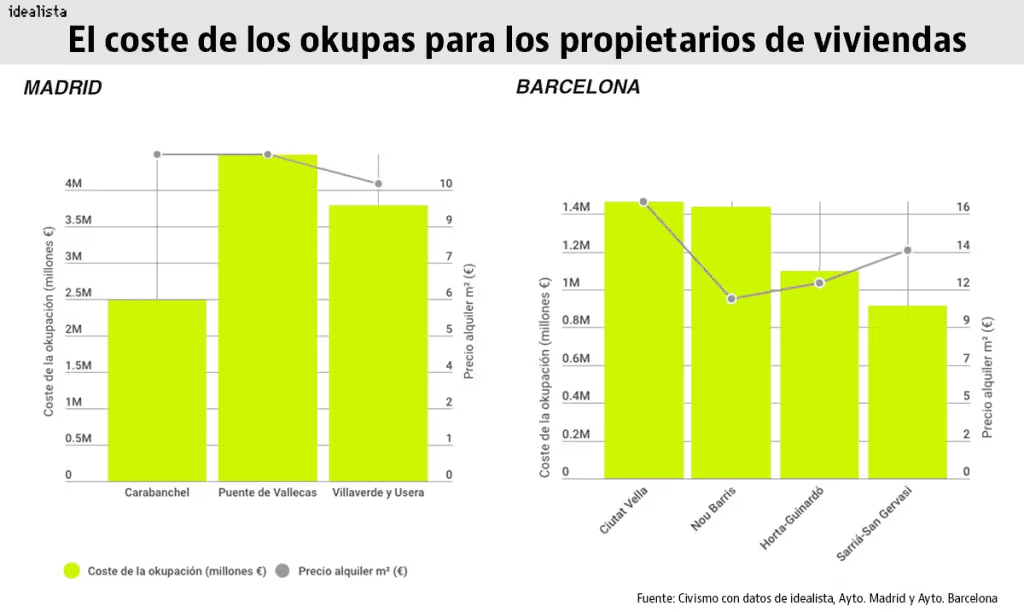
Source: https://www.idealista.com/news/inmobiliario/vivienda/2017/05/30/746666-los-okupas-cuestan-21-4-millones-de-euros-cada-ano-a-los-propietarios-de-vivienda-de
Priority investments
- Professional surveillance;
- Security systems;
- Home insurance.
The cost-benefit balance of protection against okupas
Even if these solutions are a significant investment, they pay off in the long run. Protecting a property against okupas can avoid much higher costs. When you compare the cost of security systems, insurance and professional services with the risks of illegal occupation, the balance is clearly favourable.
Useful resources and contacts
Owners' associations
Several owners' associations in Spain offer advice, resources and support in cases of illegal occupation. They defend owners' rights and can provide useful information on legal procedures. Search online to see whether there is one in your area.
Specialist legal services
Many lawyers specialising in Spanish property law can guide you through the legal procedures linked to illegal occupation. Contact a lawyer as soon as possible to assess your options and put an effective strategy in place.
Here are some of these services (the UK government's “Find a lawyer abroad” service also lists English-speaking lawyers in Spain):
- Seguro Contra Okupas: National company specialising in squatter evictions and related legal services, guaranteeing the recovery of your property.
- Squat Solutions: Offers an alternative to court proceedings by buying squatted properties, taking care of the legal side and the eviction delays.
- Squat Solutions, Alexis Duc Dodon (lawyer): Lawyer specialising in civil, property, commercial and business law, inheritance and family law.
Competent authorities
Local authorities, such as the National Police or the Guardia Civil, are the first to respond to an illegal intrusion.
Here are some emergency numbers to know:
National Police (Policía Nacional): 091
Guardia Civil and emergencies: 062, 112
Guardia Civil headquarters: Calle Guzmán el Bueno 110, 28003 Madrid
Phone: +34 915 146 000
Email: dg-registrocentral@guardiacivil.org
Important: It is advisable to call 091 for the National Police or 062 for the Guardia Civil in case of illegal intrusion. For situations that need immediate assistance or other emergency services, 112 is also available.
If you own property in Spain, protecting it against okupas is essential. This takes a proactive approach that combines legal, technical and security solutions. By putting the right security measures in place, surrounding yourself with qualified professionals and knowing your rights, you can minimise the risk of illegal occupation. Prevention is essential, and if okupas do get in, act quickly.
Thomas Rouer is the founder of Alveo Search and the CEO of the Alveo group. Based in Spain for almost ten years, he develops property services designed for the specific needs of foreign buyers.
His expertise covers every aspect of buying property in Spain: understanding the market, searching for and selecting properties, negotiation, financing, paperwork, tax and securing the purchase process.


Our resources for buying in Spain