Français
 English
Cédula de Habitabilidad in Spain: what it is and when you need it

Have you finally found the right property in Spain and are about to reserve it? Great, but have you checked that it has a Cédula de habitabilidad?
The Cédula de habitabilidad, literally the “certificate of habitability”, is a very important document for owners and tenants alike. Alveo Search looks at this licence with Maria Grifo, an architect in Valencia, who told us at the start of our interview: “As with many topics, each autonomous community has its own rules on the Cédula de habitabilidad, but the differences from one region to another are really minimal.” Here is what you need to know.
What is the cédula de habitabilidad?
The cédula de habitabilidad is a Spanish administrative document certifying that a home meets the minimum conditions to be lived in. In English, it is usually called a certificate of habitation, although the Spanish term is often used as it is in property transactions.
In practice, the cédula confirms that the property has what it needs to be used as a home: enough floor space, ventilation, natural light, water, electricity, bathroom facilities, a kitchen, basic safety of the installations and so on. It is about whether the property can legally be lived in, beyond how it looks.
For a foreign buyer, this is an important document to check before committing. A flat can look perfectly habitable during a viewing but cause problems if the cédula de habitabilidad is missing, has expired or no longer matches the current state of the home.
A simple definition of the certificate of habitation in Spain
The cédula is administrative proof that the competent authority recognises the home as habitable. Depending on the region, it may be issued by the autonomous community, the town hall or a specific administrative body.
It is used in particular when buying, selling or renting, or when connecting essential services. Some autonomous communities require it strictly; in others, it has been abolished, replaced or merged into other local documents.
That is why you should never look at it only at national level. When buying property in Spain, the rule always depends on where the property is.
What the cédula proves, and what it does not
The cédula proves that the home meets minimum habitability standards. In particular, it can show that the property has enough usable floor space, bathroom facilities, access to the utility networks and sanitary conditions suitable for residential use.
However, it does not prove everything. It does not replace the title deed, does not guarantee that there are no debts, does not automatically approve all the work carried out and does not replace the legal checks to be done before buying. So it should not be confused with other documents such as the licencia de primera ocupación (first occupation licence), the energy performance certificate, the nota simple from the land registry or the cadastral records.
Before buying, it is therefore wise to check the cédula together with the other key documents of the transaction. To see where this step fits in the whole journey, read our guide to the property buying process in Spain.
In English: cédula, certificate of habitation or habitation licence?
All three terms are often used, but they do not always mean the same thing.
In Spanish, the most common term is cédula de habitabilidad. In English, it is generally called a certificate of habitation. You will also sometimes see the term habitation licence, a more literal translation of “licencia de habitabilidad”, but it can be confused with other administrative licences.
To avoid confusion in a transaction, it is best to use the Spanish name of the document when dealing with a notary, a lawyer, an estate agency or a local architect. You can then explain it in English as a certificate proving that the home is officially fit to live in.
What is the cédula de habitabilidad for when you buy a property?
When you buy property in Spain, the cédula de habitabilidad secures the use of the property after signing. It confirms that the home can be lived in legally, and that it can be connected to essential services, rented out or resold more easily.
Foreign buyers sometimes underestimate its importance. Yet a missing cédula can have very real consequences: difficulty connecting the meters, administrative blocks, problems with financing, being unable to rent out, or even having to carry out work to bring the property up to standard.
Buying, selling or renting a home
In several regions of Spain, the cédula is required when a home is sold or rented. It reassures the buyer or tenant that the property meets minimum habitability standards.
For a seller, a valid cédula makes the transaction easier. For a buyer, it is something to ask for before signing, just like the nota simple, the cadastral information or the documents of the community of owners.
If the property is meant to be rented out, you need to be even more careful. Some regions require proof of habitability to rent out a home legally, including for long-term or holiday rentals. In that case, a missing cédula can make the property less attractive as a buy-to-let investment.
Opening or changing water, electricity and gas contracts
The cédula may also be requested to open, change or transfer water, electricity or gas contracts. This is one of the most practical points for buyers: even after signing at the notary's office, you can be stuck if you cannot put the meters in your name.
This risk depends on the region, the supplier and the situation of the property. But where a valid cédula is required, not having one can mean extra paperwork, delays and sometimes work before you can use the property normally.
If you are buying remotely or in a region you do not know well, this check should be part of your analysis of the property very early on, ideally before the reservation. Our guide on how to reserve a property in Spain can help you see where this check fits in the first steps of the transaction.
Getting a mortgage and reassuring the notary and the buyer
The cédula can also play a role in financing. Some Spanish banks may ask for this document before granting a mortgage, especially if they want to make sure the property they finance is properly intended for residential use.
The notary may also point out to the parties that the cédula is missing or that a document is irregular. The notary does not carry out every check on the buyer's behalf, but does help secure the deed. To understand this better, read our article on the role of the notary in Spain.
Finally, if you are buying an old, unusual, renovated or converted property, it is strongly recommended to get advice from a local professional before signing. A lawyer or an architect can check whether the official status of the home matches its actual use. This is especially important when commercial premises have been turned into a home, when an extension has been added or when the actual floor area does not match the official documents.
The different types of cédula de habitabilidad
There is more than one administrative situation behind the cédula de habitabilidad. Depending on the age of the home, its previous use or the work carried out, the document required can vary. This matters when buying property in Spain, as a new build, an older flat or a renovated home will not always be checked in the same way.
In the regions where the cédula is still required, the authorities generally distinguish between new homes, existing homes and properties that have been heavily renovated. In Catalonia, for example, the official procedures clearly separate the first occupation cédula and the second occupation cédula, as shown on the Generalitat de Catalunya's page on cèdules d'habitabilitat.
Cédula de primera ocupación for new homes
The cédula de primera ocupación applies to new homes, or properties that have just been built and have never been lived in. It confirms that the finished home meets minimum habitability standards and can be used as a dwelling.
It is often linked to the completion of the building work and the documents issued after construction. Depending on the region, you may also hear of a licencia de primera ocupación (first occupation licence) or an equivalent document. The idea is the same: checking that the property can be legally occupied once it is built.
For a buyer, this document matters most with new builds. Before signing the final deed, you need to make sure the developer or seller can provide the required occupancy documents. In Andalusia, for example, the Junta points out that for a vivienda de nueva construcción (new-build home), the buyer must make sure the developer hands over the licencia de primera ocupación (first occupation licence).
Cédula de segunda ocupación for existing homes
The cédula de segunda ocupación applies to homes that have already been built and lived in. This is usually the most common case when buying a resale flat or house.
It checks that the older home is still habitable at the time of the application. In other words, the authorities do not just check whether the property has been lived in before: they also check that it still meets the minimum conditions to be used as a home.
In Catalonia, the official procedure for a second occupation cédula requires a qualified technician, often an architect or a technical architect, who issues the habitability certificate before the application is filed.
Cédula after renovation or change of use
A renovated property may need a new check, especially if the work changed its layout, floor area, installations or use. This is the case, for example, when commercial premises are turned into a home, when a major renovation is carried out or when part of the property was added without being properly legalised.
This is one of the most sensitive cases for a foreign buyer. A home may be presented as habitable, nicely renovated and already lived in, yet cause problems if the work does not match the official documents. Before committing, it is essential to compare the real state of the property with the official documents.
If the property is old, renovated or unusual, it can be useful to combine the cédula check with other technical checks. Our article on the ITE building inspection in Spain explains the checks on the general condition of buildings.
| Type of document | Property concerned | When it is useful |
|---|---|---|
| Cédula de primera ocupación | New home | Handover or first occupation |
| Cédula de segunda ocupación | Older or previously occupied home | Purchase, sale, rental or change of contracts |
| Cédula after renovation | Renovated or substantially altered property | After major work or a change of use |
| Licencia de primera ocupación | Equivalent local or regional document in some cases | End of construction or first use |
Is the cédula required everywhere in Spain?
No, the cédula de habitabilidad is not required in the same way throughout Spain. This is one of the most important points to understand: habitability depends on each autonomous community's own rules, and sometimes on local practice at the town hall or the utility supplier.
In some regions, the cédula is still a key document for selling, renting or connecting the meters. In others, it has been abolished and replaced by a licencia de primera ocupación (first occupation licence), a declaración responsable (self-declaration) or another equivalent document. So avoid overly general answers such as “it is compulsory in Spain” or “it no longer is”. The right question is: which habitability document is required in the region where the property is?
A rule that depends on the autonomous communities
Spain's regions have wide powers over housing and planning. This means the rules can vary greatly between Catalonia, the Balearic Islands, Madrid, Andalusia, the Valencian Community or the Canary Islands.
When buying, you therefore need to check three things: the regional rule, the practice of the town hall concerned and any requirements of the water, electricity or gas suppliers. Even when a cédula is no longer strictly compulsory, an equivalent document may be requested to prove that the property can legally be used as a home.
This is also why it is wise to get support before signing, especially if the property is old, renovated or in an area with complex local rules. You can read more about this in our guide on the lawyer's role in a Spanish property purchase.
Catalonia, Balearic Islands, Canary Islands: areas where extra care is needed
In Catalonia, the cédula is still a key document. The Generalitat states that the cédula certifies that a home meets the minimum habitability conditions, and sets out the procedures for first occupation and second occupation homes. So this is a region where buyers need to pay particular attention to whether the document exists, which type it is and whether it is still valid.
In the Balearic Islands, the rules have changed recently. In particular, the regional government announced an administrative simplification that removes the requirement for a first occupation cédula in some cases, in favour of other administrative procedures. When buying in Mallorca, Menorca or Ibiza, it is therefore essential to check the rule that applies at the time of the transaction, as the documents required may depend on the type of property, its age and the municipality.
In the Canary Islands, habitability is also an important issue, especially for older properties, holiday rentals or houses in rural areas. Here again, you need to distinguish between a cédula, an occupancy licence and an equivalent document.
Madrid, Andalusia, Valencia: abolished, replaced or local equivalents
In other regions, the cédula de habitabilidad has been abolished or replaced by other documents. In Andalusia, for example, the Junta de Andalucía abolished the cédula de habitabilidad as early as 1987, as stated in the decree published in the BOJA. This does not mean there are no checks at all: for a new home, the first occupation licence remains a key document.
In Madrid, the cédula de habitabilidad is generally no longer the central document in property transactions. Checks focus more on the occupancy licence, planning compliance, land registry documents and the permits linked to the property.
In the Valencian Community, you also need to look at each case. Depending on the municipality, the type of home and the work carried out, the buyer may need to check an occupancy licence, a declaración responsable (self-declaration) or an equivalent document. When buying on the Costa Blanca or in the Valencia area, this check must therefore be done locally, not based on a general rule found online.
| Autonomous community | Cédula required | Notes |
|---|---|---|
| Catalonia | Yes | Required for sale, rental and utility connections |
| Balearic Islands | Yes | Systematically checked by notaries |
| Canary Islands | Yes | Included in sale documents |
| Navarre | Yes | Strict regional rules |
| Murcia | Yes | Required for long-term rentals |
| Asturias | Yes | Applies to older homes |
| Galicia | Partly | Depends on the type of property and the municipality |
Why you should always check locally before signing
The cédula is more than an administrative detail. It can affect how you actually use the home after buying: connecting the meters, renting, reselling, financing or legalising work. That is why it should be checked before the final deed, and ideally even before reserving the property.
If the seller says the document is “not necessary”, ask why, in which region, and what document replaces it. A missing cédula can be normal in some autonomous communities but a problem in others. What matters is being able to prove that the property can legally be used as a home.
Before reserving, you can add this check to your list of document checks. Our guide on how to reserve a property in Spain helps you place this step at the right time in the buying process.
The criteria for obtaining a Cédula de habitabilidad in Spain
To obtain a Cédula de habitabilidad, the home must meet a set of technical criteria proving that it can be lived in under good conditions. These criteria go beyond comfort: they also cover safety, hygiene, ventilation, natural light, essential equipment and the layout of the rooms.
In practice, the check must be carried out by a qualified professional, usually an architect or a technical architect. They check whether the property meets the applicable standards before preparing the application or renewal file for the cédula.
Which criteria are checked before the cédula de habitabilidad is issued?
To issue a cédula de habitabilidad, the authorities do not look at whether the home is “beautiful”, modern or tastefully renovated. Above all, they check whether it meets the minimum conditions to be lived in: floor area, layout, light, ventilation, access, essential equipment and safety in use.
To obtain the certificate of habitation, the home must meet several general conditions. They make it possible to check that it can be occupied with normal levels of comfort, safety and hygiene:
- the home must have access to drinking water and electricity;
- the bathroom facilities must be suitable and in good working order, including the plumbing and drainage systems;
- natural light must be able to enter the home, especially in the main rooms;
- the home must meet minimum ventilation standards, to ensure enough fresh air;
- the living spaces must suit the number of people who may live there. The minimum dimensions of the bedrooms, living room, kitchen and other living areas must therefore be respected;
- the home must offer sufficient guarantees of structural safety: walls, floors, stairs, balconies and load-bearing elements must allow it to be occupied without any obvious risk;
- fire safety standards may also be taken into account, especially for building materials and detection devices;
- in some cases, accessibility requirements for people with reduced mobility may apply, in line with current legislation.
Example of the rules in force in the Valencian Community
As we have seen, each autonomous community applies its own habitability rules. So there are common criteria, but also local requirements to check depending on the region where the property is.
To understand this better, let's take the example of the Valencian Community. Valencian architect Maria Grifo, founder of the architecture firm Piano-piano studio, explains the rules that apply in this region.
According to her, “there are two sets of rules in force”, which depend mainly on the year the home was built:
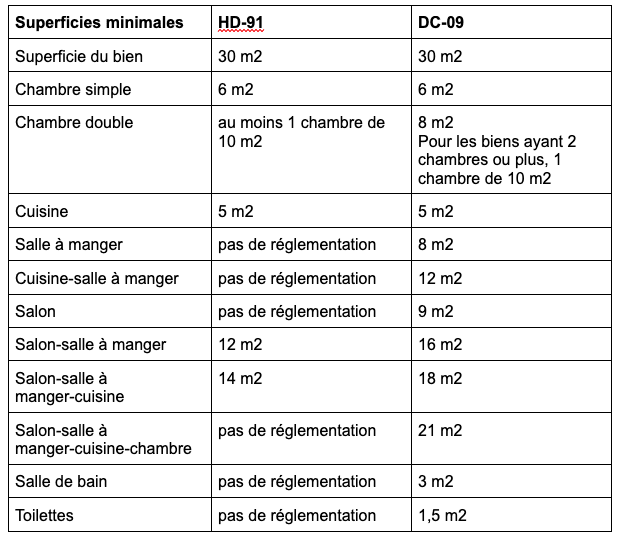
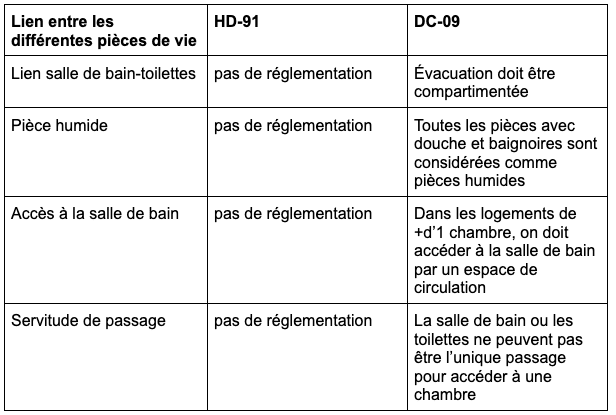
- HD-91: for homes built before 2009. This standard only applies to second occupation licences;
- DC-09: for homes built after 2009. This standard applies to all types of licence: first occupation licence, first occupation licence after renovation work and second occupation licence.
In the Valencian Community, these rules set precise requirements for ceiling height, ventilation, natural light and minimum room sizes.
For example:
- homes built before 2009 must have a minimum ceiling height of 2.4 m;
- homes built after 2009 must have a minimum ceiling height of 2.5 m;
- the bathroom, kitchen and corridors cannot have a ceiling height below 2.2 m;
- ventilation is compulsory in the bathroom;
- 30% of the floor area of the home must get natural light, not counting outdoor spaces;
- natural lighting is compulsory in the living room.
The rules cover more than dimensions. They also govern how the living spaces relate to each other: circulation, layout, access to the rooms, the actual use of the home and consistency between floor areas and the purpose of each room. That is why an architect is the best-placed professional to carry out the necessary checks before applying for a Cédula de habitabilidad. They do not just look at whether the home seems habitable: they check whether it meets the technical criteria that actually apply. For information, the expert will pay particular attention to minimum floor areas, ceiling heights, ventilation, natural light, bathroom facilities, access, the internal layout and the overall compliance of the home.
Maria Grifo also gives some very practical advice: “If you buy a property that needs work and the home is already connected to electricity and water, it is better to wait until the work is finished before applying for your Cédula.”
This advice is particularly useful for properties that need renovating. If the layout changes, a room is created or a bathroom is moved, the cédula application should ideally cover the final state of the home.
Here is an example of the minimum floor areas required for each living space, which the architect will check during the visit.
Here are also a few examples of the points the expert will look at when inspecting the home.
One last piece of advice from Maria Grifo: “If you buy a property that needs work and the home is already connected to electricity and water, it is better to wait until the work is finished before applying for your Cédula.”
Photo credit: Piano-piano studio
A 30 m² flat renovated by Piano piano studio to meet the Cédula de habitabilidad criteria
How do you get a Cédula de habitabilidad in Spain?
To obtain a Cédula de habitabilidad, you need to have the home checked by a qualified professional, prepare a technical file and then submit the application to the relevant authority. The exact procedure varies by autonomous community, but the principle is the same: proving that the property meets the minimum habitability conditions.
This procedure can apply to several situations: a first application, a renewal, an expired cédula, a request for a duplicate or a renovated home whose compliance must be checked. In all cases, it is best to deal with this step before signing, especially if the property is old, altered or intended for rental.
The technical check by an architect
The first step is usually to bring in an architect, a technical architect or another qualified technician. This professional visits the home and checks the criteria needed to obtain the cédula: floor area, ceiling height, ventilation, natural light, room layout, kitchen, bathroom, utility connections, safety and the general condition of the property.
Their role is essential: this is far from a courtesy visit. The architect checks whether the home really meets the standards that apply in the region. If the property has been renovated, divided, extended or converted, they also check that its actual state is consistent with the official documents.
After the visit, the professional can issue a technical certificate or list the points to fix before the application is submitted. If work is needed, it is better to wait until it is finished before applying for the cédula, so that the document reflects the final state of the home.
The paperwork to plan for
Once the technical check is done, you need to put together the application file. The exact documents vary by autonomous community, but the file generally includes:
- the technical certificate issued by the architect or qualified technician;
- the identification of the home;
- the contact details of the owner or applicant;
- the administrative documents requested by the region or the town hall;
- payment of the relevant fees.
The application can then be submitted to the competent authority: the autonomous community, the town hall, the housing agency or a dedicated regional department. In some regions, it can be done online; in others, it must be filed locally or through the professional.
If you are buying remotely or are not yet resident in Spain, you can also appoint a professional to represent you. In that case, a power of attorney can be useful. See our guide on how to give power of attorney at a notary in Spain.
How long is a Cédula de habitabilidad valid?
On this point, Maria Grifo warns: “Be careful, the Cédula de habitabilidad is valid for 10 years! If you are buying an older home, the document held by the current owner has probably expired. You will then need to apply for a new one”. (The validity period may vary by region.)
In some regions, the cédula can be valid for several years, or even several decades, depending on the type of document. In others, the rules have changed over time. That is why you should always check the date of issue, the expiry date and the authority that issued the document.
Before buying, ask three simple questions:
- is the cédula still valid?
- does it match the home as it is being sold today?
- will it be enough to connect the meters, rent out or resell the property?
An expired cédula does not necessarily mean the property cannot be sold. However, it may mean a new technical check, costs, delays and sometimes work to bring the home up to standard.
How long does it take to get a cédula?
Timeframes vary depending on the region, the authority's workload and how complex the file is. The time needed also depends on the state of the home: a compliant, well-documented property will move faster than a renovated or older one, or one whose administrative situation is unclear.
You should generally allow for two separate stages: first the architect's visit and certificate, then the processing of the file by the authorities. If corrections are needed, it can take longer.
For a buyer, the right move is not to wait until the day before signing. The cédula should be among the documents checked from the reservation stage, like the nota simple, the cadastral information or the community fees. To see where this step fits in the buying process, read our guide on how to reserve a property in Spain.
What if the property has no cédula?
If the property has no cédula, there is no need to panic, but do not play the issue down either. The first step is to understand why the document is missing: a lost cédula, an expired one, one that was never applied for, one that is not compulsory in the region, or one that cannot be obtained as things stand.
In some cases, a missing cédula can be normal because the region uses an equivalent document. In others, it can point to a real problem: a home converted without permission, a non-compliant floor area, poor ventilation, work that was never legalised or contracts that cannot be opened.
Before signing, ask for a clear analysis of the situation. A lawyer can check the legal risks, while an architect can confirm whether the home can obtain the cédula after an inspection or some work. Our guide on thelawyer's role in a Spanish property purchase can help you understand this role in securing the transaction.
Thomas Rouer is the founder of Alveo Search and the CEO of the Alveo group. Based in Spain for almost ten years, he develops property services designed for the specific needs of foreign buyers.
His expertise covers every aspect of buying property in Spain: understanding the market, searching for and selecting properties, negotiation, financing, paperwork, tax and securing the purchase process.
FAQ on the Cédula de habitabilidad
What is the Cédula de habitabilidad?
The Cédula de habitabilidad is a certificate showing that a home meets the minimum conditions to be lived in. It may be required to sell, rent, connect certain meters or check that a property complies with the rules.
Is the Cédula de habitabilidad required everywhere in Spain?
No. It depends on the autonomous community. Some regions still require it, such as Catalonia or the Balearic Islands, while others have replaced it with an occupancy licence or an equivalent document.
Who inspects the home to obtain the Cédula?
The check is usually carried out by an architect, a technical architect or another qualified professional. They check the habitability criteria: floor area, ceiling height, ventilation, natural light, equipment, safety and the layout of the home.
How long is a Cédula de habitabilidad valid?
The validity period varies by region, type of cédula and date of issue. Before buying, always check that the cédula is still valid and that it matches the current state of the home.
Can you buy a property without a Cédula de habitabilidad?
Yes, in some cases, but this needs to be checked carefully. A missing cédula can be normal in some regions, but it can also make it harder to connect the meters, rent out or resell, or reveal a compliance problem with the home.

Our resources for buying in Spain