Français
 English
Living in Marbella: budget, neighbourhoods and property

- Housing budget: average rent is €19.7/m² (May 2026, Idealista), or about €1,575 a month for 80 m² and €2,360 for 120 m². Allow €1,500 to €2,200 for a couple and €2,300 to €3,500 for a family in sought-after areas.
- Purchase prices: €5,581/m² on average, up 8.1% in a year. The average sale price is €711,138 across the municipality, against a national average of €210,361, and €1,085,457 on the Golden Mile.
- Neighbourhoods: the centre for year-round living, Puerto Banús for nightlife, Nueva Andalucía for families close to international schools and golf courses, the Golden Mile for prestige properties.
- Daily life: Málaga airport nearby, city buses at €1.18 (free for eligible residents), a full range of healthcare and several international schools, whose fees can reach several thousand euros a year per child.
- Key point: Marbella is more than a holiday town, but housing takes a big share of the budget. The neighbourhood you choose changes everything, from costs to lifestyle.
Marbella is one of those Spanish towns that instantly bring to mind sun, sea, villas with views, elegant restaurants and a certain idea of the easy Mediterranean life. But behind this very upmarket image, Marbella is also a place where you can live all year round, work, send your children to school, prepare for retirement or buy property on the Costa del Sol.
So the question is simple: is living in Marbella really a good idea in 2026? To answer it, you have to look past the clichés. Marbella is a holiday destination and a luxury town, but also a property market in high demand: a large municipality made up of very different neighbourhoods, with real advantages and some constraints to plan for.
Budget, neighbourhoods, property, quality of life, daily life: here is what you need to know before settling in Marbella. And if you are still hesitating between several areas in southern Spain, you can also read our guide to living on the Costa del Sol.
Marbella, a town apart on the Costa del Sol
Marbella is in Andalusia, in the province of Málaga, at the heart of the Costa del Sol. The town enjoys a mild climate almost all year round, a pleasant coastline, a strong international presence and one of the most sought-after property markets in Spain.
Unlike Málaga, a large city with a dense urban centre, Marbella offers a more residential experience, focused on the seafront, private estates, golf courses and villas. This is precisely what attracts some foreign buyers: the chance to live in a calmer, more exclusive setting while staying close to Málaga airport and the facilities of the Costa del Sol.
Marbella attracts families, retirees, entrepreneurs, investors and remote workers in particular. The town is also popular for its international community, private schools, high-end services and its ability to function all year round, even if some areas remain more seasonal than others.
More broadly, Marbella benefits from the appeal of Andalusia, a region very popular with foreigners moving to Spain for the climate, a gentler pace of life and an outdoor lifestyle.
But Marbella does not suit every profile. If you are looking for a cheap, very local Spanish town where you can live without a car, it is probably not the best choice. If, on the other hand, you want a sunny, safe, international and high-quality setting, Marbella is clearly worth considering.
Quality of life in Marbella: the real advantages
Quality of life is Marbella's main selling point. The town combines several rare assets: climate, sea, nature, services, safety, food, sport, an international community and a major airport nearby.
The climate makes it possible to enjoy outdoor activities all year round. Beach, walking, golf, padel, cycling, water sports, hiking in the hills: daily life in Marbella is very much lived outdoors. This weighs heavily in the decision of many expats.
The town also has a very wide choice of restaurants and leisure activities. From simple places to upmarket addresses, Marbella has a varied food scene. To find out more, see our selection of good restaurants in Marbella.
Another advantage: Marbella is international. If you do not yet speak fluent Spanish, this can be reassuring. You will find professionals used to working with foreigners, services adapted to them, international schools and an established expat community.
Finally, the location is practical. Málaga airport makes it easy to reach the UK and the rest of Europe. Málaga, Estepona, Benahavís, Ronda and Gibraltar are all within easy reach for day trips or errands.
Infrastructure in Marbella: airport, transport, healthcare and schools
Living in Marbella means more than choosing a sunny seaside town. It also means settling in a well-connected destination, with solid healthcare, international schools and quick access to the rest of Europe. This is one of Marbella's great strengths compared with more isolated coastal towns.
Málaga airport, the main gateway to Marbella
Marbella does not have its own commercial airport. The town relies mainly on Málaga-Costa del Sol airport, about 50 kilometres away. By car, allow 40 to 50 minutes to reach Marbella from the airport, depending on traffic and where you are going.
This airport is one of the busiest in Spain. According to the 2026 market report by Panorama Marbella, it handled 24.9 million passengers in 2024, with 174,915 flights and 155 direct destinations. This accessibility is a real advantage if you want to travel back and forth regularly, have family visit or keep working between your home country and Spain.
Málaga airport serves many European cities, including London, Dublin, Amsterdam, Brussels, Geneva, Paris, Lyon and Marseille, depending on the season and the airline. For a second home or an active retirement, this proximity is an important argument.
Bus, car and train: how do you get around Marbella?
A car remains the most practical way to live in Marbella day to day. The town is spread out, with several residential areas sometimes far from the centre: Nueva Andalucía, East Marbella, San Pedro de Alcántara, the Golden Mile or the areas near the golf courses. For shopping, school runs, getting to the airport or exploring the surroundings, a car is often essential.
There are, however, public transport options. Marbella's city bus network is run by Avanza. According to the fares shown by Urbanos de Marbella / Avanza, the single ticket costs €1.18, while the Tarjeta Municipal de Movilidad lets eligible residents use the city buses for free. The card is available to people registered on the padrón, that is, officially registered as residents of Marbella.
To get to Málaga airport without a car, Avanza also runs a bus between the airport and Marbella. The fare shown by Avanza Málaga starts at €6.33 from Málaga Airport to Marbella, and at €7.49 from Málaga Airport to San Pedro. The journey usually takes around 40 to 60 minutes depending on traffic and the type of service.
However, Marbella has no railway station. The C-1 Cercanías line links Málaga, the airport and Fuengirola, but does not go as far as Marbella. The most useful station for regional trains is therefore Fuengirola, while Málaga María Zambrano station has AVE high-speed trains to Madrid, Cordoba, Seville and other major Spanish cities. For a Marbella resident, this means the train is handy for long distances but rarely enough for everyday travel.
Hospitals and healthcare: reassuring medical provision
Solid medical facilities are essential for families, retirees and expats. Marbella has well-developed public and private healthcare.
The main public hospital is the Hospital Universitario Costa del Sol, on the A-7 east of Marbella. It serves a large part of the western Costa del Sol, including Marbella, Estepona, Mijas, Fuengirola, Benahavís, Manilva and Ojén. In 2026, its extension was opened after a major investment, with new medical areas, more capacity and upgraded equipment.
In the private sector, several hospitals are well known to international residents. Hospital Quirónsalud Marbella, on Avenida Severo Ochoa, offers a wide range of medical specialities and care adapted to international patients. HC Marbella International Hospital, near Puerto Banús, is also very focused on foreign patients, with multilingual communication and strong medical specialisation.
Expats should check their health cover in advance: the European Health Insurance Card (or the UK GHIC) for temporary stays, registration with the Spanish public system if you become resident and are entitled to it, or private insurance for faster access to some specialists.
International schools in Marbella
Marbella is particularly attractive for international families thanks to its private and international schools. Several schools follow a British, bilingual or international curriculum, often with preparation for IGCSEs, A-levels or the International Baccalaureate.
Among the best-known schools is Aloha College Marbella, in Nueva Andalucía. It is a popular choice for families living in Nueva Andalucía, Puerto Banús, the Golden Mile or Benahavís. It takes children aged 3 to 18 and offers an international curriculum with a strong English-language focus.
Swans International School is another leading school in Marbella, with classes from Foundation Stage to Sixth Form. Its location suits families living near Sierra Blanca, the Golden Mile or central Marbella.
East of Marbella, The English International College also takes pupils aged 3 to 18 and follows the British curriculum in an international environment. For families living around Elviria, Las Chapas or East Marbella, this school can be particularly convenient.
Finally, in San Pedro de Alcántara, Laude San Pedro International College is an important option for families living in San Pedro, Guadalmina, Nueva Alcántara, Benahavís or East Estepona. The school combines an international environment with a bilingual English-Spanish approach.
The choice of school can strongly influence the choice of neighbourhood. A family with children at Aloha College will not have the same commute as one aiming for Laude San Pedro or The English International College. Before buying or renting, it is wise to check journey times at school drop-off and pick-up times.
Living and working in Marbella: sectors that are hiring and major employers in the area
Marbella is more than a town for retirees and second homes. It also attracts working people, entrepreneurs, multilingual profiles and remote workers. The local job market is mainly service-based, but there are real opportunities in luxury hospitality, property, private healthcare, international education and, more broadly, in Málaga's tech ecosystem.
In Marbella itself, the biggest employers are often in upmarket hospitality. The Puente Romano Marbella, one of the best-known resorts on the Costa del Sol, regularly advertises jobs in catering, accommodation, sales, marketing, events and sport. According to Cadena SER, it even plans a team of about 1,900 staff for summer 2026, making it one of the largest hotel employers in the province of Málaga. The Marbella Club Hotel, the Nobu Hotel Marbella and the Marriott group's hotels around Marbella also offer opportunities in hospitality, customer relations, concierge services, catering and operations management.
Property is another very active sector. As the Marbella market is driven by international buyers, agencies regularly recruit sales, marketing, administrative and multilingual staff.
Private healthcare is also a major employer, especially for medical, paramedical, administrative and international patient roles. Hospitals such as Hospital Quirónsalud Marbella, HC Marbella International Hospital or Recoletas Salud Marbella serve local and foreign patients and need multilingual staff.
For expat families, international education is another sector to look at. Schools such as Aloha College Marbella, Swans International School, The English International College or Laude San Pedro International College can offer opportunities in teaching, school administration, admissions, communications and family services.
Finally, for tech, sales or corporate profiles, look beyond Marbella towards Málaga. The Málaga TechPark is home to several hundred companies and is one of the main technology hubs in southern Europe. The Spanish press reported in 2026 that the park had about 29,000 employees and more than 700 companies. Groups such as Google, Vodafone, Oracle, Accenture, Capgemini, Ericsson, IBM, Huawei, EY, NTT Data, Globant and Citi are based there or have grown there. From Marbella, the commute to Málaga or the TechPark can be long at rush hour, but the area greatly widens job opportunities for qualified profiles.
In practice, Marbella particularly suits people working in international services, luxury, property, healthcare, education, premium tourism or digital. For a classic salaried job search, Málaga offers a wider market. But for a multilingual, sales, hospitality, medical, teaching, freelance or remote profile, Marbella can offer an interesting working environment, especially if you target an international clientele.
What budget do you need to live in Marbella?
The budget needed to live in Marbella depends mainly on three things: the neighbourhood, the type of home and your lifestyle. Marbella is not the cheapest town in Spain, and housing weighs heavily on the monthly budget, especially for a family.
According to Idealista data, the average rent in Marbella was €19.7/m² in May 2026, up 2.8% year on year. By way of comparison, an 80 m² flat therefore costs around €1,575 a month, a 100 m² home around €1,970, and a 120 m² family flat around €2,360. These averages are a useful starting point, but they hide big differences depending on the neighbourhood, proximity to the sea, the condition of the property and whether it has a pool, parking or is in a gated community. Source: Idealista, rental prices in Marbella.
For a couple without children, a two-bedroom flat can be found for around €1,500 to €2,200 a month depending on the area. In central Marbella or East Marbella, you can still find homes around these levels, but well-located, renovated or beachside homes quickly cost more. On Idealista, some two-bedroom flats in Marbella are listed, for example, at around €1,400 to €1,900, but many are offered as short-term or off-season rentals, which makes it harder to find a genuine long-term lease.
For a family with two children, the housing budget is higher. A three-bedroom flat suitable for year-round living often costs between €2,300 and €3,500 a month in sought-after areas. In Nueva Andalucía, for example, family flats can easily exceed €3,000 a month, especially near international schools, golf courses or Puerto Banús. In San Pedro de Alcántara or parts of East Marbella, the size-to-price ratio can be a little more balanced, but demand remains strong.
On top of housing, add everyday expenses. For a family of four, it is reasonable to budget around €700 to €1,000 a month for groceries, depending on eating habits, the supermarkets you use and how many imported products you buy. Eating out can quickly push the budget up: Marbella has many affordable restaurants, but also plenty of upmarket places, especially around Puerto Banús, the Golden Mile and the luxury resorts. To discover the town's food scene, see our selection of restaurants in Marbella.
Transport remains fairly affordable if you use the bus. A single city bus ticket costs €1.18, and residents registered on the padrón can apply for the Tarjeta Municipal de Movilidad, which gives free use of Marbella's city buses. In practice, though, a car is often necessary, especially with children. So budget for insurance, fuel, maintenance, any parking and tolls if you regularly use the AP-7.
Schooling can also change the budget completely. Spanish state schools are open to residents, but many expat families choose an international school. In that case, plan for a significant budget: depending on the school and the child's age, fees can amount to several thousand euros a year per child. Aloha College, Swans International School, The English International College and Laude San Pedro International College are among the best-known schools in the area, but exact fees should be checked directly with each school.
The best areas to live in Marbella
Choosing your neighbourhood is one of the most important decisions before moving to Marbella. The town is more than its centre or Puerto Banús. Each area corresponds to a different way of life.
Central Marbella
Central Marbella is convenient for those who want to live close to shops, restaurants, the beach and the old town. It is one of the most pleasant areas to live without constantly depending on a car.
It has a more Spanish feel than some very international areas. The centre lets you enjoy everyday life: cafés, walks, services, the market, local shops. It is a good option for people who want to live in Marbella all year round without being isolated on a residential estate.
On the other hand, well-located properties can be expensive, especially near the sea or in the most central areas. Parking can also be harder than on the outskirts.
Puerto Banús
Puerto Banús is one of the best-known places in Marbella. Marina, yachts, luxury boutiques, restaurants, nightlife: the area embodies the town's glamorous image.
For year-round living, Puerto Banús can suit some profiles, especially those who like a lively atmosphere, being close to the sea and an international feel. But it is not necessarily the best choice for a family looking for peace and quiet or for someone who wants a more local life.
Prices are high, the atmosphere can be very touristy, and the summer season changes the pace of the area considerably. Puerto Banús should therefore be considered with care: perfect for some projects, less suited to others.
Nueva Andalucía
Nueva Andalucía is one of the areas most popular with international residents. North of Puerto Banús, this residential area is known for its villas, upmarket flats, golf courses and calm atmosphere.
It is particularly interesting for families, golfers and buyers looking for a prestigious address. Nueva Andalucía lets you stay close to Puerto Banús without being in the middle of its bustle.
The area attracts international buyers and enjoys strong property demand. It can suit a main home, a second home or a long-term investment. On the downside, prices are high and a car is almost essential.
The Golden Mile
The Golden Mile (Milla de Oro) links central Marbella to Puerto Banús. It is one of the most prestigious addresses in Spain, with luxury villas, upmarket residences, iconic hotels and the sea right on the doorstep.
Living on the Golden Mile means choosing the most exclusive side of Marbella. The setting is exceptional, and so are the prices. This area is mainly for buyers with a high budget looking for a rare, very well-located property with strong long-term value.
For an ordinary move, it is not always the most rational choice. For a prestige purchase, however, it is one of the most sought-after areas.
San Pedro de Alcántara
San Pedro de Alcántara is often an excellent alternative for living in Marbella with a more family-friendly and local feel. West of Marbella, this area offers a quieter daily life, shops, schools, restaurants and a less showy atmosphere than Puerto Banús or the Golden Mile.
San Pedro appeals to families and residents who want to enjoy Marbella without being in the heart of its most luxurious part. Prices can remain more affordable than in the ultra-prime areas, even if demand is rising there too.
It is an area to consider seriously for year-round living, especially if you are looking for a balance between services, quality of life, proximity to the sea and a more residential atmosphere.
East Marbella
East Marbella includes several residential areas popular for their calm, their beaches and their more open setting. You will find residential estates, villas, flats near the sea and a quieter atmosphere than in the centre or Puerto Banús.
This area can suit families, retirees or people looking for a more peaceful residential environment. Check carefully how close shops, schools and services are before buying or renting, though, as some areas depend more on a car.
Property in Marbella: prices, market trends and advice before buying
The Marbella property market remains one of the most dynamic in Spain in 2026. The town benefits from strong international demand, limited supply in the best areas and a very upmarket position on the Costa del Sol. This explains why Marbella stands out so clearly from other Andalusian cities, including Málaga, which is already very attractive. To compare the two, our guide to living in Málaga helps you understand the differences in lifestyle and market.
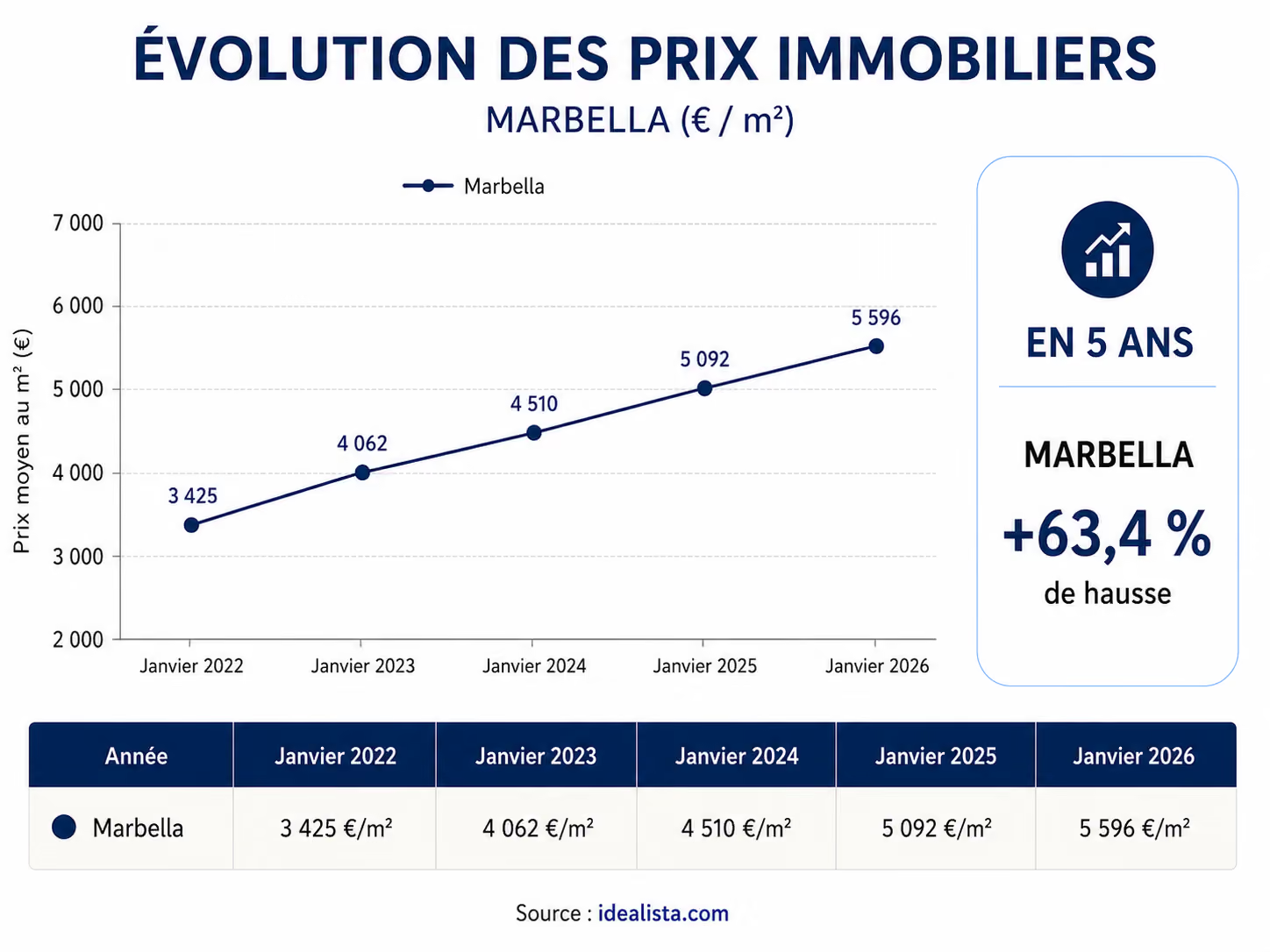
According to Idealista data, the average sale price in Marbella reached €5,581/m² in May 2026, up 8.1% in one year compared with May 2025.
This trend shows that Marbella is no longer just a second-home market. It is also a long-term wealth market, driven by buyers looking for a rare location, solid property value and an international lifestyle. The town is fully part of the momentum of the luxury property market in Spain, where areas such as Marbella, Ibiza, Madrid and Mallorca attract strong international demand.
Average prices should be read with caution, though. In Marbella, the price per square metre varies enormously between neighbourhoods and types of property. A villa on the Golden Mile, a flat in Puerto Banús, a family house in San Pedro de Alcántara or a home in East Marbella do not require the same budget. The Panorama Marbella 2026 market report points out, for example, that some very high-end new villas can far exceed the municipal averages, especially in the luxury segment.
Buying in Marbella can therefore make sense if your project is clear: main home, second home, long-term investment, retirement plans or a purchase in a prime area. On the other hand, this is not a market in which to buy in a hurry. At this price level, the location, the legal status of the property, the condition of the development, community fees, orientation, access to services and resale potential must be analysed seriously.
Renting before buying can be a good strategy, especially if you only know Marbella from holidays. It lets you test the town out of season, compare neighbourhoods and check whether daily life really matches your expectations. Some areas that are very pleasant in summer can be much quieter in winter, while others have real year-round life.
Before buying, also take into account the rules on holiday lets. If you plan to let the property for part of the year, find out about local regulations, the permits required and any restrictions set by the community of owners. Marbella attracts many investors, but not every property is suited to a letting strategy.
For a property purchase in Marbella, finding a beautiful home is only part of the job. You need to buy in the right place, at the right price, with a realistic view of the market. Marbella remains a very attractive destination, but its price level calls for rigorous analysis before signing.
Marbella, a luxury destination gone international
Marbella is no longer just a chic seaside resort on the Costa del Sol. For several years, the town has established itself as a luxury residential destination on a European scale, alongside parts of the Balearic Islands, the French Riviera, Miami or Dubai.
This trend is also visible in tourism. An analysis by CaixaBank Research on international luxury tourism in Spain notes that Marbella is consolidating its position as a destination highly specialised in this segment within the province of Málaga. In other words, the town attracts visitors who come not only for holidays, but also to spend, invest, stay for long periods and sometimes settle.
This move upmarket explains why Marbella continues to attract buyers with large budgets. The average age of buyers in Marbella was 52 in 2025, with 54% of buyers aged 41 to 60. 63.14% of buyers were foreign, which confirms the weight of international demand in setting prices.
Another interesting figure: the actual average sale price across the whole municipality of Marbella reached €711,138, against €210,361 for the Spanish national average. On the Golden Mile, the average price rose to €1,085,457. These figures do not replace Idealista's per-square-metre data, but they show the reality of the market: Marbella attracts buyers who buy bigger, more expensive homes, often as a long-term investment.
Branded residences: the new showcase of luxury in Marbella
One of the big trends in Marbella's luxury property market is the growth of branded residences: developments linked to luxury brands, hotel groups or design houses, which offer an upmarket home together with services, a brand identity and a complete residential experience.
Four Seasons Resort & Private Residences Marbella, Design Hills Marbella by Dolce&Gabbana, EPIC Marbella by Fendi Casa, Villas Karl Lagerfeld, Villas Versace in Nueva Andalucía, as well as projects linked to Elie Saab, Missoni or Lamborghini in the Marbella, Estepona and Benahavís triangle, are examples of this trend.
This trend is changing how the market is perceived. Buyers are no longer looking only for a villa with a sea view or a well-located flat. They also want services: security, concierge, wellness, design, rental management, premium facilities, shared spaces and signature architecture. This is an important change, as it brings Marbella closer to international standards of luxury living.
For a foreign buyer, this can be an opportunity, but also a point to watch. Branded residences can offer a high level of service and easy resale, but they also mean higher purchase prices, high community fees and dependence on the reputation of the brand behind the project.
A market driven by lifestyle more than speculation
Historically, many buyers came to Marbella to buy a holiday home. Today, the logic is changing: more and more buyers want a home they can use for long periods, or even as their main home.
This trend is reinforced by remote working, the search for a better work-life balance, the climate, safety, international schools, private healthcare and the connection with Málaga airport. Marbella therefore sells a lifestyle as much as a home. This explains the strength of the market despite high prices.
Marbella or Málaga: which to choose for living on the Costa del Sol?
Marbella and Málaga meet two different needs.
- Málaga is more urban, more cultural, better served by public transport and often more practical for those who like city life. It has a lively historic centre, a railway station, a nearby airport, museums, universities and a more distinctly Spanish atmosphere.
- Marbella, for its part, focuses more on a premium lifestyle, residential neighbourhoods, proximity to the sea, golf courses, international services and a more exclusive atmosphere. It is better suited to people looking for space, calm, an upmarket environment or a quality second home.
For a working person without a car, Málaga will often be more practical. For an international family, a retiree or a buyer looking for a prestige property on the Costa del Sol, Marbella may be more appealing. To compare the main coastal destinations more broadly, you can also read our article Costa del Sol or Costa Blanca: which one to choose.
The best choice therefore depends on your project: city life, investing, buying a villa, preparing for retirement, letting in season or moving with children.
Should you live in Marbella in 2026? Our view
Living in Marbella in 2026 can be an excellent choice if you are looking for a sunny, international, comfortable lifestyle by the sea. The town offers a quality of life that is rare in Europe, with a solid property market, strong international appeal and a wide variety of neighbourhoods.
Marbella particularly suits people with a comfortable budget who want to settle on the Costa del Sol, appreciate international services and want to buy property in a sought-after area.
However, Marbella requires real preparation. You need to choose your neighbourhood carefully, understand the property market, anticipate costs, check legal constraints and not confuse holidays with a lasting move.
To make your project a success, start by clarifying your goal: living there all year round, buying a second home, investing, letting part of the year or preparing for retirement. Then compare neighbourhoods, visit out of season and get support to avoid the classic mistakes of buying property in Spain.
Marbella is not the cheapest town in Spain. But for those looking for a combination of climate, sea, comfort, safety, quality property and international life, it remains one of the most attractive destinations on the Costa del Sol.
Anthony Lerouge is head of the Benalmádena office of Alveo Search (Alveo group), in the province of Málaga. Based in Spain since 2010, he supports international buyers on the Costa del Sol. With a background in banking, brokerage and property, he shares his advice on choosing an area, assessing a property and preparing a purchase.


Our resources for buying in Spain