Français
 English
Spanish property portals: how to use Idealista, Fotocasa and others

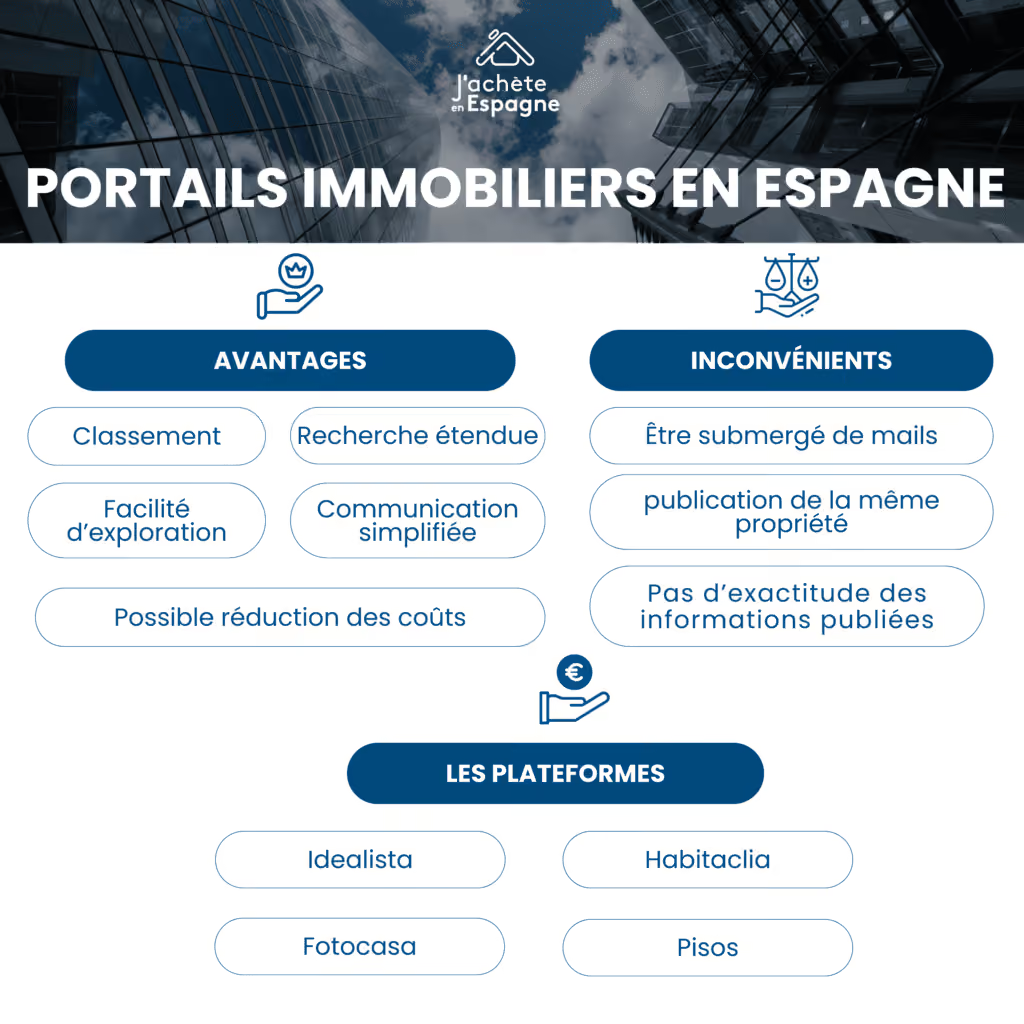
- Usage: according to a Capterra study cited in the article, 54% of people looking to buy a home use property portals as their main search tool. These sites are funded by advertising and by monthly fees paid by agencies and developers.
- The main portals: Idealista, the leader with 20 years' experience and around 14.8 million visitors a month, is available in English. Fotocasa, created in 1999 by Adevinta, has around 2.7 million visits a month. Habitaclia, with 1.3 million visits a month, is the go-to site in Catalonia and the Balearic Islands. Pisos.com, created in 2009 by the Vocento group, reaches a million users and leads in the Basque Country.
- Second tier: Milanuncios has 10 million visits a month across all categories, Green Acres around 15,500 users and Vibbo 70,000 visits.
- Risks: fake listings, wrong floor areas or addresses, properties without a cédula de habitabilidad, homes with debts attached and illegal buildings; nobody checks what is published.
- Key point: compare market prices, run a reverse image search on the photos, check the location, ask for a nota simple and never pay before seeing the property.
With its sunny climate, beautiful beaches and good rental yields, Spain attracts many potential international buyers. As we said in our latest report, “Spanish property news, first half of 2023”, experts expected them to buy 14.5% of the properties available in 2023.
In this booming market, property portals play a key role in helping buyers find their dream home.
This article has two aims: to look at the most popular sites in Spain and to give you valuable tips for finding your way around online property while avoiding scams, of which there are many.
Background: the rise of property portals in Spain and how they work
The rise of property portals in Spain and technological progress
Technology has deeply transformed the property sector, in Europe and around the world. Online portals began to appear in Europe in the 1990s. They quickly became popular by offering an efficient, convenient way to connect buyers, sellers (professional or private) and tenants, while providing detailed information on properties, neighbourhoods and sometimes the market itself. In recent years, they have become an essential tool for everyone in this market.
Search filters, interactive maps, videos, smartphones and mobile apps have strengthened this trend even further.
The change is now structural. According to a recent study and a fascinating article by the technology company Capterra, 54% of people looking to buy a home use property portals as their main search tool, a little over 5 in 10.
Next come online estate agents, high-street estate agents and general e-commerce platforms, in roughly equal proportions.
How do these property websites work?
Let's take a quick look at how online property portals work in Spain.
Behind the scenes, these sites are mainly funded by advertising and by agencies and developers who pay monthly fees to be listed. Some also charge private sellers to publish listings.
Good to know: reputable platforms all follow the rules on transparency, security and privacy, and protect their users' data.
If you want to buy property in Spain safely, contact us, that is our speciality. Our English-speaking team of experts works across Spain and can guide you from start to finish. You will avoid many disappointments and save valuable time.

Key features of property portals
Benefits for buyers
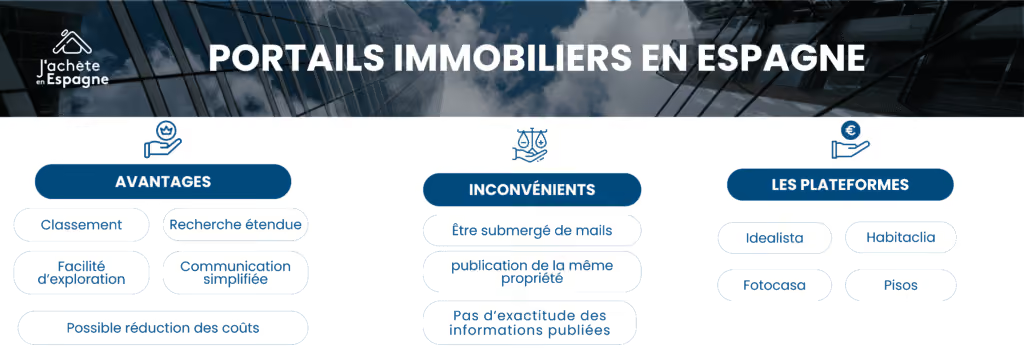
- Easy browsing and access to information: today, most portals are designed to be easy and efficient to use. Buyers can filter their search (by location, price, features) and explore options from their computer, tablet or phone. In a few clicks, they can see descriptions, photos, floor plans and sometimes even video tours or detailed data on neighbourhoods.
- Wide search: property portals let users search several regions of Spain, so they can compare prices and features remotely in a few minutes.
- Ranking: listings are generally ranked by relevance and quality. Complete, accurate listings appear first, which is good for buyers.
- Easier communication: potential buyers can easily reach the seller, private or professional, usually directly through the site, to ask questions or arrange a viewing.
- Possible cost savings: if buyers manage to complete their purchase on their own without problems, property portals can be a cheaper alternative to traditional estate agencies. We want to draw your attention to this point: we strongly advise against handling your property purchase in Spain on your own, for many reasons we will come back to below.
Benefits for sellers
We won't dwell on the benefits for sellers, but it is worth remembering that these platforms:
- Make it easier to interact with buyers. Some professionals may abuse this.
- Give listings more visibility and a wider geographical reach. They can reach a larger audience than traditional marketing methods, which makes selling much easier. A listing for a property in a small village in Andalusia can now reach a potential buyer living in London, Amsterdam or a small village in Germany, for example.
- Let sellers target a specific audience: these portals can also reach specific buyers, people who really want a particular kind of property, in a particular village, with particular features. This can greatly simplify the sale.
- Let sellers customise their listings: sellers can tailor listings to their needs and edit them easily. Professionals can promote several properties at once very easily, and private sellers can fix mistakes.
Drawbacks of property portals
There are concerns about how effective these pure players (in other words, businesses that operate only online) in property really are. Here are some of their pitfalls:
- Because competition is strong, several agencies may list the same property, which can be frustrating for buyers who keep seeing the same listing on screen or in their inbox, with different prices, descriptions and photos.
- If you ask to be notified when a property matches your criteria, you risk being flooded with emails or push notifications on your phone.
- Nobody checks that the information published is accurate.
If you would like to invest in Madrid, buy a seaside house in Malaga or a flat with a high rental yield in Alicante, book an appointment online with our specialists on the ground. This first meeting is free and with no obligation.
There are a great many property portals in Spain.
Before we look at the traps and scams to avoid at all costs on these websites, let's review the main sites.
The main property platforms in Spain
Note: most property portals in Spain offer an all-in-one listing service: they mix listings from private sellers and professionals, resale homes and new builds, so it can be hard to find your way around.
Idealista
Idealista.com is the undisputed leader among property portals in Spain. It has 20 years of experience and is used in southern Europe: Spain, Italy and Portugal. But it is especially popular in Picasso's homeland. Every month, it attracts around 14.8 million visitors.
Thanks to large-scale, multilingual advertising campaigns on TV, in airports and along motorways, Idealista is well known among foreign buyers.
For buyers, it lets you search for properties to buy, to rent and even to share. The site is also available in English.
The portal is very comprehensive and offers various features to make searching easier, including advanced search filters, interactive maps and simulation tools. There is also a mobile app, which says a lot about the portal's strength and makes it easy to use.
Besides publishing listings, Idealista positions itself as a property expert by providing information and analysis on the property market at national and local level, helping users make informed decisions. Idealista also lets professionals advertise, manage their clients with a customer relationship management (CRM) tool and even take training courses.
Fotocasa
Fotocasa.es is a portal owned by Adevinta. It was created in 1999 and operates in nine countries in Europe and Latin America. With around 2.7 million visits a month, it is the second-largest online-only property site in Spain. It lists properties to buy and to rent.
It has become a major player in online property and is gaining authority by regularly publishing accurate studies on the sector. As with Idealista, this inspires confidence.
Fotocasa is a very popular platform, notably because it offers a range of services for sellers (valuations, selling tips, etc.) and for buyers, who can estimate their buying costs, search by neighbourhood and, more recently, by commute time.
Fotocasa has a mobile app for even more convenience.
Habitaclia
With 1.3 million visits a month, Habitaclia.com holds its own. While it is fairly well known in Spain, it is much less known abroad, and it is more regional than Idealista. Habitaclia is the go-to site for property in Catalonia and the Balearic Islands, but it has very few properties for sale in the rest of Spain. It belongs to Fotocasa. A subsidiary of the Schibsted Spain group (a digital media company), this portal also offers various advertising options for property professionals. There is a Habitaclia mobile app.
Pisos
A million users visit Pisos.com every month. The site was created in 2009 and belongs to Vocento, one of Spain's most powerful media groups. The platform regularly publishes new listings and analyses of the Spanish property market.
Pisos stands out for being user-friendly and intuitive. It also offers a variety of search filters, personalised alerts and an app to make buyers' searches even easier.
Property professionals also get support from Pisos, though less advanced than on Idealista.
Pisos.com is the leader in the Spanish Basque Country.
These audience figures change over time, so treat them as an order of magnitude rather than an exact count.
To get your property project in Spain started, contact us, it is what we do.
Less popular Spanish property portals
In the second tier, there are the following portals:
- Milanuncios is a site that stands apart from the rest. It records 10 million visits a month because it covers far more than property. It is a kind of Spanish Gumtree or Craigslist that offers free classified ads in a wide range of categories: property, of course, but also vehicles, jobs, furniture and home decor, services and more. The marketplace is organised by region, so it is a truly local platform that connects buyers and sellers. Some professionals use it to post listings, but that is not what Milanuncios is really about.
- Green Acres was originally a French site, created 18 years ago to search for second homes in Europe. In Spain, it draws 15,500 users a month.
- Vibbo has 70,000 visits a month and was recently merged into Milanuncios.
Of course, our list is not exhaustive. As you search, you will certainly come across portals that specialise in a particular market segment, such as Enalquiler.com for rentals, Terrenos.es for land sales, and Kyero.com or Thinkspain.com, which target foreign buyers. Ventaobranueva.com specialises in new builds; there is also Yaencontre.com (owned by Idealista since 2020, with search by map, public transport and even points of interest) and Tucasa.com, among others.

How do you choose the right property portal in Spain?
Now that we have listed most of the online property platforms, how do you choose the one you need? On what criteria?
Here are our three tips to help you choose.
- Traffic and reliability: choosing a portal with high traffic is always a good idea. Highly visible sites are generally of better quality. Favour sites recommended by estate agencies or industry professionals, and avoid sites that look unprofessional, contain many spelling mistakes, look unreliable overall or do not display a privacy policy.
- Check its online reputation: along the same lines, always check that the portal has a good reputation and is well rated by its users. Online reviews and testimonials are often a reliable source and can tell you a lot about users' experience with a portal. Some reviews are fake, so do some digging. In a few clicks, you should be able to check them: does the reviewer really exist?
- Mobile app: if the portal has a mobile app, that is generally a good sign. It says a lot about the strength of the group behind it, and it is a very useful tool when you start a property search.
Would you like to talk to an English-speaking property specialist in Spain? Good idea. It beats sitting alone in front of your screen with thousands of listings, some of them inaccurate or misleading. Our advisers are available within two working hours. Book a video call with one of them, free of charge.
Which scams should you avoid on property portals?
A general warning about Spanish property
Spanish property is, by nature, opaque and complicated for a foreign buyer, as we have written several times on this blog. The language, the market, the legal system: everything is different. That alone makes the market harder to access for a foreigner.
So it is unrealistic to think you can buy a beautiful villa in the Balearic Islands or invest in a profitable flat in Barcelona from your sofa, simply by hunting for the perfect property on one of the Spanish portals.
On this point, keep these essentials in mind:
- First of all, the regulations, administrative procedures and taxes involved in buying property in Spain are complex and vary from one autonomous community to another. It is easy to get lost, miss a crucial piece of information and fail to see the final impact on your investment.
- If you want to invest in holiday rentals, be even more careful and read our article: “Tourist licences in Spain: the complete guide.”
- The notary's role is limited: they only check that the sale complies with the law. In other words, the buyer is officially responsible for the checks before the transaction: collecting and checking all the documents relating to the property and its owner (title deed, building permit, mortgage status, community of owners documents, etc.).
- Next, some practices in Spain may differ from what you are used to. In Spain, listings usually give the built floor area rather than the usable floor area, for example. Another important point: community fees and property taxes are tied to the property, not to the owner, so if you don't check carefully, you could inherit debts.
These are the main differences that are traps in themselves.
The most common property scams in Spain
Beyond these misleading cultural differences, there are scams in the true sense of the word.
Some context helps explain why so many deliberate traps are set online.
The Spanish property market was hit hard by the 2008 global financial crisis, which led to properties being repossessed or put up for sale at very low prices.
This attracted many investors, but also fraudsters looking to exploit foreign buyers, who are less familiar with the Spanish market.
Property portals have unfortunately become a favourite playground for fraudsters and sellers with questionable ethics.
In short, during your online search you may well come across:
- Fake listings, in other words properties that do not exist.
- Inaccuracies in floor area, addresses, number of windows, etc.
- Uninhabitable properties (legally speaking), in other words without a cédula de habitabilidad. This is an official certificate issued by the relevant Spanish authorities after an inspection, proving that the property is fit to live in. Some unscrupulous sellers deliberately fail to mention that the property they are selling does not have one. See our article on the subject: “The cédula de habitabilidad, an essential certificate for your property in Spain.”
- Listings for flats with “debts” that are not disclosed (as mentioned above). An unwary buyer could end up having to pay them or start long, complex proceedings to seek compensation.
- Illegal buildings, for example built without an official permit.
In other words, be careful.
Our tips for avoiding fraudulent listings
How to read property portal listings closely
Have your eyes been opened to the complexity of property portals in Spain? Good. So how do you spot fraudulent listings? To avoid scams, you need to “dissect” listings: learn to read between the lines and even play detective.
- Beware of offers that look too good: research average property prices in the Spanish region where you want to buy, and be sceptical of prices well below the market.
- Check the photos: examine the property photos closely. Look for signs of editing or tampering. Run a reverse image search on Google to see whether the same photos appear on other property websites or have been reported as fraudulent.
- Use Google Maps: use Google Maps to check the exact location of the property and confirm that the address matches the one in the listing.
- Investigate: look up nearby services, schools, public transport and shops to assess the location and check that it matches the listing.
- Question the advertiser: ask detailed questions about the property through the site (condition, maintenance costs, neighbourhood, etc.) and pay attention to the answers. Scammers often struggle to give consistent, specific information.
- Watch how the seller wants to communicate: be careful if they refuse to talk on the phone.
Beware of sellers who are in a hurry or pushy, especially if they try to rush you into closing the deal.
- Research the agency that published the listing and ask for references: if you are dealing with an agency, make sure it has a good reputation. A quick online search is enough: find its website, phone number, address and any information that lets you check it exists and is reliable. Read online reviews and ask for testimonials from previous clients.
- Check the owner: confirm the owner's identity by checking the Land Registry or by requesting an official nota simple (a kind of identity card for the property) online.
- Trust your instincts: if something seems too good to be true or the seller seems unreliable, step back and reassess.
What to do once you have chosen a property
- Inspect the property: go there if you can, or hire a qualified professional to make sure the property matches its description and to check its physical condition, including structure, electrics and plumbing.
- Collect the official documents and carry out the necessary legal checks: as we said, it is up to you to make sure the property has all the necessary legal documents and complies with local regulations. Make sure a lawyer checks these legal documents to confirm they are genuine.
- Protect your personal and financial data: do not give out personal, banking or professional information without checking that the listing and the website are genuine.
- Be wary of requests for advance payment: avoid sellers who ask for payment through insecure or anonymous methods. Be careful when paying a deposit (arras) and make sure the cancellation terms are clear so you don't lose your money if you withdraw. This deposit is used to reserve the property. To find out more, we have written a practical guide on the subject: “What is an arras contract?” Never pay in advance without having seen the property.
- Understand the costs and taxes: to know exactly what you are committing to, get to know the taxes on property in Spain. They can vary from region to region and add up to a large sum.
In short, play it safe. If you have doubts about a listing, stop all contact with the seller and report it to the website.
The benefits of working with a specialist English-speaking agency
The best advice a reputable estate agency can give you for approaching the Spanish market is to get support from the start of your search until the transaction is completed.
It is THE best way to make life simpler, avoid trouble and save time (and often money).
Many disappointed buyers end up turning to property experts who offer turnkey support in English. To find out how to choose an agency you can trust, read our article: “Why choose an established estate agency rather than a low-cost one?”
The list of benefits is long, and if you have read this article carefully, you will have understood why. But it is worth summing up.
- Specialists based in Spain are bilingual: this is obvious, but the language barrier is a major obstacle in property transactions abroad. Hiring a bilingual intermediary is a huge advantage: no more translation problems, misunderstandings or nasty surprises.
- A simpler search: rather than spending hours scrolling through endless property lists on portals and checking them, use a specialist agency. It can target properties that match your criteria and budget exactly. Property experts who specialise in the Spanish market are also trained to spot scams, fake listings, inaccuracies and potential traps. Established agencies with real offices, such as Alveo Search, have also built a network of contacts that lets them offer off-market properties. Flats or houses you won't find anywhere else.
- In-depth knowledge of the market (prices, practices, etc.): one of the main strengths of an English-speaking agency based in Spain is its in-depth knowledge of the local market, which gives buyers access to the information they need to make decisions. Take an example: someone in Manchester who wants to invest in their own city should be able to manage without an estate agent (or maybe not…), decode listings and tell good deals from bad ones, but in a foreign and tricky market, it is harder and riskier.
- Organising and supervising viewings: organising viewings from a distance is complicated. At Alveo Search, our teams save you valuable time by pre-visiting properties for you, planning your viewing schedule or, if needed, touring properties with you on a live video call. Depending on your project and situation, you may not even need to travel at all.
- Administrative and legal support: buying property in Spain involves many administrative and legal hurdles: getting your NIE, the foreigner identification number without which you cannot become an owner (read our practical guide: “How to get an NIE”), checks on the property and its history, handling the legal side, knowledge of the tax system, etc. A specialist English-speaking agency offers full, personalised support at every step.
At Alveo Search, we handle the paperwork for you, and lawyer's fees are included in our service.
- Negotiation: another important point: entrusting your purchase to an agency takes the financial negotiation off your hands. In-depth knowledge of the property market helps identify negotiating levers.
- Renovation quotes: established agencies work with trusted professionals and can arrange renovation quotes if needed. This is the case at Alveo Search, which offers a turnkey buying experience.
- Buy without travelling: property experts support and/or represent you at every official step, up to the signing of the title deed before the notary. You can give them power of attorney and buy without having to travel.
- Specialist agencies will also support you after the sale: transferring contracts into your name, etc.
In short, working with a leading English-speaking agency in the Spanish property market means a smoother search, a secure transaction and a buying experience in Spain without nasty surprises.
Talk to our team of property professionals in Spain. They are all English-speaking and work across the country, including the Canary Islands and Balearic Islands too, and they are here to help. Contact them.

In short
Planning to buy a property in Spain?
Get a call back from one of our experts on the ground.
Thomas Rouer is the founder of Alveo Search and the CEO of the Alveo group. Based in Spain for almost ten years, he develops property services designed for the specific needs of foreign buyers.
His expertise covers every aspect of buying property in Spain: understanding the market, searching for and selecting properties, negotiation, financing, paperwork, tax and securing the purchase process.


Our resources for buying in Spain