Français
 English
Tourist rental licence in Spain: the complete guide

- The basics: this authorisation lets you rent out a home for short stays. Required in almost every part of Spain since 2016, its number is requested by Airbnb or Booking, otherwise the listing is deactivated.
- Regional rules: 17 laws for 17 autonomous communities: VUT, HUT in Catalonia, ETV in the Balearic Islands. In Madrid, decree 27/2026 completes the Special Plan; only 250 of the 12,915 tourist flats there were reportedly legal, under 2%. In Barcelona, new licences are frozen in 2026: you have to buy a property that already has an HUTB licence. Valencia requires the ground or first floor.
- Community of owners: since 3 April 2025, a new tourist rental needs the prior, express approval of three fifths of the owners, who can also raise its share of the community fees by up to 20%.
- Tax and fines: IBI of 0.4% to 1.3% of the cadastral value, IRNR at 19% for EU residents and 24% for others (including UK and US residents), filed with Modelo 210, VAT at 10% with hotel-type services. Fines range from €2,000 to €150,000.
- Key point: check feasibility before you sign: community of owners, town hall, autonomous community, tourism register and whether the licence can be transferred.
Have you decided to buy in Spain to rent your home out to tourists? You are right: holiday rentals are popular with travellers and can be very profitable. In its latest report, the European Union's statistics office (Eurostat) states that Spain is, after France, the EU country with the most stays in holiday rentals.
Tourist rentals are tightly regulated in Spain. Getting a tourist licence depends on the autonomous community, sometimes on the town hall, and more and more often on very precise local rules: the community of owners, the urban zone, the type of property, the rental period, the number of nights, the technical compliance of the property, etc.
This guide helps you understand:
- what a tourist licence in Spain is;
- when you need one;
- how to get a tourist licence;
- how to check a licence before you buy;
- which rules apply in each region;
- what risks you take if you rent without authorisation.
The aim is simple: to help you assess your buy-to-let project before you buy, and avoid finding out too late that a property cannot legally be used as a holiday rental.
Planning a buy-to-let investment? We offer a 100% free consultation in which we answer all your questions to help your project succeed.
What is a tourist licence in Spain?
A simple definition of a tourist licence
A tourist rental licence in Spain is an administrative authorisation that allows an owner to rent out their home to travellers for short stays.
It confirms that the property meets the conditions required to host holidaymakers: safety, habitability, equipment, planning compliance and, depending on the region, registration in an official tourism register.
In practice, this licence regulates holiday rentals and stops homes from being offered illegally. Without it, a tourist rental may be considered irregular, with the risk of a fine, removal of the listing or a ban on renting out the property.
In other words: buying a flat in Spain does not automatically mean you can rent it out by the week.
Why do I need a tourist licence in Spain?
Tourist licences help regulate the market
To understand why the tourist licence matters so much in Spain, you have to go back a few years. Faced with the boom in Airbnb and holiday lets between private individuals, especially in big cities and on the Mediterranean coast, the country chose to legislate.
Since 2016, the tourist licence has therefore been compulsory in almost every part of the country.
Today, most holiday rental websites, such as Airbnb or Booking.com, require a licence number (NIRC) for every rental listing. If the owner does not quickly provide this information, the listing is considered illegal and the websites deactivate it.
It is therefore essential.
The tourist licence: a guarantee for holidaymakers
The tourist licence guarantees that the rented home meets the required quality and safety standards.
It also helps regulate the market for tourist rentals and avoid a black economy by limiting fraud.
Tourist licence, VUT, HUT, ETV: the main names by region
There is no single name used everywhere in Spain. Depending on the autonomous community, you may come across several terms:
- VUT (vivienda de uso turístico) is the most common term for a home rented to tourists; Andalusia adopted it in 2024, replacing the former VFT (vivienda con fines turísticos).
- HUT (habitatge d'ús turístic) is the name used mainly in Catalonia.
- ETV (estancia turística en vivienda) is a common term in the Balearic Islands.
- Tourist licence is the generic term used in English for the permission to rent to tourists, also called a holiday rental licence.
Each of these terms often comes with its own regulatory framework. A tourist licence in Valencia, Barcelona, Madrid, Roses or Mallorca does not necessarily come with the same conditions.
A concrete example: a flat with a tourist licence in Alicante gives you no automatic right if you then buy a property in Catalonia. Each region has its own rules, and some towns add their own restrictions.
Tourist, seasonal and long-term rentals: know the difference
A tourist rental generally means a furnished home, equipped for immediate occupation, offered to travellers for short stays and marketed through tourist channels: booking platforms, specialist agencies, listing sites, etc.
It differs from a long-term rental, which follows a classic residential logic, with a tenant who lives in the property as their main home or for an extended period.
In between, there are also temporary or seasonal rentals, which may fall under a different framework depending on the situation: students, work assignments, stays of a few months, temporary family needs, etc.
The key point: the length of the stay is not the only thing that counts. The authorities also look at:
- the purpose of the rental;
- how it is marketed;
- how often guests stay;
- the services offered;
- the local rules that apply to the property.
A concrete example: does a flat rented for 3 weeks in summer count?
Yes, it may.
If you buy a flat on the Costa Brava and rent it to holidaymakers for three weeks in August through a booking platform, it may be considered a tourist rental. In that case, a licence or a specific registration may be needed, depending on the town and the autonomous community.
On the other hand, if you rent the same home for several months to someone who comes to work temporarily in Spain, the legal framework may be different. That is why you should always check the exact nature of your rental project before you buy.
Is a tourist licence mandatory to rent out in Spain?
When a licence is generally required
In most Spanish regions, a tourist authorisation or registration is required as soon as a home is offered to travellers for short stays in exchange for payment.
The tourist licence becomes especially important if you want to:
- rent out your home by the night or by the week;
- list it on Airbnb, Booking or a similar platform;
- host holidaymakers on a regular basis;
- run the property as a holiday rental investment;
- buy a property already marketed as “profitable as a holiday let”.
Spain has been tightening controls on this type of rental for several years. The framework changed notably with Real Decreto 1312/2024, published in the BOE, which introduced the Ventanilla Única Digital (single digital window) for short-term rentals.
To understand the differences between the possible rental strategies, you can also read our article on tourist rentals and long-term rentals in Spain.
Why do the rules change between autonomous communities and towns?
Tourist rental regulation does not depend only on the Spanish state. It falls largely under the autonomous communities, and sometimes the town halls too. That is why there is no single rule for the whole of Spain.
A home may be authorised in one town but impossible to rent out in another a few kilometres away. Some cities limit new licences in historic centres, while others set conditions on the floor, independent access, type of building or density of tourist rentals in a neighbourhood.
A concrete example: a flat in Barcelona, a property in Valencia and a house in Menorca will not be assessed on the same criteria. If your project is in Catalonia, our article on tourist rentals in Barcelona can help you understand the local logic. For the Valencian Community, you can also read our guide to tourist rentals in Valencia.
So the project must be studied locally, before you sign the purchase.
What platforms such as Airbnb or Booking may require
Tourist rental platforms now play an important role in checking listings. In many regions, they may ask for a licence number or registration reference before allowing a property to be published. If the owner does not provide the required information, the listing may be refused, suspended or removed.
You should also follow national developments around the Ventanilla Única Digital of the Spanish Ministry of Housing and the data-sharing obligations of platforms. The framework changed in 2025 and 2026: in May 2026, the Supreme Court annulled the parts of Real Decreto 1312/2024 that created the single national register. The general idea remains clear, though: the Spanish authorities want to identify short-term rentals better and keep a closer check on online listings.
For an investor, this means it is no longer enough to “put the property on Airbnb”. You must be able to prove that it complies with the applicable rules.
A concrete example: renting without a licence in Barcelona, Valencia or on the Costa Brava
Let's look at three common situations.
- In Barcelona, the rules are particularly strict. Buying a flat without checking whether it has a tourist licence, and whether that licence is valid, can make it impossible to run as a holiday rental.
- In Valencia, some areas and types of building may be subject to specific planning conditions. A flat that looks attractive on paper may therefore not be compatible with tourist use.
- On the Costa Brava, especially in towns such as Roses or Empuriabrava, tourist demand is strong, but you still have to check the local rules, the tourism register and the community of owners.
In all three cases, the right reflex is the same: check whether a tourist rental is feasible before you buy, not after. To keep up with recent changes, you can also read our article on what is changing for tourist rentals in Spain in 2026.
How do you get a tourist licence in Spain in 2026?
In Spain, there is no single national rule that guarantees you can get a tourist licence.
Tourist rental regulation is mainly the responsibility of the autonomous communities. The rules can therefore change from one region to another, and sometimes even from one town to another. They also change regularly. For accurate information on the rules in force, it is best to contact the local authorities and get help from a property expert.
In general, each autonomous community will ask you for information on:
- the property;
- its equipment;
- its owner;
- its manager, if there is one.
Alveo Search can explain these procedures and help you with the checks to make before you buy or rent out. Just book a call with one of our advisers.
Check feasibility before you buy
Even before applying for a tourist licence in Spain, the first step is to check whether the property can actually be used as a tourist rental.
This is essential, especially if you buy in a high-demand area: Barcelona, Valencia, Madrid, the Balearic Islands, the Costa Brava, Andalusia or the Canary Islands. A property may be ideally located, close to the beach or the city centre, and still not be authorised for tourist rental.
Before you sign, you need to check:
- the rules of the autonomous community;
- the town hall's rules;
- the planning status of the property;
- the rules of the community of owners;
- any restrictions in the neighbourhood;
- whether or not you can obtain a tourism registration number.
For example, a flat in Barcelona or in some Costa Brava towns may face much stricter restrictions than a home in a less pressured area. If your project is in Catalonia, our article on tourist rentals in Barcelona can help you understand these local constraints better.
Gathering the documents needed to apply for a tourist licence
The documents required vary between autonomous communities, but some come up often when applying for a tourist licence in Spain.
You may need to provide:
- the owner's ID;
- the title deed or a document proving your right to use the property;
- the property's cadastral reference;
- the cédula de habitabilidad, which proves that the property is fit to live in under Spanish law. It shows in particular that the property complies with planning rules, is recorded in the land registry and has basic sanitary facilities;
- the tourist accommodation suitability certificate, usually issued by an architect. It confirms that your home meets the conditions to be rented to a third party. Heating, ventilation, evacuation plan, safety and equipment: several items may be checked;
- the energy performance certificate;
- third-party liability insurance;
- a plan or description of the property;
- the number of bedrooms and beds;
- a declaration of compliance with safety standards;
- proof of planning compatibility, in some towns.
In some regions, a simple responsible declaration (declaración responsable) may be enough to start. In others, the procedure may be stricter and require administrative approval before you can rent. For owners hesitating between short-term and more traditional rentals, it may help to compare the constraints with our guide on tourist rentals and long-term rentals in Spain.
Depending on the region, other documents may be requested: third-party liability insurance, a responsible declaration, proof of planning compliance, authorisation from the community of owners or proof of registration in the tourism register.
Alveo Search can explain these procedures to you. Just book a call with one of our advisers.
Property requirements for a tourist licence
More specifically, to be rented to holidaymakers, your home must meet certain general conditions.
In particular, it must:
- have a bedroom, a living room, a bathroom and a kitchen;
- be furnished;
- have the household appliances needed for immediate occupation;
- have a wifi connection;
- give guests access to an emergency number;
- meet the applicable safety and habitability rules.
Here again, each autonomous community has its own rules. You must therefore check with your town hall for the exact list of points to watch. The aim is simple: tick every box before you apply. Otherwise, your tourist licence may be refused, delayed or challenged during an inspection.
How long does it take to get a tourist licence in Spain?
If you have bought in an area where tourist rentals are allowed, your property meets the conditions and you have followed the administrative steps correctly, you can generally get a licence in less than three months.
This timeframe is only a guide, though. It can vary with the autonomous community, the town hall, the time of year and the complexity of the application.
Once you have your licence, your property can legally be used as a tourist rental. You can then use the registration or licence number in your listings, where platforms or local rules require it.
How much does a tourist licence cost in Spain?
In many cases, a tourist licence in Spain has no fixed “price” as such. Depending on the autonomous community, the process may take the form of a responsible declaration or a registration in the tourism register, sometimes with no direct administrative fee.
You should, however, distinguish between the cost of the procedure itself and the cost of putting together a compliant application.
Even if registration is free in some regions, the owner may have to pay for:
- the energy certificate;
- the cédula de habitabilidad, if required;
- a technical certificate or an architect's report;
- third-party liability insurance;
- any work needed to bring the property up to standard;
- the fees of a gestor, a lawyer or a property expert.
In areas where new licences are rare or frozen, such as Barcelona or parts of the Balearic Islands, the cost sometimes lies elsewhere: a property already sold with a valid tourist licence may be priced higher than an equivalent home without one.
Our advice: do not think only in terms of administrative cost. Before you buy, check above all whether a licence is possible, whether the property meets the conditions and whether the extra costs undermine the profitability of the project.
The role of the community of owners in getting a tourist licence
The community of owners can veto a tourist licence
Since a royal decree-law of March 2019, communities of owners can block tourist rentals with a three-fifths majority. Since 3 April 2025 the rule is even stricter: before starting a new tourist rental, the owner needs the express approval of three fifths of the owners, who must also hold three fifths of the property shares. This law applies nationwide.
Higher community fees for tourist rentals
The other owners can also ask the owner of a tourist rental to pay a larger share of the community fees. The increase can be up to 20%.
Our advice: before you start renting to holidaymakers, make sure the community of owners is on your side.
Tourist licence rules in Spain's regions and cities
In 2023, 17 different laws governed tourist rentals in Spain: 17 laws for 17 autonomous communities. You therefore need to look closely at the rules that apply in the autonomous community you have in mind.
The key point is that the Spanish state protects and regulates tourist rentals by imposing various restrictions.
They concern:
- The geographical area
- The floor of the building
- The number of nights
- Compliance with the rules of the community of owners
These rules apply mainly in big cities (Barcelona, Madrid, Valencia, Málaga, Seville…), but they are spreading to medium-sized and small towns, which are also increasingly affected by this black economy.
The tourist licence in Madrid
In 2019, the Spanish capital decided to regulate tourist licences with a Special Accommodation Plan to prevent mass tourism in the city.
To get a licence, properties must meet two criteria on top of the basic hygiene and furnishing conditions mentioned above:
- Have an independent entrance
- Have an entrance reserved for guests if they are on the ground floor
In 2026, the Community of Madrid updated its rules with decree 27/2026, which changes the framework for tourist apartments and homes for tourist use. The official references are on the Community of Madrid's page on the regulation of tourist accommodation.
Before renting a home to tourists in Madrid, you need to check in particular:
- whether the home can be declared as a vivienda de uso turístico;
- whether the building or community of owners allows this activity;
- whether the city council restricts it in the neighbourhood;
- whether the home meets the equipment, safety and habitability requirements;
- whether the activity must be declared by the owner or by a management company.
The community of owners has become a particularly important point. Since the changes to the Spanish law on horizontal property (Ley de Propiedad Horizontal), a new tourist rental requires the express approval of the community of owners. So it is not enough to check the tourism rules: you also need to reread the building's statutes and the decisions voted at general meetings.
The Special Accommodation Plan also divides Madrid into 3 rings, concentric circles running from the very centre to the outskirts. The closer you get to the historic centre, the harder it is to get a licence.
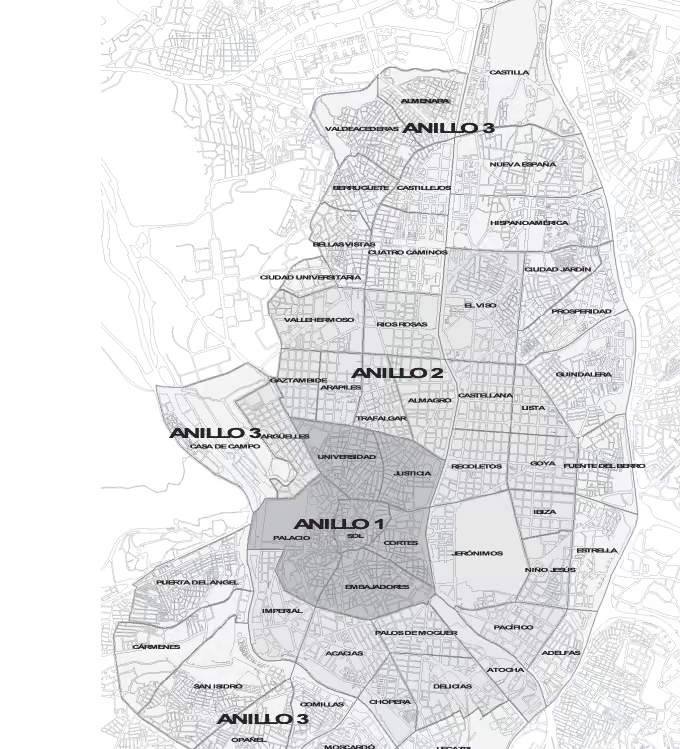
In reality, this Special Accommodation Plan seems to be poorly enforced, with few inspections. Only 250 of the 12,915 tourist flats available in Madrid were reportedly legal, under 2%.
If you are considering a property project in the Spanish capital, our page on property in Madrid can help you understand the local market. For more on rentals, see also our guide to tourist rentals in Madrid.
The tourist licence in Catalonia, the Costa Brava, Roses and Empuriabrava
In Catalonia, the tourist licence is often called HUT, short for habitatge d'ús turístic. To rent out a home to tourists, the owner must notify the start of the activity and meet the conditions set by the Generalitat. The official procedure is explained on the Generalitat's portal on homes for tourist use.
Since the Catalan decree-law on tourist homes, some towns are subject to a much stricter regime. In municipalities where access to housing is under pressure or where tourist rentals are highly concentrated, a prior planning licence may be required. Decree-law 3/2023, published in the BOE, reinforced this approach.
On the Costa Brava, especially in Roses or Empuriabrava, tourist demand remains strong, but that does not mean every home can get a licence. Before you buy, check whether the property already has an HUT number, whether the town hall allows the activity, whether the community of owners objects and whether the licence can be kept after the sale.
The tourist licence in Barcelona
Barcelona has long been one of the strictest cities in Spain on tourist licences. As early as 2016, the Catalan capital made headlines with a record fine of €600,000 imposed on Airbnb, accused of letting owners rent out their homes without a licence.
In other words, if you plan to buy in the Catalan capital, you must comply with the law. Without a valid licence, the penalties can be heavy, and the holiday rental project may become impossible to run legally.
In Barcelona, the rules rest mainly on the PEUAT, the Special Urban Plan for Tourist Accommodation. This plan divides the city into several zones, much like Madrid. In theory, the further you are from the centre, the “easier” it may seem to get a licence. In practice, the situation today is much more restrictive.
In 2026, new tourist licences in Barcelona are practically frozen. The only realistic way to rent a home to tourists is often to buy a property that already has a valid HUTB licence, that is, a habitatge d'ús turístic de Barcelona licence.
But be careful: a property sold with a tourist licence usually costs more than its standard market value. You need to check that this premium is really justified.
Before you buy, it is advisable to check:
- the property's HUTB number;
- the validity of the licence;
- the property's compliance with the PEUAT;
- the approval or restrictions of the community of owners;
- whether the activity can continue after the sale;
- that there is no ongoing procedure or penalty.
Barcelona is now taking a very restrictive line on tourist rentals, with a stated aim of returning more homes to residential use. The Catalan decree-law 3/2023 reinforced this approach by requiring, in some towns, a prior planning licence and time limits.
Under its Special Urban Plan for Tourist Accommodation (PEUAT), the city of Barcelona is divided into several zones, on the Madrid model. The further you are from the centre, the “easier” it would be to get a licence.
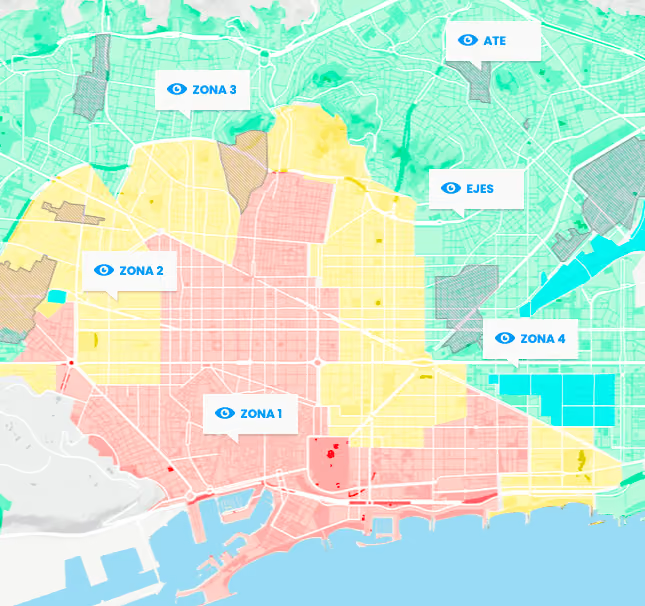
A concrete example: a flat in the Eixample, in Gràcia or near the beach may look ideal for Airbnb or Booking. But if it does not already have a valid tourist licence, it will be very hard, or even impossible, to rent it legally by the night or by the week. Conversely, if a seller claims the home already has a licence, you need to check that it exists and on what terms before including it in the purchase price.
In reality, new tourist licences are currently frozen, and the only way to rent your home to tourists is to buy a property that already has a licence. Note: such a property costs more than its market value. To understand the local short-term rental rules, see our guide to tourist rentals in Barcelona. And if you are considering buying in the Catalan capital, our page on buying property in Barcelona can also help you understand the local market.
The tourist licence in the Canary Islands
The key point is that in the Canary Islands, each island and each town may take its own approach to tourist rentals. Local decisions to slow down new authorisations in the busiest tourist areas are often a bigger obstacle than the technical criteria of the home.
The archipelago wants better control over what it sees as a parallel tourist rental market. There is a large gap between the homes listed on platforms and those actually registered with the authorities. Inspections are sometimes limited, notably for lack of staff, but the framework is getting tougher.
Since Ley 6/2025 on the sustainable tourist use of homes in the Canary Islands, the rules have been tightened. The Canary Islands government also points out that holiday homes must be furnished, equipped for immediate use and declared through the official procedure for viviendas vacacionales.
If you want to rent to tourists in the Canary Islands, you must check:
- whether the town still allows this type of activity;
- whether the home can be declared as a vivienda vacacional;
- whether the community of owners prohibits tourist rentals;
- whether the property meets the technical and planning criteria;
- whether the island in question applies specific restrictions.
Aude Chevallier, our Canary Islands specialist, had already warned about this: in Tenerife, some towns such as El Rosario have taken a very restrictive line, while other tourist areas, such as Puerto de la Cruz or Lanzarote, are regularly debated over tourist saturation. This remains true in 2026: local politics weigh heavily on the subject, and the rules can change quickly.
For a property project in the archipelago, see also our pages on buying property in Tenerife or in Lanzarote.
The tourist licence in Valencia
Planning rules on tourist rentals in Valencia have become much stricter since 2018, and even more so with the municipal rules adopted in 2026.
To obtain or keep a tourist licence in Valencia, you must in particular check that the property is compatible with planning rules. The city applies strict rules to protect the residential use of buildings.
In 2026, Valencia city council states that tourist flats in mixed buildings that are mainly residential must, among other things, be on the ground or first floor, always below the residential homes. The city also applies blocking thresholds: a maximum number of tourist flats can be set per neighbourhood, district or building. The council presented these restrictions in its communication on the new regulation of tourist flats in Valencia.
In practice, you need to check:
- whether the home is on the ground or first floor;
- whether its tourist use is compatible with local planning;
- whether the building stays below the authorised thresholds;
- whether the community of owners allows the activity;
- whether the area is subject to tougher restrictions.
In some neighbourhoods, such as Ciutat Vella or El Cabañal, the restrictions can be even stricter. Licences have also been frozen or tightly limited several times because of residents' complaints and tourist pressure.
For more, see our guide to tourist rentals in Valencia. If your project is about buying, our page on property in Valencia may also interest you.
The tourist licence in the Balearic Islands: Mallorca, Menorca and Ibiza
In the Balearic Islands, tourist rentals are among the most tightly regulated in Spain. The licence is often called ETV, short for estancia turística en vivienda. It applies in particular to Mallorca, Menorca, Ibiza and Formentera.
In Mallorca, the rules are particularly strict. After several years of restrictions, the Balearic Islands tightened their framework further with decree-law 4/2025, which aims in particular to fight illegal supply and better control the number of tourist places. In many cases, it is very hard to get a new licence, especially for a flat in an apartment block.
In Menorca, there may still be opportunities, but the framework remains tightly controlled. You generally cannot rent your property to holidaymakers if it is officially protected housing, if it is on protected rural land, if the community rules prohibit it or if you only want to rent a room rather than the whole home.
Ibiza follows the same cautious logic: strong tourist demand, sensitive regulation, possible inspections and a shortage of properties that can really be rented out legally.
For more information, see our full article on tourist rentals in Menorca, in the Balearic Islands.
The tourist licence in Andalusia: Málaga, Seville and the Costa del Sol
To get a tourist licence in Andalusia, you must submit a responsible declaration (declaración responsable) to the Junta de Andalucía. This declaration registers the home in the tourism register, provided it meets the required criteria.
The Junta states that this declaration is mandatory when the home is rented out regularly for tourist purposes. It also points out that a home rented without a declaration may be considered clandestine. You can read the official information in the Junta de Andalucía's FAQ on viviendas de uso turístico.
Be aware, though, that Andalusian cities can tighten their rules. To curb property speculation and ease pressure on residential housing, some towns can block or limit new authorisations in the most pressured areas.
In Málaga, Seville, Granada, Marbella or on the Costa del Sol, you therefore need to check:
- the responsible declaration to the Junta;
- the property's planning compliance;
- the town hall's rules;
- any restrictions by neighbourhood;
- the decisions of the community of owners;
- the tax rules that apply once the activity starts.
Our advice remains the same: if you plan to run a tourist rental in Andalusia, focus on areas where the rules remain compatible with your project, and make sure you stay within the law before, during and after renting, especially when declaring your income.
The tourist licence in Alicante
In Alicante, rules on tourist rentals have become stricter since 2018 as licence applications increased. The city follows an approach close to Valencia's, as it belongs to the same autonomous community, but with its own municipal rules.
Historically, Alicante has limited licences to homes on the ground or first floor, notably to make evacuation easier in an emergency and limit disturbance for other residents of the building.
Some central areas, such as the Centro Tradicional or the Casco Antiguo, have also faced tougher restrictions, with rules that may favour whole buildings over individual homes.
In 2026, Alicante is still working to tighten its framework. The city council has announced a new regulation of tourist uses, with a moratorium kept in place during the process and the aim of limiting licences in saturated areas. You can read the official announcement from Alicante city council on the new regulation of tourist uses.
Before buying a property in Alicante to rent to tourists, you therefore need to check:
- the floor the home is on;
- the exact area where it is located;
- planning compatibility;
- the rules of the community of owners;
- whether a licence is already active;
- any current or upcoming restrictions.
To find out all about the local market, see our page on buying property in Alicante.
Your obligations as the owner of a tourist rental in Spain
As the owner of a tourist rental in Spain, you have several legal obligations, including:
- Giving guests information on the community rules and the conditions of use of the home
- Checking guests' identity and keeping a register of their stay
- Paying the relevant local and national taxes
- Complying with safety rules
- Providing an assistance number (24 hours a day, 7 days a week).
- Keeping an up-to-date register of your guests' arrivals and departures
Rights and duties of a tourist rental owner in Spain
Once the tourist licence has been obtained, the owner cannot rent out the home freely without following certain rules. In Spain, running a tourist rental involves legal obligations, rights as an owner, and the risk of penalties if the property is badly managed or has no licence.
The obligations of a tourist rental owner
As the owner of a tourist rental in Spain, you have several legal obligations. They can vary between autonomous communities, but some rules apply almost everywhere.
In particular, you must:
- give guests information on the community rules and the conditions of use of the home;
- check guests' identity;
- keep an up-to-date register of arrivals and departures;
- report guests to the relevant authorities where required;
- pay the relevant local and national taxes;
- comply with safety and habitability rules;
- provide an assistance number available 24/7;
- display or provide the tourist licence number where the rules require it.
In practice, this means the owner must run the home as a regulated activity rather than an occasional let. Guests must know how to use the home, what the building rules are, who to contact if there is a problem and what conditions to respect during their stay.
A concrete example: if a guest causes a nuisance in the building, the owner may be held responsible if the community rules were not clearly communicated or if no emergency contact was available.
The rights of a tourist rental owner
As the owner of a tourist rental in Spain, you also keep several important rights.
In particular, you can:
- set the rental price freely;
- decide when the home is available;
- set the house rules;
- ask guests for a deposit;
- choose to manage the property yourself or use a manager;
- refuse a booking that does not meet your conditions.
A deposit is highly recommended. It covers any damage during the stay: damaged furniture or equipment, lost keys, exceptional cleaning costs or breaches of the house rules.
Our advice: always ask for a deposit or an equivalent guarantee. Without one, you risk complex disputes with foreign guests who have already left Spain.
What are the penalties for a badly managed or unlicensed property?
Breaking the rules can lead to heavy penalties. Depending on the autonomous community, the seriousness of the offence and the situation of the property, fines can range from about €2,000 to €150,000 for very serious offences.
You also face other consequences:
- withdrawal or revocation of the tourist licence;
- suspension of the listing on platforms;
- an order to stop the activity immediately;
- a tax inspection;
- a dispute with the community of owners;
- lost income if the property can no longer be rented out.
Penalties can be particularly heavy if the home is offered without a licence, if the number displayed is false, if the owner does not report guests or if the property does not meet minimum safety conditions.
In short, getting a tourist licence is only the first step. To rent legally in Spain, you also need to meet your management obligations, keep your registers up to date, declare your income and keep an eye on local rules, which can change.
Tax on tourist rentals in Spain
Tax on tourist rentals in Spain depends on several factors: your tax residence, the type of rental offered, the services included and the way the property is run.
One thing is certain: income from a tourist rental must be declared. Renting through Airbnb, Booking or another platform does not exempt the owner from tax obligations. On the contrary, platforms pass more and more information to the tax authorities, which makes inspections easier.
Before declaring your rental income, you first need to determine whether you are considered tax resident in Spain or non-resident.
As a rule, you are considered tax resident in Spain if you meet one of the following criteria:
- you spend more than 183 days a year in Spain;
- the main centre of your economic or professional activities is in Spain;
- your spouse or minor children usually live in Spain, unless proven otherwise.
Tax on tourist rentals for Spanish residents
If you are tax resident in Spain, the income from your tourist rental must be declared in Spain.
IBI
Spain’s IBI, or Impuesto sobre Bienes Inmuebles, is the Spanish property tax. It is paid every year to the town hall where your property is located. The amount depends mainly on the cadastral value of the property and the rate set by the town. In general, the rate applied to this value is between 0.4% and 1.3%, depending on the municipality. Whether or not the home is rented out, the owner must pay the IBI.
IRPF
If you are tax resident in Spain, income from tourist rentals in Spain is subject to IRPF, the Impuesto sobre la Renta de las Personas Físicas, in other words personal income tax.
The tax rate depends on your total income, your tax situation and your autonomous community. It can therefore vary widely.
You may have read that there is a 60% tax reduction for some home rentals. Be careful: this reduction applies in principle to rentals of a tenant's main home and does not apply to short-term tourist rentals.
The Agencia Tributaria points out that income from a tourist rental may be treated as income from real estate, or as an economic activity if you provide hotel-type services. You can read its official page on the taxation of tourist apartments.
VAT
VAT, called IVA in Spain, depends on the services provided with the rental.
If you simply rent out a furnished home, without hotel-type services, the tourist rental may be exempt from VAT. If, on the other hand, you offer services similar to those of a hotel, the rental may be subject to VAT, generally at the reduced rate of 10%.
This is the case in particular if you offer:
- a reception desk or permanent assistance;
- regular cleaning during the stay;
- regular changes of linen;
- a laundry service;
- catering or similar services.
To keep things simple, it is common in Spain to use a gestor to file your taxes and avoid mistakes in how your income is classified.
Tax on tourist rentals for non-residents
If your tax home is outside Spain, for example in the UK, the US or another EU country, you are generally considered a non-resident for tax purposes in Spain. This does not exempt you from declaring the income from your Spanish property.
IRNR
The IRNR, or Impuesto sobre la Renta de No Residentes, is the non-resident income tax. You must pay it if you own a property in Spain while keeping your tax residence outside Spain.
IRNR is declared using Modelo 210. For a tourist rental, rental income must in principle be declared periodically. The Agencia Tributaria explains this obligation on its page on non-resident income tax.
For tax residents of the European Union, Iceland, Norway or Liechtenstein (Germany, Ireland or the Netherlands, for example), the general rate is 19%. For other taxpayers, including residents of the UK and the US, it is generally 24%. The official rates are on the Agencia Tributaria's page on IRNR rates.
If you are tax resident in another EU country, Iceland, Norway or Liechtenstein, you can in principle deduct certain property costs, provided you can justify them: community fees, mortgage interest, repairs, management fees, insurance, etc. Residents of the UK, the US and other countries are taxed on their gross income, with no deductions.
IBI
Even if you are not tax resident in Spain, you must also pay the IBI, the local property tax. It is due every year to the town hall where the home is located.
This tax does not depend on your tax residence. In other words, a foreign owner with a flat in Valencia, Alicante, Madrid or Barcelona must pay the IBI, whether or not the property is rented out.
What are the risks if I do not declare my income from tourist rentals?
Not declaring the income from a tourist rental in Spain can lead to heavy tax penalties. Rental income must be declared whether you are tax resident in Spain or a non-resident.
In the event of an omission, mistake or concealment, the Spanish tax authorities can apply penalties, with surcharges of up to 25% of the undeclared amounts, or even more depending on the seriousness of the case. The Spanish tax authorities can also review your returns over several years. To be safe, keep all your supporting documents: contracts, invoices, platform statements, management fees, community fees, local taxes and proof of payment.
Booking platforms such as Airbnb or Booking now play an important role in tax checks on tourist rentals. They can pass certain information to the tax authorities, notably under European transparency obligations for digital platforms.
Be careful: this does not mean the platform takes over your reporting obligations. Even if some data is passed on automatically, the owner remains responsible for declaring their income correctly in Spain.
Our advice: if you are a non-resident and rent out your tourist property, get help from a gestor or a tax adviser. This will help you declare your income correctly, avoid mistakes on the Modelo 210 and check which costs you can deduct.
Before you buy: the essential checks
If your goal is to buy a property in Spain to rent to tourists, the tourist licence must be checked before you sign. It is one of the most important points of your property project.
A home may be well located, attractive, renovated and presented as “ideal for Airbnb”, yet not be legally usable as a tourist rental. In some cities, new licences are frozen, limited or subject to very strict conditions.
Before you buy, you therefore need to check the feasibility of the project at several levels: community of owners, town hall, autonomous community, tourism register and the actual situation of the home.
Check the community of owners
The first check concerns the community of owners. Even if the region or town hall allows tourist rentals, the building may have restrictions.
Before you buy, ask for the community statutes and the minutes of the latest general meetings. They show whether tourist rentals are allowed, limited or prohibited in the building.
In particular, check:
- whether the community of owners allows tourist rentals;
- whether a ban has been voted;
- whether neighbours have already complained;
- whether special rules apply to the common areas;
- whether tourist activity leads to extra fees.
A concrete example: you buy a flat with an existing tourist licence, but the community of owners has recently voted a restriction on this activity. In that case, the licence alone is not enough: you need to check whether the rental can really continue.
Check with the town hall and the autonomous community
The second step is to check the rules that apply with the town hall and the autonomous community.
In Spain, tourist rentals depend largely on the autonomous communities, but town halls have more and more power. Some cities set conditions on the floor, the zone, tourist density or planning compatibility.
Before you buy, you therefore need to confirm:
- whether the town still grants new licences;
- whether the home is in an authorised zone;
- whether a planning licence or a municipal report is required;
- whether the building meets local conditions;
- whether any regulatory changes are under way.
A concrete example: a flat in Valencia, Alicante, Barcelona or Madrid may be in an area where tourist rentals are tightly regulated. Even if the property is attractive, the town hall may refuse tourist use.
Check that the licence exists and whether it can be transferred
If the seller says the home already has a tourist licence, do not take their word for it. Ask for the exact licence or registration number, then check that it really matches the property for sale.
This check should cover several points:
- the licence number;
- the exact address of the home;
- the name of the holder;
- the validity of the licence;
- that there is no ongoing penalty or procedure;
- whether the licence can be kept or transferred after the sale.
Be careful: depending on the region, a tourist licence may not be automatically transferable. In some cases, it is tied to the owner, the home, a specific declaration or conditions that must be checked again after the purchase.
A concrete example: a property sold with a tourist licence may be priced above its standard market value. This premium only makes sense if the licence is valid, usable and can be kept after the sale.
Get support to avoid buying a property you cannot rent out
Buying a home in Spain to run as a tourist rental needs more thorough checks than a standard purchase. Assessing the location, the price or the rental potential is not enough. You also need to confirm that the activity is legally possible.
Professional support lets you check the sensitive points before signing: community of owners, town hall, autonomous community, tourism register, tax, real profitability and management constraints.
At Alveo Search, we help English-speaking buyers with their property projects in Spain. If your goal is to rent to holidaymakers, we can help you identify the risks before you buy and avoid a property that cannot be rented out legally.
Thomas Rouer is the founder of Alveo Search and the CEO of the Alveo group. Based in Spain for almost ten years, he develops property services designed for the specific needs of foreign buyers.
His expertise covers every aspect of buying property in Spain: understanding the market, searching for and selecting properties, negotiation, financing, paperwork, tax and securing the purchase process.
FAQ: the tourist licence in Spain
How do you get a tourist licence in Spain?
To get a tourist licence in Spain, you need to check the rules of the autonomous community and the town hall, gather the required documents, then submit a responsible declaration or an application to the relevant authority. Conditions vary by region: some still allow new licences, while others strictly limit them.
How do you check a tourist licence in Spain?
To check a tourist licence in Spain, ask the seller or owner for the exact number, then check it with the tourism register of the autonomous community or the relevant local authority. Make sure the licence matches the home, is active and can be kept after the sale.
Can you rent out in Spain without a tourist licence?
In most regions, renting a home to tourists without a licence or tourism registration exposes the owner to penalties. Fines can be heavy, and the listing can be removed from platforms. Before renting on Airbnb, Booking or another site, check whether a licence is required in the town concerned.
Is a tourist licence valid throughout Spain?
No. A tourist licence is not valid throughout Spain. It depends on the autonomous community, the town and the home concerned. A licence obtained in Alicante, Barcelona or Mallorca gives no right to rent out another property in another region. Each project must be checked locally.

Our resources for buying in Spain