Français
 English
The Valencian Community: a region guide

- Status: an autonomous community has legislative, executive and administrative powers, with a Legislative Assembly elected by universal suffrage, a Governing Council and a president elected by the Assembly. Spain has seventeen of them.
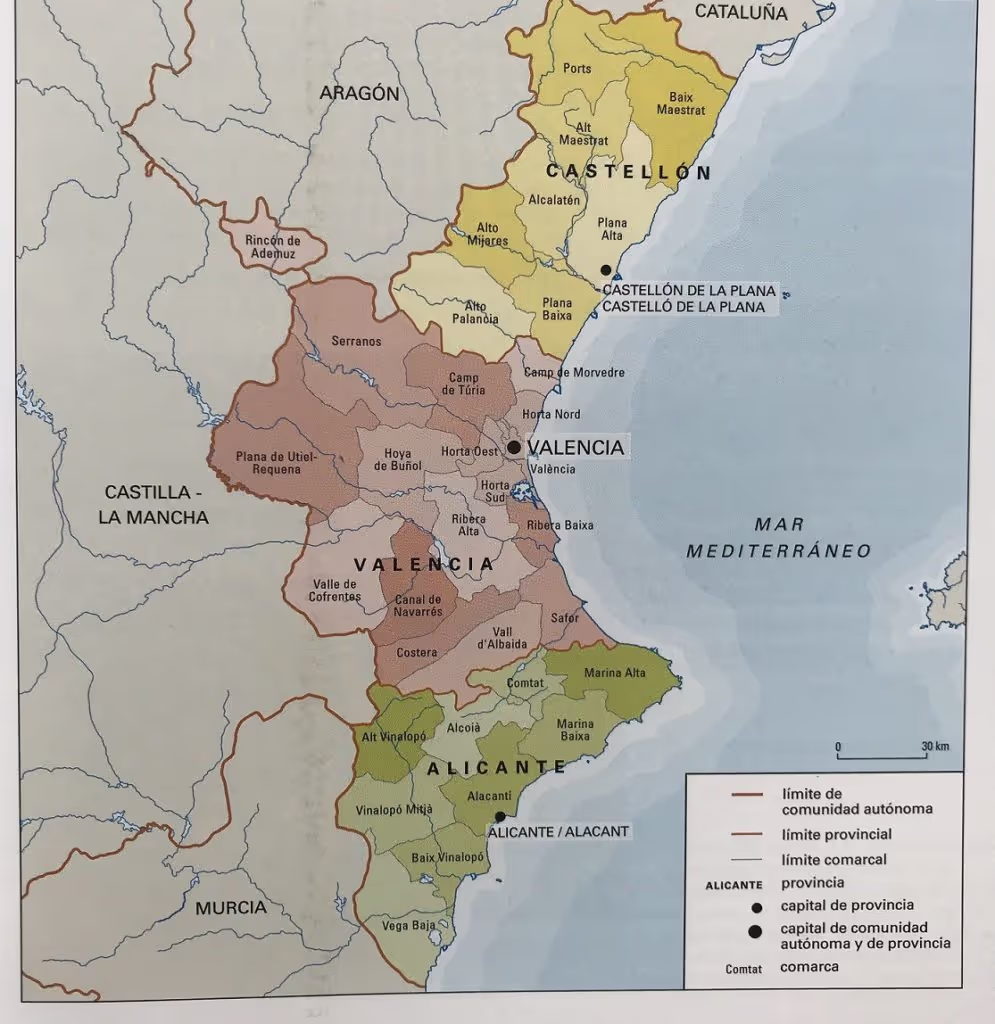
- The area: its capital is Valencia, in the east and south-east of the Iberian Peninsula. It covers 23,255 km², making it the eighth largest region in the country, and is made up of the provinces of Alicante, Castellón and Valencia, plus the Columbretes islands and Tabarca.
- Population: 5,003,769 inhabitants across 542 municipalities. The Valencia metropolitan area has 1,559,084 inhabitants and the Alicante area 757,085.
- History: after the 1919 Valencian Commonwealth project and proposals that never went to a vote under the Second Republic (1931-1939), the Statute of Autonomy was approved in 1982, with the Generalitat taking charge of health and education.
- Geography and languages: mostly mountainous terrain, 524 km of coastline, natural parks and wetlands such as the Sierra de Irta. Mediterranean climate, with dry summers and highs of around 30°C. Two official languages: Valencian and Spanish.
- Key point: a coastal and mountainous region with its own institutions since 1982, whose population is concentrated around Valencia and Alicante.
Spain is made up of seventeen autonomous communities, each with its own culture and traditions. One of them is the Valencian Community, a historic region of the Iberian Peninsula. If you would like to know more about it, this article is for you.
What is an autonomous community?
An autonomous community is a Spanish territorial entity that has self-government under the constitutional legal system. It has its own institutions and representatives. It also holds certain legislative, executive and administrative powers. Today, the basic bodies shared by all autonomous communities are: a Legislative Assembly, elected by universal suffrage, and a Governing Council with executive functions. There is also a president of the autonomous community, elected by the Legislative Assembly from among its members.
Where is the Valencian Community?
The Valencian Community, whose capital is Valencia, lies in the east and south-east of the Iberian Peninsula. The Columbretes islands, Tabarca and other small islands and islets near the coast are also part of Valencian territory. The Valencian Community covers 23,255 km² and is the eighth largest autonomous community in Spain. It is made up of the provinces of Alicante, Castellón and Valencia. It borders Catalonia and Aragon to the north, Castilla-La Mancha and Aragon to the west, and the Region of Murcia to the south.
What is the population of the region?
The Valencian Community currently has 5,003,769 inhabitants across a total of 542 municipalities. The largest concentration of people is around the city of Valencia, whose metropolitan area has 1,559,084 inhabitants. The second largest is the Alicante metropolitan area, with 757,085 inhabitants.
What is the history of the Valencian Community?
In the early 20th century, some sections of society began to call for a degree of political autonomy for the Valencian region, for example with the Valencian Commonwealth project of 1919. During the Second Republic (1931-1939), several proposals for a statute of autonomy were drafted, but none was approved by vote. In 1982, after the Spanish Constitution set up the State of Autonomies, a Statute of Autonomy was approved for the Valencian Community, establishing the Generalitat as the regional government in charge of areas such as health and education.
What are its geographical features?
Mostly mountainous terrain
Mountains cover most of the Valencian Community and leave only a narrow coastal strip of plains, which only widen in the far north (the Vinaròs plain, the Plana de Castellón, the Huerta de Valencia). The terrain is shaped by the northern mountains (the Iberian System), the southern ranges (the Baetic System) and various plains and plateaus. The Valencian Community also includes several islands, including the Isla de Tabarca and the Columbretes islands.
A coastal region
The Valencian Community has 524 km of coastline. The area has natural parks such as the Sierra de Irta and wetlands such as the Prat de Cabanes-Torreblanca and the Albuferas of Valencia and Elche. The coastline is shaped by the gulf that runs along the provinces of Castellón and Valencia, and by Cabo de la Nao. Further south is the Gulf of Alicante, known to tourists as the Costa Blanca.
A pleasant climate
A Mediterranean climate prevails on the northern coast and in the centre of the region. Summers are long, dry and hot (highs of around 30°C). Rainfall is concentrated in spring and autumn, with a risk of heavy cold-drop storms (gota fría) in autumn. Towns typical of this climate include Castellón, Gandía, Sagunto and Valencia.
Which languages are spoken in the Valencian Community?
The Valencian Community has two official languages: Valencian and Spanish. Valencian is recognised locally, while Spanish remains the language most used by the majority of the population and the media.
Would you like to invest in an apartment or a house in the Valencian Community? Contact us! We will look at your purchase project together.
Thomas Rouer is the founder of Alveo Search and the CEO of the Alveo group. Based in Spain for almost ten years, he develops property services designed for the specific needs of foreign buyers.
His expertise covers every aspect of buying property in Spain: understanding the market, searching for and selecting properties, negotiation, financing, paperwork, tax and securing the purchase process.


Our resources for buying in Spain