Français
 English
Working in Spain as a British or American citizen: visas, jobs and salaries

- Paperwork: EU citizens need no visa. British and American citizens need a work visa or residence permit, usually backed by a Spanish employer, or the digital nomad visa for remote work. In practice, everyone needs a NIE for a contract, a bank or taxes, a social security number (NUSS) to work locally, and residence registration after three months.
- Job market: in the first quarter of 2026, Spain had 22.293 million people in work, 527,600 more than a year earlier, with an unemployment rate of 10.83% according to the INE.
- Salaries: the minimum wage is €1,221 a month over 14 payments in 2026 (€17,094 a year). By sector: €2,500 to €4,000 in IT, €1,300 to €1,800 in tourism and hospitality, €1,300 to €2,000 in administration.
- Cost of living: around 30% lower than in the UK according to Eurostat: €700 to €950 for a one-bedroom flat in a city centre, €40 to €60 for a monthly transport pass.
- Key point: EU citizens can work freely, while British and American citizens must secure a visa first. After that, everything comes down to preparation: city, sector, status and paperwork. Madrid and Barcelona offer the most jobs; Valencia, Málaga and Alicante are cheaper places to settle.
Working in Spain is one of the most popular plans for people moving abroad from the UK, the US and northern Europe. The country attracts people with its climate, its quality of life, its short flights from much of Europe, the energy of some of its big cities and a job market open to EU citizens. Many people want to work in Spain to change pace, find a better work-life balance, join an international company based there, find a job in English or prepare a longer-term move.
But before taking the plunge, the same questions always come up: how can you work in Spain as a British or American citizen? Do you need a visa? Can you work in Spain without speaking Spanish? What paperwork should you plan for? Where can you find job offers in Spain? Which international companies in Spain are hiring? And can you live in Spain while working for an employer back home?
The short answer: citizens of EU countries such as Germany, the Netherlands or Ireland can work in Spain without a visa. British and American citizens need a work visa or residence permit before they start. Either way, a successful move takes planning. You need to understand the rules, prepare your documents, target the right sectors, adapt your CV, assess salaries and choose the city that best fits your plans.
In 2026, the Spanish market is still attractive, but it should not be idealised. Spain offers real opportunities in tourism, tech, services, customer service, property, international trade, sales, digital marketing, hospitality, catering and international companies. But unemployment is still high in some regions, and salaries can be lower than in the UK, the US or northern Europe, especially outside senior skilled roles. So the challenge is not only finding a job in Spain: it is finding the right job, in the right city, with the right status.
This guide covers everything you need to know about working in Spain as a British or American citizen, and what changes for EU citizens: visas and paperwork, sectors that are hiring, salaries, international companies, job hunting, remote work from Spain, tax, settling in and practical tips.
Why work in Spain?
Quality of life in Spain
Many parents with exhausting schedules dream of leaving big cities in the UK, the US or northern Europe for Spain. Too much time spent in traffic jams or on public transport, and too little time to enjoy life, are often what drives their wish for change.
Spain is known for a more relaxed daily life and an exceptional quality of life. And that reputation is deserved. According to the crowd-sourced website Numbeo.com, which compares quality of life and cost of living in countries around the world, Spain has a high quality of life index: 183.4 in the 2026 mid-year ranking, against 173.8 for the United Kingdom. The Spanish working world is also said to be less rigid. Working hours are often flexible, partly to avoid the heat, and there are many public holidays: up to 14 a year, compared with 8 bank holidays in England and Wales, and a holiday that falls on a Sunday is moved to the Monday. Workers therefore seem able to balance work and personal life more easily. The siesta culture and long lunches are also part of the Spanish way of life. Mid-morning and afternoon breaks are sacred.
In short, work is not seen as a burden, but as one part of everyday life.
Cost of living: Spain vs the UK
According to Eurostat's price level indices, consumer prices in Spain were around 30% lower than in the United Kingdom in 2024, and also below Germany, the Netherlands and Ireland. Restaurants and hotels, for example, cost about a quarter to a third less than in those three countries. Spain also applies a reduced VAT rate to essential goods, which keeps the weekly shop affordable. To find out more about the cost of living in Spain, read our article on the subject.
Everyday expenses (rent, groceries, restaurants, leisure, transport) are much more affordable than in the UK or northern Europe, so even on a modest salary you can live comfortably, especially outside Madrid and Barcelona. Here are some typical figures:
Typical costs in Spain 🇪🇸
- Gross minimum wage (2026): €1,221 a month over 14 payments
- Average net salary: €1,700 to €2,000 a month
- One-bedroom flat in a city centre: €700 to €950 a month
- Monthly transport pass: €40 to €60
- Restaurant meal: €10 to €15
- Monthly groceries (1 person): €180 to €250
So, despite lower salaries, the standard of living balances out thanks to a lower cost of living. Expats who earn a foreign income, such as a UK or US salary, while living in Spain enjoy excellent purchasing power. By contrast, a local worker on the Spanish minimum wage can live decently, but on a tight budget in the big cities.

Can you work in Spain as a British or American citizen?
Yes, but the route differs from that of EU citizens. Since 1 January 2021, British citizens who move to Spain need a work visa or residence permit, like Americans and other non-EU nationals. Citizens of EU countries such as Germany, the Netherlands or Ireland can look for a job, sign an employment contract, become self-employed or join a company in Spain without a work visa.
Spain remains one of the most popular choices for working abroad. The country offers an attractive lifestyle, short flights from much of Europe, a pleasant climate and opportunities in several sectors: tourism, hospitality, property, customer service, tech, international trade, digital marketing, services for expats and international companies.
However, working in Spain always involves some paperwork. Free movement lets EU citizens enter and work in the country, while non-EU citizens need an authorisation first. In every case, a long-term move means meeting certain administrative obligations. In particular, you need to get a NIE, register as a resident if you stay more than three months, apply for a Spanish social security number and clarify your tax situation.
Working in Spain as an EU citizen
As EU citizens, German, Dutch or Irish nationals have the right to move, live and work freely in Spain. They can answer a job offer in Spain, be hired by a Spanish company, work for a foreign company based there or be self-employed. British citizens who have lived legally in Spain since before 1 January 2021 also keep the right to work, under the Withdrawal Agreement.
This European status makes things much simpler than for a non-EU national. An EU citizen does not need a specific work permit before starting to work in Spain. They can look for a job from their home country, have interviews remotely, then move once the contract is signed or the job search is well advanced.
In practice, several situations are possible. Some people move to Spain with a local Spanish contract. Others join an international company in Spain that recruits English speakers. Some keep a professional link with their home country, for example through remote work or freelancing, while living in Spain. Others set up as autónomo, the Spanish self-employed status.
In every case, it is best to prepare your plans before you leave. Even with the right to work, employers, banks, public offices and estate agencies will often ask for Spanish documents: NIE, social security number, local address, bank account or proof of activity.
Do you need a visa to work in Spain?
If you are a British or American citizen, yes: you need a work visa to work in Spain. A tourist stay (up to 90 days in any 180) does not allow you to work. For a job with a Spanish employer, the employer applies for your residence and work authorisation at the immigration office (Oficina de Extranjería). Unless the job is on the shortage occupation list (Catálogo de ocupaciones de difícil cobertura) published every quarter by the SEPE, the employer must show that the post could not be filled locally.
Once the authorisation is granted, you have one month to apply for the visa at the Spanish consulate that covers your address. After arriving, you register with Social Security within three months, then apply for your foreign national identity card (TIE) within a month. Other routes exist for the self-employed and for remote workers (see the digital nomad visa below). EU citizens need no visa at all.
EU citizens are often confused because some steps are compulsory even without a visa. For example, if they stay in Spain for more than three months, they must register in the Central Register of Foreign Nationals as resident EU citizens. This registration records their long-term presence in the country. It should not be confused with a visa: it is not permission to enter Spain, but a registration step once settled.
Similarly, the NIE is often presented as essential for working in Spain. That is true in practice, as it serves as an identification number for many work, tax, banking and property procedures. But the NIE is not a visa. On its own, it gives no right to live or work in Spain. It mainly identifies you to the Spanish authorities.
The difference between the NIE, residence and the right to work
To understand how to work in Spain as a foreigner, you need to distinguish three things: the right to work, the NIE and residence.
The right to work depends on your nationality. EU citizens can work in Spain without a visa or work permit. British and American citizens get it through a work authorisation or visa. Either way, it is separate from the NIE, even though you will soon need that number for paperwork.
The NIE, or Número de Identidad de Extranjero, is an identification number given to foreigners with economic, professional or administrative interests in Spain. You may be asked for it to sign an employment contract, open a bank account, buy a property, file taxes, set up a business or complete some official procedures. So for anyone working in Spain, the NIE is almost unavoidable in practice.
The residence requirement, for its part, applies when you settle in the country for the long term. EU citizens who stay in Spain for more than three months must register as EU residents. British and American citizens receive a foreign national identity card (TIE) once their visa or permit is granted. This step makes your residence in Spain official. It is particularly important if you have a local contract, move with your family, want to buy a property or become a Spanish tax resident.
These three things are linked, but they do not mean the same. Your right to work comes from your EU citizenship or your work authorisation. You need a NIE to be identified in many procedures. And EU citizens must register as residents if they settle for more than three months.
In short, working in Spain is simple for EU citizens and takes more paperwork for British and American citizens, but nobody should skip preparation. The right approach is to plan ahead before you leave: check the documents you need, check which visa applies to you, prepare your NIE, understand the residence rules, identify your tax obligations and learn how the Spanish job market works.
How do you work in Spain in 2026?
To work in Spain in 2026, the most important thing is not to set off with only a general idea of the country. The Spanish job market varies a lot by city, sector, level of Spanish and type of contract. Whatever your nationality, build a clear strategy: which job to target, which city to apply in, which paperwork (and, outside the EU, which visa) to plan for and which professional status to choose.
The right approach is to move forward step by step. Before answering a job offer in Spain, define your plans, adapt your CV to the local market, identify the right recruitment channels, prepare the paperwork and organise your move.
Step 1: choose your sector and target city
Before applying, identify the sectors where your profile is worth the most. For English speakers, opportunities are often greater in jobs where English, international experience or knowledge of English-speaking markets is an asset: customer service, tourism, hospitality, property, tech, digital marketing, sales, international trade, SaaS support, recruitment or services for expats.
Choosing the city matters just as much. Madrid is home to head offices, finance, consulting, sales functions and large companies. Barcelona attracts tech, digital, creative and international profiles. Valencia is increasingly popular with remote workers, families and people looking for a better balance between work and quality of life. Málaga, Alicante, the Balearic Islands and the Canary Islands offer more opportunities in tourism, property, services and businesses linked to expats.
If your career plans go hand in hand with plans to live or buy property in Spain, it can help to compare regions before settling for good. For example, you can read our guide to buying property in Spain.
Step 2: prepare a CV adapted to the Spanish market
To maximise your chances, prepare a CV adapted to the Spanish market. A CV in English only may be enough for an international company, but it will hold you back if you target local employers. Ideally, have at least two versions: one in Spanish and one in English.
Your CV should highlight your languages, your international experience, your concrete results and your ability to work with English-speaking markets. If you apply for a sales job, give the targets you met, your revenue or the markets you managed. If you target digital marketing, showcase your skills in SEO, paid search, CRM, acquisition, analytics or content. If you are looking for a customer service job, stress your English, your Spanish, your CRM tools and your multichannel experience.
For your language level, use a clear scale: A1, A2, B1, B2, C1 or C2. Do not overstate your Spanish: the interview will quickly reveal your real level. On the other hand, native English can be a real asset for roles serving English-speaking clients or markets.
Step 3: look for jobs on the right channels
To find a job in Spain, use several channels at once. LinkedIn is often the most effective for skilled, international or English-speaking roles. Try searches such as “English speaker Spain”, “English-speaking Madrid”, “UK market Barcelona”, “jobs in Spain” or “customer support English”.
Spanish job sites are important too. InfoJobs is one of the most used job sites in Spain, especially for local roles and Spanish employers. You can also check Indeed Spain, Welcome to the Jungle, Glassdoor, company careers pages and the European portal EURES, which brings together useful information for EU citizens who want to work in another European country.
To target an international company in Spain that is hiring, go beyond standard job ads. Check the careers pages of British, American and other international groups with operations in Spain, chambers of commerce, expat groups and international recruitment firms. Speculative applications can also work, especially if your profile would help the company develop or manage an English-speaking market.
Do not overlook the traditional routes.
- You can, for example, contact European employment bodies such as the EURES portal dedicated to worker mobility within the EU.
Consider sending speculative applications to international companies based in Spain. Here is a non-exhaustive list:
- Sanofi
- Havas
- Carrefour
- Elis
- Yves Rocher
- Pierre Fabre
- Danone
- Veolia
- Atos
- Amazon
- E-dreams
- King
- Volkswagen
Step 4: handle the paperwork
Whether or not you need a visa, some steps quickly become essential. The NIE is often requested to sign a contract, open a bank account, deal with tax or move forward with a property purchase.
If you stay in Spain for more than three months, you will also need to register as a resident: a registration certificate for EU citizens, a TIE for British and American citizens. You will also need a Spanish social security number if you start working locally. These steps matter for working legally, paying contributions, accessing the Spanish social system and keeping your situation clear with the authorities.
If you work in Spain for a company from your home country, check the contract framework carefully: a local Spanish contract, a posting, remote work from Spain or self-employed status. Each option has different consequences for tax, social contributions, social security and employee rights.
Step 5: organise your move
Once your job search is under way, you need to prepare the move itself. Housing is often the most sensitive point, especially in Madrid, Barcelona, Málaga, Valencia or in coastal areas in high demand. It is generally better to start with a short-term rental to test the city, the neighbourhoods, the transport and the pace of life before committing for the long term.
Also set aside a safety budget. Even with a contract under negotiation, plan for the deposit, the first months' rent, travel costs, paperwork, opening a bank account, health insurance and any other moving costs.
Finally, if your goal is to live in Spain for the long term, do not separate your career plans entirely from your personal plans. The choice of city, neighbourhood, home, schools, transport and lifestyle will have a direct impact on the success of your move. Working in Spain is about more than finding a job: it means building a plan that brings together career, quality of life and a long-term move.
Paperwork for working in Spain
The steps for working in Spain are manageable, but they must be planned. Many EU citizens think it is enough to arrive with an ID card and look for a job on the spot. That works for a first look around, but not for a long-term move. British and American citizens, for their part, must sort out their visa before they start working.
Get a NIE
The NIE is the identification number for foreigners in Spain. Banks, employers, public offices, notaries, estate agencies or the tax authorities may ask for it. If you plan to work in Spain, buy a property, rent a home, open a bank account or set up a business, you will almost always need this number.
You can apply for a NIE in Spain, usually at the National Police or another competent office, or from abroad through Spanish consulates. The process generally involves filling in a form, showing ID, justifying why you need it and paying an administrative fee. Waiting times can vary a lot depending on the city and the time of year.
The key point: the NIE is not a residence permit. It is an administrative number. Anyone who wants to work and live in Spain for more than three months must also deal with residence: registration for EU citizens, a visa and a TIE for British and American citizens.
Register as a resident or get your TIE
If you are an EU citizen staying in Spain for more than three months, you must apply for registration in the Central Register of Foreign Nationals, often called the EU citizen registration certificate. This document records your residence in Spain. It usually shows your identity, nationality, address, NIE and registration date. British and American citizens get a TIE instead, which they apply for at the police within a month of registering with Social Security.
The Spanish authorities state that citizens of an EU member state have the right to live in Spain for more than three months if they meet one of the conditions set out, in particular if they work in Spain as employees or self-employed, or if they have sufficient resources and health insurance.
In practice, this step is essential for anyone who really wants to settle: it may be requested in some banking, tax, administrative or property procedures. It also clarifies your status with the Spanish authorities.
Apply for a Spanish social security number
To work legally in Spain, you also need a social security number, called NUSS or Número de la Seguridad Social. You need this number to join the Spanish system when you start working. The Spanish Social Security explains that the NUSS is needed to be registered when you start working and to access certain benefits.
If you are an employee, your employer can help you with this step or tell you which documents you need. If you are self-employed, you must handle your registration and affiliation yourself. The NUSS is also useful for healthcare, benefits and your working life in Spain.
Opening a Spanish bank account
Opening a Spanish bank account is not always compulsory at the very start, but it soon becomes practical. You may need one to receive a salary, pay rent, take out a subscription, pay local bills or complete certain formalities. Some banks accept non-residents, but conditions vary from bank to bank. With a NIE and proof of your situation, opening an account is generally easier.
Check your tax residence
Tax should not be overlooked, especially if you live in Spain while keeping income in your home country. The Spanish tax agency points out that an individual may be considered a Spanish tax resident if they spend more than 183 days in Spain in a calendar year, with specific rules on temporary absences and residence criteria.
Not every case is the same. Tax residence also depends on where your main economic interests are, your family situation and tax treaties (Spain has one with the UK, the US, Germany and the Netherlands, among others). If you work in Spain while keeping an employer, clients or rental income in your home country, it is best to get advice from a specialist.
The Spanish job market in 2026
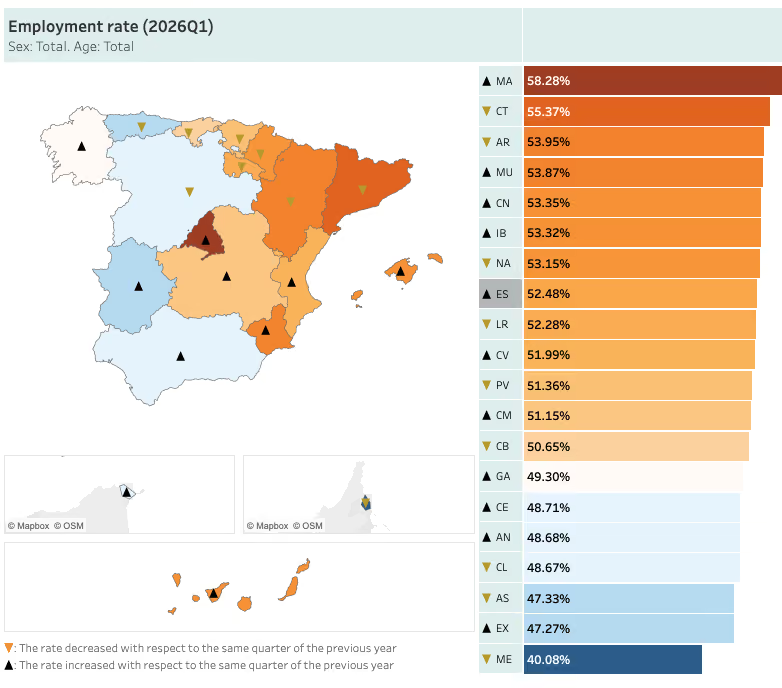
The Spanish job market is more dynamic than ten years ago, but it remains uneven. According to Spain's National Statistics Institute (INE), in the first quarter of 2026 Spain had 22.293 million people in work. Employment had grown by 527,600 over the previous twelve months, but the unemployment rate was still 10.83%.
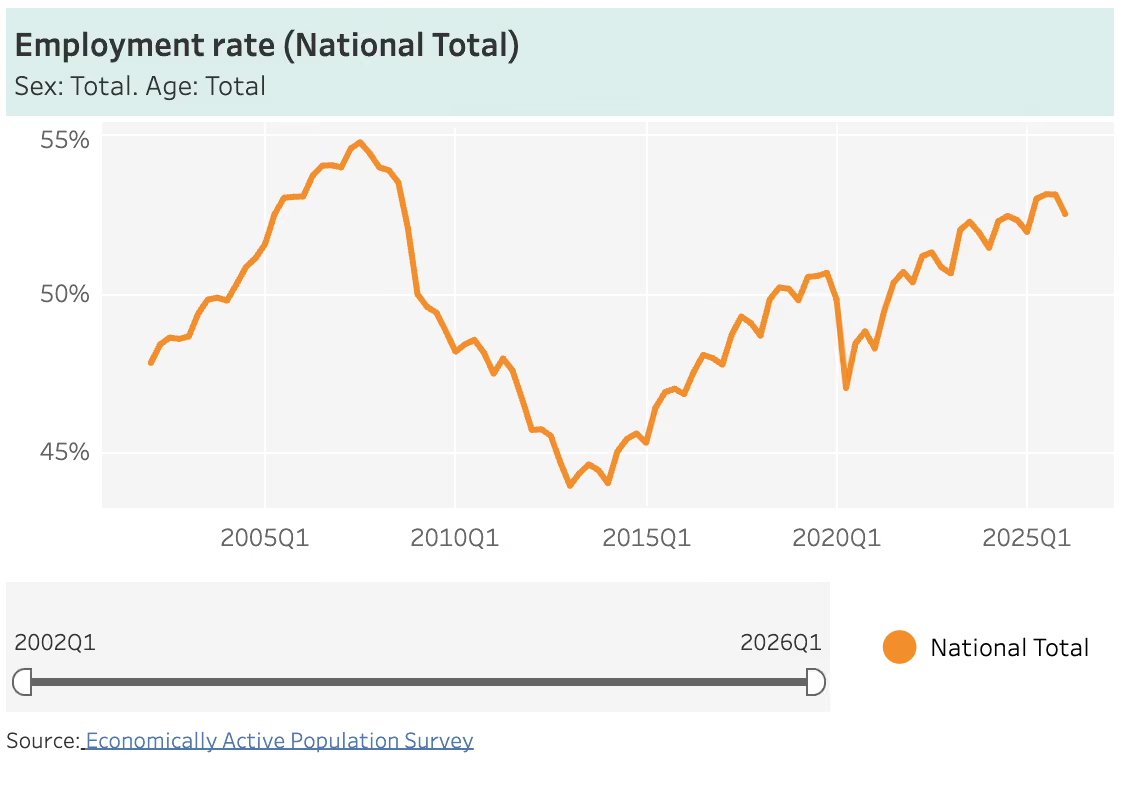
These figures show two realities. On one side, the Spanish economy is creating jobs and offers real opportunities. On the other, the market remains competitive, with big differences between regions, sectors and skill levels. So you should not approach jobs in Spain as a single, uniform market.
English speakers have better chances in sectors where English, international experience or knowledge of English-speaking markets is valued. This is the case in customer service, sales support, service centres, tourism, hospitality, upmarket restaurants, property, digital marketing, sales, tech, recruitment, training, finance, insurance, international trade and services for expats.
Bilingual or trilingual profiles are especially sought after. English is an asset, but it is rarely enough in the long run. English and Spanish together, ideally with a third language, open many more doors, especially in international companies and skilled roles.
Your job search also depends on your level of experience. A recent graduate can target customer support, sales, hospitality, tourism, internships or junior sales roles. An experienced professional can target project management, business development, marketing, finance, team management, consulting or tech. A self-employed professional can set up as autónomo and sell services to Spanish or international clients.
Sectors that are hiring in Spain
Jobs in Spain are not limited to tourism. Tourism remains important, but other fields are hiring too, especially in the big cities.
Tourism, hospitality and catering
Tourism is still a pillar of the Spanish economy. There are many opportunities in hotels, restaurants, reception, travel agencies, events, leisure activities, premium services and coastal destinations. Foreigners can find seasonal or permanent jobs there, especially if they speak English and Spanish.
The areas most concerned are the Balearic Islands, the Canary Islands, the Costa Blanca, the Costa del Sol, Barcelona, Madrid, Seville, Valencia, Málaga and Alicante. Bear in mind, though, that salaries can be modest and seasonal contracts are still common.
Customer service and service centres
This is one of the most accessible sectors for finding a job in Spain without perfect Spanish. Many companies based in Barcelona, Madrid, Valencia or Málaga recruit English speakers to handle clients from the UK, Ireland or the US. Job titles include customer support English, English-speaking customer adviser, account manager UK, sales development representative UK market or technical support English.
This kind of job can be a first way into the Spanish market. It lets you get a contract, settle in, improve your Spanish and build a local network.
Tech, SaaS and digital marketing
Madrid and Barcelona account for a large share of tech and digital opportunities. Málaga, Valencia and Alicante are growing too. Sought-after profiles include developers, product managers, SEO specialists, paid media managers, UX designers, data analysts, SaaS sales, customer success managers and international marketers.
Knowing the UK or US market can be an advantage. A SaaS company based in Spain that sells to English-speaking countries will need salespeople, marketers or support teams who understand how those markets work.
Property and services for expats
Property is a particularly relevant sector for English speakers in Spain. Many international buyers want to settle, invest, prepare their retirement or buy a holiday home. Estate agencies, buyer's agents, law firms, brokers, insurers, rental managers and service providers therefore look for people who can support an international clientele.
Speaking English, understanding what British or American buyers expect and knowing the cultural differences can become a real professional advantage.
International trade, sales and export
Spain has strong trade links with the rest of Europe and beyond. Spanish companies that sell abroad and foreign companies based in Spain need people who can bridge two markets. Jobs can involve export, business development, logistics, import-export, sales administration, distributor relations or account management.
Education, training and languages
English speakers can also work in teaching English, vocational training, international schools, language academies or private tutoring. Conditions vary a lot between employers, and some posts require specific degrees or certificates.
Working in Spain for an international company
Working in Spain for an international company is a particularly attractive option for an expat. It lets you settle in a foreign country while keeping some professional bearings: language, company culture, clients from your home market, English-speaking management or knowledge of your home market.
Foreign companies in Spain are active in many sectors: retail, banking, insurance, industry, energy, cosmetics, transport, property, consulting, tech, hospitality, business services and international trade. Some have Spanish subsidiaries with local teams. Others recruit foreigners to manage their home markets from Spain.
To find an international company in Spain that is hiring, take a targeted approach. Generic searches such as “jobs Spain” or “job offers Spain” bring up many results, but not always relevant ones. It is better to combine several approaches:
- search LinkedIn with keywords such as “English speaker Spain”, “native English”, “UK market”, “English-speaking Madrid” or “English-speaking Barcelona”;
- check the careers pages of international groups with operations in Spain;
- watch the offers shared by the British and American chambers of commerce in Spain;
- join English-speaking expat groups in Spain;
- contact local subsidiaries directly;
- send speculative applications to companies that work with English-speaking markets;
- use platforms such as InfoJobs, Indeed, Glassdoor, Welcome to the Jungle or EURES.
This strategy makes sense if you want to work in Spain while making the most of your native language. It also works if your Spanish is not yet fluent, as some international companies accept people whose main working language is English.
Be careful, though: a foreign company in Spain is subject to local rules if it hires you on a Spanish contract. Salary, contributions, holidays, working hours, probation period and collective agreements will depend on Spanish law and the applicable convenio colectivo.
Can you find a job in Spain without speaking Spanish?
Yes, it is possible to find a job in Spain without speaking Spanish, but you need to be realistic. Opportunities exist, especially in the big cities and international sectors, but they are more limited than for someone who can work in Spanish.
Jobs open to English speakers
The roles most open to people without Spanish are usually English-speaking roles such as customer support, after-sales service, business development, telesales, account management, content moderation, technical support, international tourism, luxury hospitality, teaching English, marketing for English-speaking markets or jobs in international companies.
Barcelona, Madrid, Málaga and Valencia are the best cities for this kind of search. Companies there are more international, teams more multicultural and job ads more often written in English.
Why learning Spanish is still essential in the medium term
For most local jobs, however, Spanish remains essential. It is hard to work in a small Spanish company, in public administration, healthcare, local education, field sales, traditional restaurants or local services without speaking the language. Even in an English-speaking job, you will need Spanish for daily life: housing, banking, social security, taxes, doctors, notaries, the owners' association, school, suppliers and public offices.
So the best strategy is not to wait until you are bilingual to start, but to make fast progress. You can look for an English-speaking job as a way in while taking Spanish lessons as soon as you arrive. In the medium term, your level of Spanish is what will make the difference to move up, negotiate, change company or settle in for good.
Salaries and working conditions in Spain
Minimum and average salary in Spain in 2026
Spanish salaries are often lower than in the UK, the US or northern Europe, but compare with care. The cost of living varies a lot from city to city, and some skilled jobs in tech, finance, sales, consulting or international roles can be well paid.
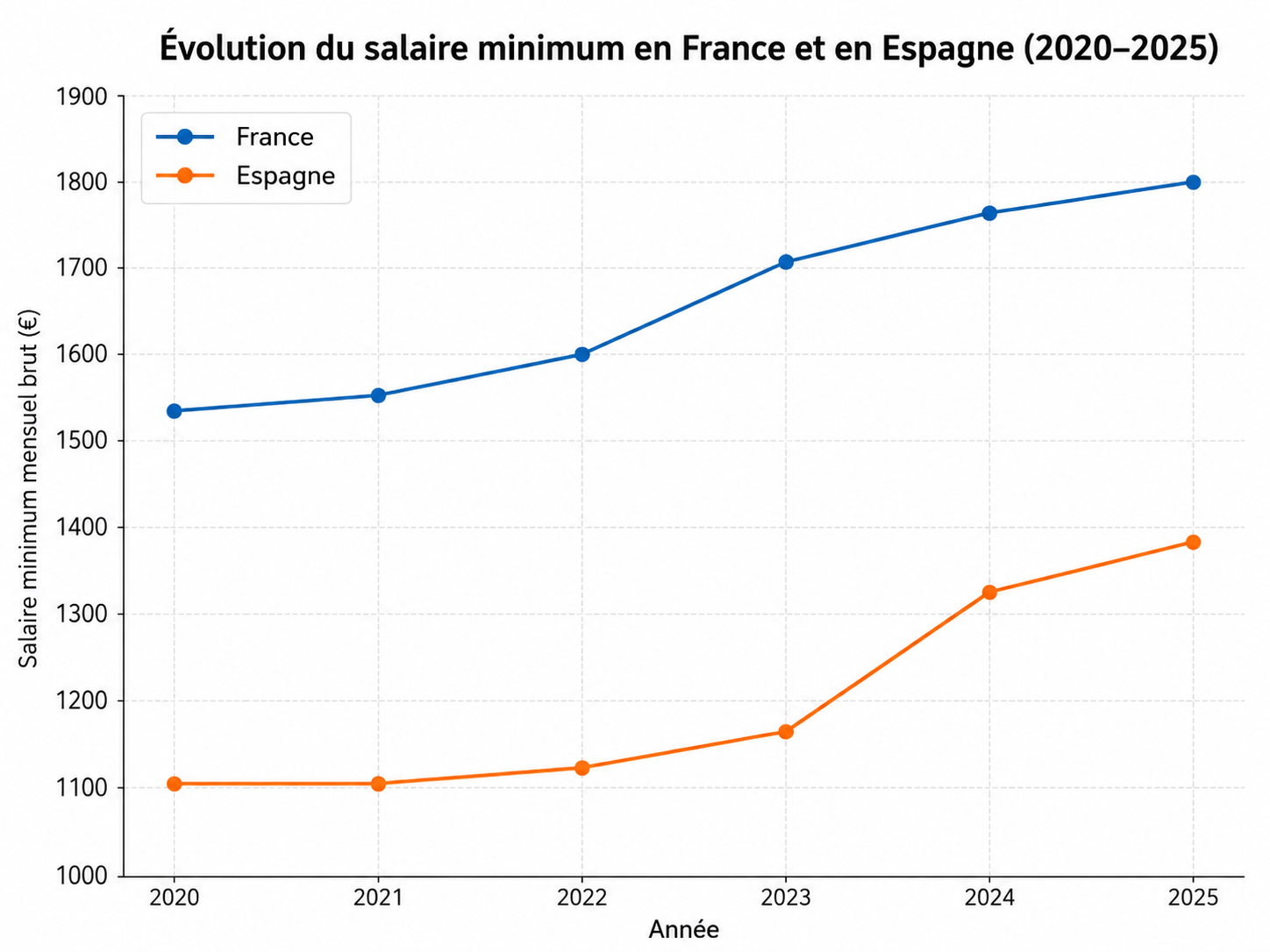
In 2026, according to official figures, the Spanish national minimum wage (SMI) is €1,221 a month over 14 payments, or €17,094 a year. This amount is a legal benchmark, but it does not reflect salaries in every sector. A skilled job in Madrid or Barcelona can pay far more, while some seasonal or low-skilled jobs stay close to the minimum. Spread over 12 months, it comes to about €1,425 gross, against roughly €2,300 to €2,400 in Germany, the Netherlands or Ireland (Eurostat, 2026), but the cost of living in Spain is generally lower, especially outside the big cities.
Average salary in Spain by sector (estimated gross per month):
- Information technology (IT): €2,500 to €4,000
- Engineering / Industry: €2,200 to €3,500
- Marketing / Communication: €1,800 to €2,800
- Tourism / Catering: €1,300 to €1,800
- Healthcare (nurses, doctors): €2,000 to €4,000
- Teaching: €1,600 to €2,400
- Administration / Support: €1,300 to €2,000
In sectors short of staff, such as tech, salaries are higher, especially in the big cities. In hospitality or retail, they remain lower, but this is offset by more affordable living costs.
Working hours, holidays, contracts and probation periods
Before accepting a job offer in Spain, compare several things: gross annual salary, estimated net salary, number of monthly payments, any bonuses, working hours, remote work, holidays, probation period, health insurance or benefits, housing and transport costs. A salary that looks lower than at home can still be attractive in an affordable city. Conversely, an average salary may not be enough in Madrid, Barcelona or some coastal areas where rents have risen sharply.
Working conditions depend on the contract, the sector and the applicable convenio colectivo. The convenio colectivo is a collective agreement that sets rules for a sector or a company: minimum salaries, job grades, working hours, bonuses, holidays, probation periods and other conditions. Before signing a contract, it is worth asking which convenio applies.
Unemployment benefit in Spain
What are the conditions for claiming unemployment benefit in Spain?
- Be registered with Social Security.
- Be officially and legally unemployed.
- Be actively looking for work.
- Have paid contributions for at least 360 days in the six years before becoming unemployed.
- A person who emigrated but paid unemployment contributions during the six years before emigrating can also receive benefits, provided they do not receive them in their country of origin.
- People who left their job voluntarily or resigned are not entitled to unemployment benefit.
The amount of unemployment benefit depends on your contributions. You receive 70% of your benefit base for the first 180 days, then 60% from day 181.
Employment contracts in Spain: permanent, fixed-term and self-employed
The Spanish job market has gone through many reforms in recent years, with a clear aim: reduce job insecurity, curb abuse of temporary contracts and encourage lasting employment. As an expat, it is essential to know the different types of contract so you can negotiate your working conditions better.
A good knowledge of the Spanish job market will help you negotiate your contract and know your rights and responsibilities as an employee.
- Permanent contracts are the priority (they reportedly rose by 12% in 2023 according to the Ministry of Labour).
- If your employment rights are breached, workers have access to a robust court system and to bodies such as the Labour Inspectorate to file a complaint and seek redress. These mechanisms ensure that workers' fundamental rights are respected and protected in the workplace in Spain.
As for entrepreneurship, since the end of the COVID-19 pandemic, the business climate has been favourable in Spain. The country has cut red tape, investment is plentiful and entrepreneurship is encouraged.
In May 2023, the government approved €98.5 million in funding for SMEs, tech companies and young entrepreneurs. It is determined to modernise the country and is clearly betting on innovation.
The startups law
The startups law passed after the pandemic, in 2022, aims to encourage the creation and arrival of foreign startups in Spain. It also greatly simplifies setting up a company and offers a wide range of tax incentives for companies, investors and startup employees.
- Corporate tax and non-resident income tax are cut from 25% to 15% for four years.
- Stock options benefit from a higher tax exemption.
- To attract foreign talent, Spain has set up a favourable tax regime for executives, expat employees, investors and digital nomads. Under certain conditions, it allows a reduced tax rate of 24% for 6 years. It aims to make it easier for skilled people to come and work or start a business in Spain, and to make the country more attractive internationally.
To find out whether your company is eligible, contact the Empresa Nacional de Innovación (ENISA). It is the body that handles companies' applications.
How do you set up a company in Spain?
Are you an entrepreneur who wants to set up a company in Spain? Here are the steps you will need to go through:
- Get your NIE, the Número de Identidad de Extranjero (see the NIE section above). Without it, no other step is possible.
- Draw up your company's articles of association with the help of a lawyer.
- Get your NIF (tax identification number) from the Agencia Tributaria (the Spanish tax agency) to pay your taxes.
- Open a business bank account.
- Register the company with the Commercial Registry (Registro Mercantil).
- Register the company with Social Security.
Working as a self-employed person (autónomo)
In Spain, autónomo status is the equivalent of being self-employed or freelance. It lets you work independently, without being subordinate to an employer. This status is very common in the country, especially in digital, retail, catering and personal services.
To work legally as an autónomo, you must:
- Register with Spanish Social Security (Seguridad Social) as a self-employed worker.
- Register with the tax authority (Agencia Tributaria), in particular to get a tax identification number (NIF) and declare your activity.
- Choose an economic activity code (IAE) that matches your sector.
These steps can be done online or directly with the authorities concerned, often with the help of a gestor (an administrative professional) to make the formalities easier.
Autónomo status is also a flexible solution for expats, entrepreneurs and remote workers living in Spain. It lets you work while living legally in the country, provided you meet local obligations (non-EU citizens first need a self-employed residence and work permit). Many platforms and coworking spaces also offer services to help foreign freelancers with their paperwork.
Digital nomads: the new status that changes the game
The founder of the website Nomad List, the social network for digital nomads, predicts that 1 billion “nomadic” workers could be travelling the world by 2035.
The COVID-19 pandemic changed the game and profoundly altered working life. Posted workers and freelancers who can work from anywhere in the world are multiplying. Zoom meetings, project management software and internal chat platforms keep workers and companies connected.
After the pandemic, Spain realised its strengths and so introduced a special visa for digital nomads. It came into force in 2023. It is open to non-EU remote workers, such as British and American citizens, who work for companies outside Spain and earn at least twice the Spanish minimum wage (€34,188 a year in 2026, about €2,849 a month). You will find everything you need for your visa application in this official checklist.
Where should you settle in Spain to work?
The choice of city is decisive. Do not choose on climate or the sea alone. To work in Spain, the right city is the one that combines job opportunities, a realistic budget, quality of life and long-term prospects.
Madrid
Madrid is the country's leading economic centre. The capital is home to many head offices, institutions, consulting firms, banks, insurers, startups, international companies and skilled jobs. It is a good city for profiles in finance, sales, marketing, human resources, tech, law, consulting, international trade and management.
The job market is wider, but competition is strong. Housing costs have also risen. Madrid suits ambitious, urban, mobile profiles and people who want to build a career in an international environment.
Barcelona
Barcelona attracts international, tech, digital, creative and sales profiles. It is very popular with expats, with many startups, SaaS companies, agencies, service centres and internationally focused businesses. There are more English-speaking job offers there than in many other cities.
The downside is the cost of housing, which is often high, and strong competition. Catalan is not always essential in international companies, but Spanish is still necessary for daily life.
Valencia
Valencia is attracting more and more international residents. The city offers a good balance between quality of life, economic dynamism, climate, the sea, transport and a cost of settling in that is still lower than in Madrid or Barcelona. It attracts families, freelancers, remote employees and entrepreneurs.
The job market is smaller than in the two big cities, but it is growing, especially in services, digital, tourism, property, logistics and international companies.
Málaga
Málaga is developing fast. The city attracts tech companies, service centres, investors, expats and remote workers. It is a good fit for digital, sales, property, tourism and English-speaking profiles.
Its popularity, however, is pushing up property prices and increasing competition for some jobs.
Alicante
Alicante is a good choice for newcomers looking for a Mediterranean setting, a more affordable cost of living and a large expat community, including many British residents. Opportunities are mainly in property, services, tourism, customer service, businesses serving English-speaking clients and self-employment.
For a highly specialised employee, the market may be more limited. For a freelancer or someone focused on services for expats, Alicante can be very attractive.
Balearic Islands and Canary Islands
The Balearic and Canary Islands offer opportunities in tourism, hospitality, catering, leisure, rental management, property and services. Seasonality is strong. Some jobs depend heavily on the tourist season, and housing can be expensive in the most sought-after areas.
Living in Spain and working for an employer back home: is it possible?
Living in Spain while working for an employer in your home country is possible in some cases, but it must be properly set up. More and more people want to settle in Spain while keeping an employer, clients or a freelance business back home. It can look ideal: a home-country income, Spanish quality of life and sunshine. But it raises legal, tax and social security questions. For British and American citizens, the usual legal route is the digital nomad visa.
There are several possible set-ups.
Remote work from Spain for a foreign employer
The first is remote work from Spain for a company in your home country. In this case, the employer must formally agree that the employee works from abroad. This is not a mere formality: the company must check the impact on social security, insurance, tax, HR obligations and the risk of creating a permanent establishment. An employee should not move to Spain for the long term without their employer's written agreement.
Posting, local contract or freelance
The second set-up is a posting. The employee stays attached to their home-country employer for a temporary assignment in Spain. This arrangement is regulated and does not suit every situation.
The third set-up is a local contract. A foreign company can hire you through its Spanish subsidiary or offer you a Spanish contract. You then live in Spain, pay contributions in Spain and come under Spanish employment law.
The fourth option is self-employment. You can live in Spain and invoice clients in your home country, but this generally means clarifying your tax residence, your autónomo status, your VAT obligations, your social contributions and your tax return.
Tax and social security points to watch
The key point is tax residence. If you spend more than 183 days a year in Spain, or if your main economic or personal interests are there, you may be considered a Spanish tax resident. The consequences can be significant: a tax return in Spain, treatment of your income from your home country, contributions, the tax treaty, assets and reporting obligations.
Before living in Spain while working for an employer or clients abroad, it is therefore best to consult a tax expert or an adviser who knows both Spanish rules and those of your home country.
Preparing your move properly before you leave
Working in Spain is about more than signing a contract. Your personal move matters as much as the job.
Many plans fail because of poor preparation rather than the job itself: an underestimated budget, no housing, delayed paperwork, too little Spanish or a misunderstanding of the net salary.
Before you leave, start by setting your budget. Plan for several months of expenses if you leave without a job. Allow for short-term housing, the deposit, any agency fees, transport, healthcare, paperwork and the unexpected. In the big cities, finding a home can be difficult, especially without a local contract or proof of Spanish income.
Prepare your documents: passport or national ID card, civil status certificates if needed, diplomas, employment certificates, a CV in Spanish, professional references, proof of income, bank documents, health insurance and digital copies.
Working in Spain and buying a property
If you are coming for a few months, renting is better. If you are thinking of buying in Spain, take the time to test the city, understand the neighbourhoods, compare prices and check your daily commute. Buying too quickly, before your job and lifestyle are settled, can be risky.
For many international buyers, the work plan and the property plan go hand in hand. Finding a job in Spain can be the first step towards a long-term move, buying a main home, a buy-to-let investment or a holiday home.
Before buying, clarify several points. Is your job stable? Is your contract Spanish or from your home country? Are you a Spanish tax resident? Will your bank agree to finance your purchase? Which city really fits your daily life? Is the neighbourhood practical for work, schooling, getting around and access to services?
The Spanish property market varies a lot from one region to another. Madrid, Barcelona, Málaga, Valencia, Alicante, Murcia, the Balearic Islands, the Canary Islands and Andalusia do not have the same prices, local rules, rental dynamics or buyer profiles.
For foreigners working in Spain, buying a property can be an excellent way to settle, but the purchase must be secure. You need to check the title deed, charges, possible debts, planning compliance, buying costs, local taxes, financing conditions and legal obligations. Working with English-speaking professionals used to Spanish transactions helps you avoid many mistakes.
At Alveo Search, we help international buyers turn a plan to move abroad into a real move: choosing the region, searching for the property, analysing the market, negotiating, coordinating the legal side and securing the purchase.

Checklist before moving to Spain for work
Before you leave to work in Spain, check the following:
- define your plans: salaried job, remote work, international company, freelance, setting up a company;
- choose the cities that suit your sector;
- prepare a CV in Spanish and in English;
- identify job search keywords: English speaker, English-speaking, native English, empleo con inglés, jobs in Spain;
- start applying before you leave;
- check the usual salaries in your line of work;
- prepare your NIE application;
- plan your residence step: EU registration after three months, or a visa then a TIE for British and American citizens;
- apply for a Spanish social security number if needed;
- open a local bank account;
- clarify your tax residence;
- compare the cost of living between cities;
- arrange short-term housing;
- learn the basics of Spanish;
- check your health cover;
- consult a specialist if you live in Spain while working for an employer or clients abroad;
- study the property market if your plans include buying.
This preparation is especially important for families, freelancers and people who want to settle for the long term. Spain offers an excellent quality of life, but a successful move abroad always depends on good planning.
Conclusion
Working in Spain in 2026 is achievable for British and American citizens, but it must be prepared methodically. EU citizens need no work visa; British and American citizens need a work visa, a self-employed permit or the digital nomad visa first. Settling for the long term then involves several steps: NIE, residence registration or TIE, social security number, bank account, tax and choosing the right professional status.
Opportunities exist, especially for English speakers and for bilingual, sales, digital, tourism, property, tech or service profiles. International companies in Spain, English-speaking roles and international sectors can be very good ways in. But the market remains competitive, and Spanish is still a major asset for moving up.
The choice of city is also decisive. Madrid and Barcelona offer the largest number of opportunities, but Valencia, Málaga, Alicante, the Balearic Islands, the Canary Islands and Andalusia may suit your plans better.
Finally, if your goal is to settle for the long term, work is only one part of the plan. Housing, tax, healthcare, schooling, transport and property must also be planned. For those ready to take the plunge, Spain remains a particularly attractive destination, provided you build a realistic, well-researched and well-supported plan.
Marion Guillet is director of operations at the Alveo group, which Alveo Search is part of. She coordinates the teams and oversees the quality of the client journey. She shares her advice on how to prepare a property project, plan the formalities of settling in and live in Spain.


Our resources for buying in Spain