Français
 English
Living in Spain: pros, cons and practical guide

- International community: more than 7.4 million foreign nationals live in Spain (INE, 1 July 2026), with large international communities in Barcelona, Madrid, Alicante and Valencia. EU citizens need no visa; British and American citizens need one to settle there.
- Steps: the NIE is the key document, required to open a bank account, buy a property, register for social security or pay tax. Next come the empadronamiento at the town hall, then the EU registration certificate for EU citizens, as the NIE is only valid for three months. British and American citizens need a residence visa, then a TIE card.
- Budget: a studio rents for €800 to €1,000 in Madrid or Barcelona, €400 to €600 in Valencia or Alicante and €300 to €500 in rural areas. The total monthly budget ranges from €1,200 to €1,800 in big cities to €700 to €1,000 elsewhere.
- Tax: after more than 183 days a year in Spain, you become tax resident. ITP ranges from 4% to 13% depending on the region, non-resident income tax (IRNR) is 19% for EU and EEA residents and 24% for others, and wealth tax applies above €700,000.
- Key point: property is still affordable, at €1,990/m² on average, but unemployment is above 12%.
You have had this plan in mind for a while, leaving everything behind to live in Spain, but you have some doubts.
The Alveo Search editorial team has put together this guide to answer all your questions about life in Spain:
- What formalities do you need to complete to settle in Spain?
- Which regions suit your lifestyle best?
- How much does a flat or a house cost there?
- How do the Spanish school and healthcare systems work?
- What are the advantages of the Spanish tax system?
- Low day-to-day costs and the Spanish quality of life: myth or reality?
- How is the Spanish job market doing?
In short, the most complete guide you can read on the subject, and one to keep if you plan to live in Spain.
Geography and history
You probably know this already, but it is always useful to start with the basics: Spain is a Mediterranean country and still a kingdom, like six other countries in Europe (the United Kingdom, Sweden, Norway, Denmark, Belgium and the Netherlands).
The peninsula borders France to the north and Portugal to the west, and is surrounded by the Mediterranean Sea to the east and south.
Spain has been a crossroads of many civilisations: Celtic, Roman, Arab and Christian. This unique mix has helped shape a warm and welcoming Spanish identity.
OECD membership and politics
Spain and the OECD
Spain is a sovereign state and a founding member of the Organisation for Economic Co-operation and Development (OECD), created in 1961.
This means it contributes to the work on improving public policy in its 38 member countries.
Spain is economically attractive
Since the COVID-19 pandemic, the country's economy has been in good health and Spain has become even more attractive.
Tax incentives, incubators and new support structures for investors are multiplying. And it works. In 2022, Spain attracted €34 billion of foreign investment. This is the highest figure since records began in 1993.
The Community of Madrid, the Basque Country, Catalonia, the Valencian Community and Andalusia are the regions that attract the most foreign capital.
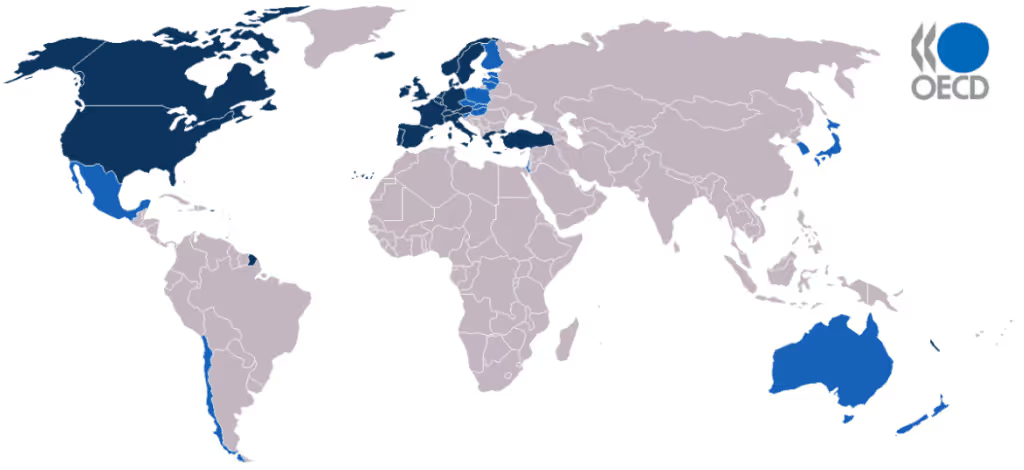
Caption and source: OECD member countries, OECD.
Living in Spain: what to know about politics
Politically, Spain is a parliamentary monarchy. King Felipe VI has been head of state since his father Juan Carlos I abdicated in 2014.
Pedro Sánchez, president of the Socialist International and secretary-general of the PSOE (Spanish Socialist Workers' Party), is Prime Minister and has led the government since 2018. The left was confirmed in power at the general election of 23 July 2023 (23J), holding back the rise of the right and of nationalism. In a country marked by the Franco dictatorship, the stakes were high.
The country is divided into 17 autonomous communities, each with its own regional government and executive and legislative powers over its territory. This is important to know if you want to settle in the land of Cervantes, as it affects many aspects of life for Spaniards, and therefore for foreigners living there: property, tax, etc.
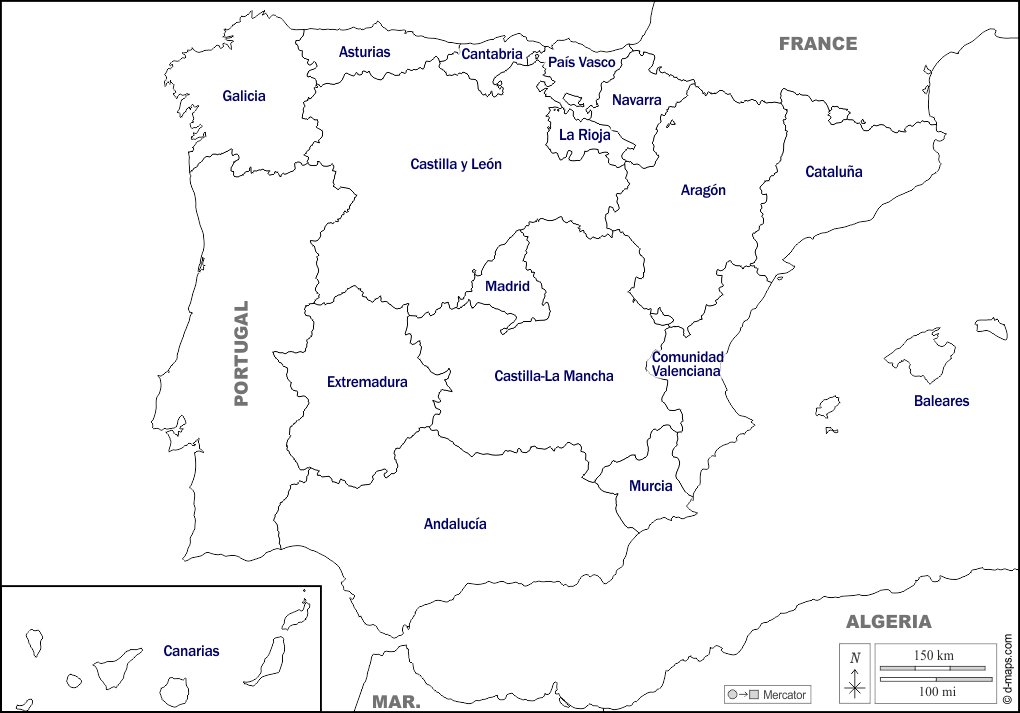
Caption and source: Spain's autonomous communities, d-maps.com
Why live in Spain?
According to the latest official figures from INE, Spain's National Statistics Institute, more than 7.4 million foreign nationals live in Spain (1 July 2026).
Mild weather all year round, an exceptional quality of life, a relatively low cost of living, a reliable healthcare system, the food, deep-rooted traditions, superb nature, cities of every size, lively or calmer but always welcoming, etc. These are just some of the reasons why so many have settled there.
A closer look at the cost of living in Spain
Living in Spain appeals in particular because the cost of living is generally lower than in the UK and much of northern Europe, while offering a good level of comfort. However, costs vary considerably from one region to another. For example, in Madrid or Barcelona, average rents for a one-bedroom flat are around €800 to €1,000 a month, while in smaller cities such as Valencia, Alicante or Murcia, you can find rentals for €400 to €600. On the Mediterranean coast, tourist areas such as the Costa Blanca or the Costa del Sol charge more in high season, but remain attractive for retirees and expats looking for a mild climate all year round.
Beyond housing, everyday expenses (food, transport, leisure) are often more affordable than in the UK or northern Europe. A restaurant meal costs €10 to €15 on average, and fresh produce at local markets is reasonably priced. The Spanish public healthcare system is another plus, offering quality care at low cost, especially for registered residents.
Finally, for an overall monthly budget, allow €1,000 to €1,800 a month for a comfortable life, depending on lifestyle and location. These figures make Spain a favourite destination for people who want to live well without breaking the bank.
Expense (approx.)
- Monthly rent (1 bedroom)
- Madrid / Barcelona (€): 800-1,000
- Mid-sized cities (Valencia, Alicante) (€): 400-600
- Rural / coastal areas (€): 300-500
- Groceries (monthly)
- Madrid / Barcelona (€): 200-300
- Mid-sized cities (Valencia, Alicante) (€): 150-250
- Rural / coastal areas (€): 120-200
- Restaurant meal (simple dish)
- Madrid / Barcelona (€): 10-15
- Mid-sized cities (Valencia, Alicante) (€): 8-12
- Rural / coastal areas (€): 7-10
- Monthly transport (pass)
- Madrid / Barcelona (€): 40-60
- Mid-sized cities (Valencia, Alicante) (€): 30-45
- Rural / coastal areas (€): 20-35
- Healthcare costs (monthly average)
- Madrid / Barcelona (€): 30-50
- Mid-sized cities (Valencia, Alicante) (€): 20-40
- Rural / coastal areas (€): 15-30
- Leisure and going out
- Madrid / Barcelona (€): 50-100
- Mid-sized cities (Valencia, Alicante) (€): 40-70
- Rural / coastal areas (€): 30-60
- Approximate total monthly budget
- Madrid / Barcelona (€): 1,200-1,800
- Mid-sized cities (Valencia, Alicante) (€): 900-1,300
- Rural / coastal areas (€): 700-1,000
Advantages of living in Spain
The Mediterranean climate and its 300 days of sunshine a year
The average annual temperature in Spain is around 16 degrees Celsius. Winters are pleasant and grey days are rare. Summers are hot, it is true, sometimes very hot. In 2023, Spain made headlines with a record heatwave. But the country is far more used to coping with such temperatures than northern Europe.
Architecture has always taken this into account. Buildings tend to have light-coloured walls and small windows to keep the sun out, and streets are narrow and shaded. There are many green spaces. The siesta shelters people during the hottest hours, and working hours are adjusted in summer.
In short, for anyone moving to Spain from abroad, the Spanish climate remains a real advantage.
A relaxed lifestyle, often outdoors
This lifestyle is envied far beyond Spain's borders. Yes, in Spain people live outdoors for much of the year. First because it is mild, and second because having a drink or even dinner on a terrace is not expensive. On the Mediterranean coast, it is common to see families meet by the sea and set up a table and folding chairs to share a homemade paella at the weekend.
And living outdoors, getting fresh air and socialising is good for your health. At any age.
A rich and unique culture
Spain is the 4th country in the world for the number of UNESCO World Heritage Sites. It is a Catholic nation, but on the mainland its history is closely linked to Muslim culture. In the Canary Islands, off the coast of Morocco, tribal influences have left their mark, as the archipelago lies less than 100 kilometres from the African coast.
Its architectural wonders are many: the Alhambra palace in Granada, the Sagrada Família, Casa Batlló, Antoni Gaudí's La Pedrera and the Torre Agbar in Barcelona, the Torre Galatea in Figueres, the Guggenheim in Bilbao, the City of Arts and Sciences in Valencia, etc.
The country has 1,500 museums and is home to many artists, some of them among the best known in the world: Goya, Velázquez, Gaudí, Picasso, Miró, Sorolla, Almodóvar and Rosalía.
The food is far richer than you might think, flamenco culture runs deeper and there are many cultural routes.
Age-old traditions bring Spaniards and generations together, and some are even on UNESCO's Intangible Cultural Heritage list (the Fallas of Valencia, flamenco, the Córdoba Patios Festival, etc.).
If you love culture, Spain is an ideal destination.
Living in Spain: the low cost of living
It is no myth: life in Spain costs less than in the UK and much of northern Europe. This difference naturally grows or shrinks depending on the towns and villages you compare. Day-to-day costs in a small village back home may be similar to those in a medium-sized Spanish town. We come back to this in more detail later in this article.
The Spanish public healthcare system
In Spain, the public healthcare system is of high quality and easy to access. Spain has social security agreements with the other EU countries and the UK, which can allow EU and British nationals to keep some of their social security rights.
In the private sector, you will also get very good care.
We explain below the steps to take to access social security if you plan to settle in Spain.
Good to know: if living near a medical facility matters to you, Catalonia has the most hospitals: 200, public and private combined.
Spain has well-established international communities
Foreign residents are especially numerous in Barcelona and its province, in Madrid and in the province of Alicante, and Valencia attracts more and more of them.
Our advice is to make connections by joining platforms such as Meetup, Eventbrite or Facebook groups. Also keep an eye on social media.
Spain, a property eldorado
Yes, Spain is still a property eldorado today, there is no doubt about it. Prices remain low: allow €1,990/m² on average according to the latest figures from Idealista, the leading property portal in southern Europe.
Prices vary widely from one region to another, as you will see below.
The choice is vast: houses, flats, big or small towns, seaside or countryside, anything is possible. You could even buy an abandoned village for less than €200,000.
Whatever your budget, you will find a property.
Feel free to contact us if you have a project in Spain. Our English-speaking property advisers work from offices across Spain and can help you.
Disadvantages of living in Spain
For an expat, there are few downsides to life in Spain, but there are some.
Unemployment
In Spain, unemployment is relatively high in some regions. On average, it was 12.15% in the first quarter of 2023. It is close to 20% for the foreign population according to INE data.
Good to know: since COVID-19 and the rise of remote working, it is easier for expats to consider a working life in Spain.
Our advice is to start exploring job opportunities before you leave: contact international companies, join expat support groups on Facebook and ask your country's chamber of commerce in Spain for information.
Speaking the language helps you fit in
To make settling in easier, learning Spanish is a must. If you are looking for useful tips, read our article: Our 7 tips to learn Spanish easily.
Spanish hours
At first, it is hard to live on Spanish time. Lunch does not start before 2 pm, dinner is around 9 pm and the siesta remains a strong tradition, to avoid the hottest hours. It takes some getting used to, and that can take a while.
Where should you live in Spain?
It obviously depends on the lifestyle you are looking for: life by the beach, the calm of the countryside, the buzz of a big city? There is something for every taste and every budget.
Most of the areas listed below have British or international schools nearby.
Living in Spain by the sea
For nature lovers who can work remotely or who are retired, our property specialists in Spain recommend:
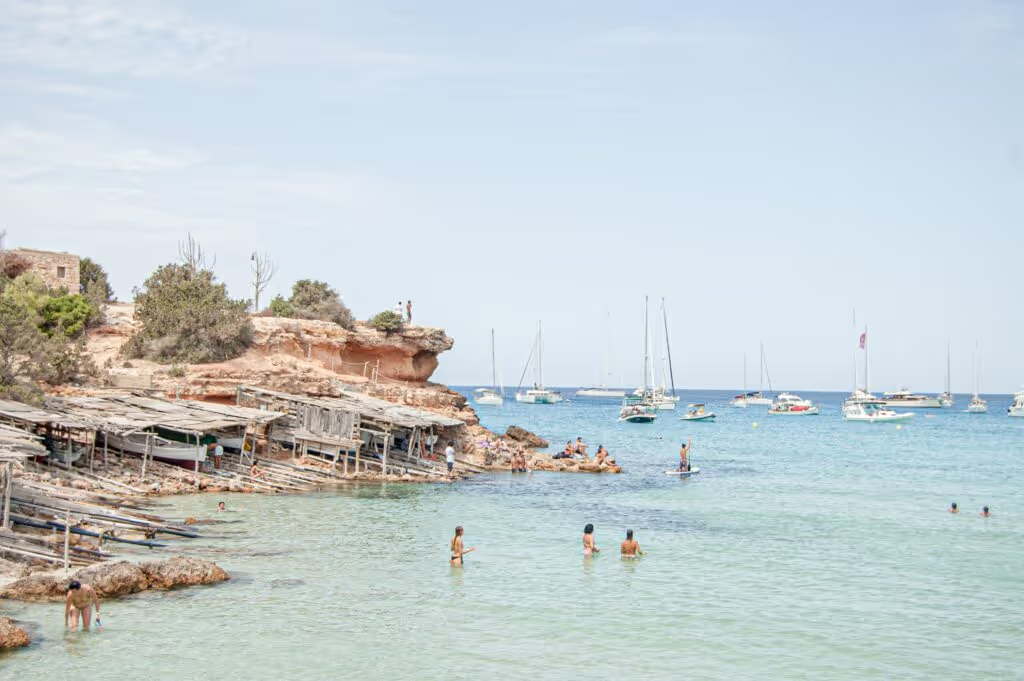
- The Balearic Islands Official census data show a large foreign community living on these idyllic islands. To buy a home in the Balearic Islands, allow €3,900/m². Over €8,000/m² for Formentera, the fashionable island opposite Ibiza. Good to know:
- The Balearics have two sides: the party is in full swing from May to October, but the rest of the time the islands are quiet, even very quiet.
- People who live in the Balearics usually choose properties in the countryside.
- If you have children, note that there are British and international schools on Mallorca and Ibiza.
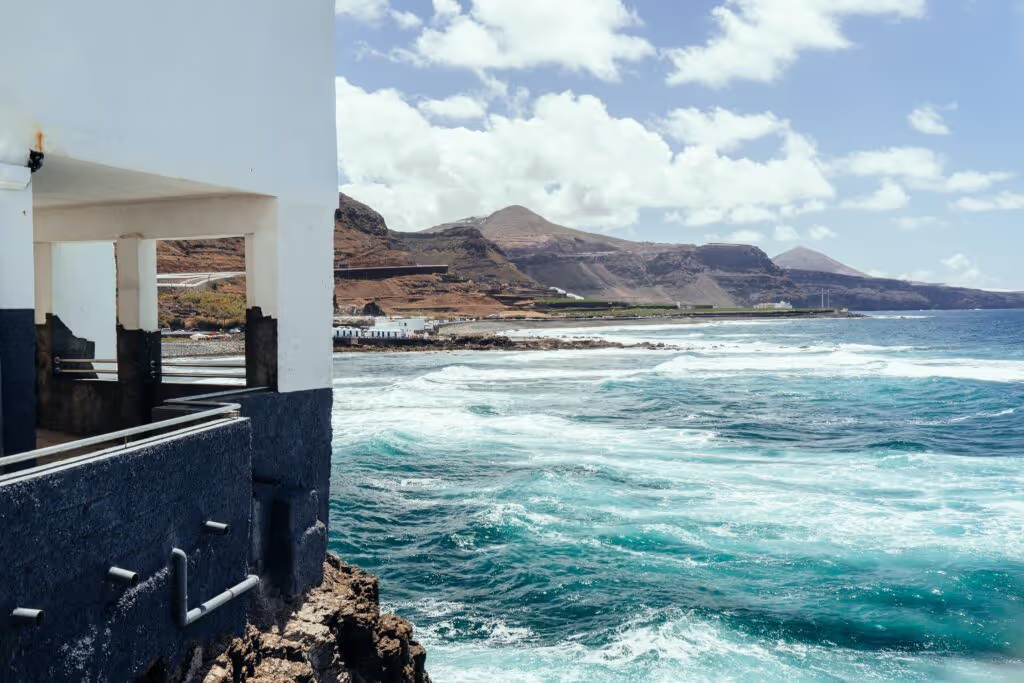
- The Canary Islands As in the Balearics, the padrón (census) records a large foreign community spread across the 7 main islands of the Canary archipelago. In the Canary Islands, you can buy a home for €2,200/m² on average. But the price range is wide. The top end is €3,800/m² in Adeje, in the south-west of Tenerife, because the town's infrastructure attracts many tourists, which inevitably pushes prices up. In the Canaries, water sports are king, which is worth knowing when you choose your destination. Note:
- Here too, there are two ways of life in the archipelago: the hectic one of tourists, with busy nightlife and crowded beaches, and a calmer side, close to nature.
- In the Canaries, you will find British and international schools on both Tenerife and Gran Canaria.
- The Mediterranean coast The Mediterranean coast remains a favourite with foreign buyers. It has many advantages.
- The Costa Brava is close to France (less than an hour from the border), with fishing coves, crystal-clear waters and a well-established foreign community. It is an ideal place to settle. Property prices average €2,250/m². Our specialist agents based in the region can guide you if you plan to buy on the Costa Brava.
- The Alicante area is home to one of the largest foreign communities in Spain, many of them retired, according to official census data. If you want to invest in the Alicante area, prices are around €2,000/m². Towns and villages on the outskirts are of course cheaper.

Living in a city in Spain
If you are looking for an urban lifestyle and job opportunities, we recommend:
- Madrid, Europe's new fashionable capital Madrid ranks 5th among the best cities for expats in the InterNations ranking, and it is no surprise that the capital is home to a large international community.
- Since the end of COVID, Madrid has attracted a great many foreigners, especially investors.
- The quality of life is outstanding for a capital. The city is very well connected, the airport is close to the centre and nature is quickly reached. In short, Madrid is perfect for young, dynamic people. It is also ideal for remote workers from Europe's big capitals.
- According to the National Statistics Institute, in 2022 the Madrid region accounted for 50% of foreign investment in Spain. Its economy is strong and its property market is booming.
- Allow €4,000/m² on average if you want to buy there.
- To invest in Madrid, book a call online with our property agents based in the capital.
- Barcelona, the Catalan city Barcelona is the city of start-ups and tourism. Tourism is said to account for 14% of the city's GDP.
- The city is home to one of the largest international communities in Spain. Many young professionals from all over Europe have settled in this cosmopolitan city.
- In this big seaside city, close to the French border, property prices are above €4,100/m², but there are many interesting investment opportunities if you get the right support.
- If you have a property project in Barcelona, our property agents can help you find the property that suits you. Contact them.
- Valencia, the city on the rise Valencia is the city that is winning the hearts of foreign buyers. It is home to a fast-growing international community.
- Spain's third-largest city lies on the Mediterranean, the weather is mild in every season, the quality of life is exceptional and property is still very affordable (€2,200/m² on average).
- Valencia was named the best city in the world to live in by the prestigious Forbes magazine.
- If you are looking for a property in Valencia, contact our property advisers there.
How do you move to Spain from the UK, the US or the EU?
Since the Maastricht Treaty, signed in 1992 by all the member states of the European Union, there has been free movement within the European Union.
This makes things much simpler for EU citizens, such as German, Dutch or Irish nationals: no visa is needed to move and start a new life, and you can work and even invest in property without difficulty. Since Brexit, British citizens, like Americans, need a visa to live in Spain for more than 90 days in any 180-day period.
Here is what to remember if you want to live in Spain:
- Even with free movement in the Schengen area, there are a number of formalities to complete to settle legally in Spain, even as an EU citizen. We come back to them in the next section.
- Processing times have been longer since the COVID-19 pandemic. This is due to the backlog built up during the crisis and the rise in applications afterwards.
- You can start the process from your home country. So do not waste time once you have decided.
- Spanish tax is no obstacle to moving because Spain has double taxation treaties with many countries, including the UK, the US, Ireland, Germany and the Netherlands.
For more information on tax in Spain, read on.
Formalities for moving to Spain
If you want to live in Spain, here are the steps you will need to take:
Applying for your NIE
The first and most essential step: applying for your NIE, the Número de Identidad de Extranjero (foreigner identity number). The NIE is the essential pass for anyone moving to Spain or investing in property there. It allows the authorities to identify you and follow your activities in Spain. It does not replace your identity document in any way.
The number you are given is yours for life, but the certificate is only valid for 3 months.
You will be asked for it to open a bank account, buy a property, register for social security, pay your taxes and even set up an internet connection or receive a parcel at home.
To get it, you will need to:
- Book an appointment on the official government website.
- Fill in form EX-15.
- Fill in the form and bring proof of payment of the following fee: Tasa modelo 790 código 012. The fee is €9.84 for a NIE and €12 for the EU registration certificate.
- Bring a document showing why you are applying for a NIE (job offer, property purchase in Spain, etc.)
- A valid passport (or EU national identity card) and a photocopy.
We have written a practical guide on getting your NIE.
The empadronamiento
The empadronamiento, or census registration, means signing up on your town hall's register of residents. Registering on the padrón is essential if you decide to settle in Spain for good, whether you buy or rent a home.
The padrón serves as proof of address and lets you enrol your children at school, register for social security and access all the social benefits you may be entitled to.
You can register ("empadronarse") at the town hall with:
- A valid passport (or EU national identity card) and a photocopy.
- Your NIE and a photocopy.
- Your rental contract or the title deed to your home (escritura) and a photocopy.
Here again, we recommend reading our practical guide to registering on the padrón.
The Certificado de Registro de Ciudadano de la Unión (EU citizens)
If you plan to stay in Spain as a resident, you must apply for it officially. As your NIE is only valid for 3 months, EU citizens apply for this EU registration certificate, which carries the same number. British and American citizens apply instead for a TIE (foreigner identity card) once they hold a residence visa.
Here is how to apply:
- Book an appointment at the police station nearest to you through this official government link.
- Bring your valid passport or identity card and a photocopy.
- Your certificado de empadronamiento and a photocopy.
- The EX-18 form duly completed.
- The completed form and proof of payment of the following fee: Tasa modelo 790 código 012. The fee is €9.84 for a NIE and €12 for the EU registration certificate.
Your Certificado de Registro de Ciudadano de la Unión will be required if you want to buy property in Spain as a resident (and so get the same bank terms as a Spanish buyer), if you need to register as unemployed or to pay your taxes.
Registering with Spanish social security
If you move to Spain for a short period, you will not need to register with social security: your European Health Insurance Card (EHIC), or the GHIC for UK residents, will be enough. Americans should take out private health insurance. You can get the card from your health insurer or national health service.
If you plan to stay, however, registering is essential.
Here is how to get your tarjeta sanitaria (health card):
- Book an appointment at your nearest health centre.
- Bring a document showing the social security number you have been given (you get one automatically if you find a job in Spain).
- Bring your valid passport or identity card and a photocopy.
- Your NIE or residence certificate and a photocopy.
- Your empadronamiento and a photocopy.
- Form S1, if you are transferring your health cover to Spain from another EU country or the UK (as a pensioner, for example). You can request it from the social security body or health insurer in your home country.
Good to know: pensioners from the EU and the UK can ask to have their health cover transferred to Spanish social security. Our guide to retiring in Spain explains this in more detail.
Other steps to plan for
- Remember to open a bank account in Spain: it will make most of your formalities easier, whether you are settling in or buying a property.
- Enrol your children at school. You will find more information on this further down.
- Find a rental home on property portals: try Idealista or Fotocasa for example.
- If you would like to buy property in Spain, our experts are there to help you.
What budget do you need to live in Spain?
As mentioned, life in Spain costs less than in the UK and much of northern Europe, but your real cost of living will depend on where you choose to settle.
To give you an idea, in 2023 the minimum wage was €1,260 a month in Spain, according to official data.
Allow roughly €20,000 a year (€1,660 a month) for a modest lifestyle. With €25,000 a year, you will live comfortably.
To compare everyday prices in Spain with those in your home country, you can use a cost-of-living comparison site (for example the Numbeo website).

Living in Spain without being a resident: is it possible?
As an EU citizen, you can perfectly well live in Spain temporarily without applying for your Certificado de Registro de Ciudadano de la Unión (residence). British and American citizens can stay up to 90 days in any 180-day period without a visa.
The right option depends on why you are moving to Spain. As mentioned, your NIE certificate will be valid for 3 months. If you want to make short stays, you can apply again. You then keep your social security cover and benefits in your home country.
Be careful: if you spend more than 183 days (six months) in Spain in a calendar year, you will automatically be considered a Spanish tax resident. You will then have new formalities to complete.
Living in Spain and working in your home country: our advice
Day to day and logistically, it is perfectly possible, not least because the main Spanish airports have frequent flights to the UK and northern Europe.
If you run your own business, you will have no problem. If you are an employee, however, check with your employer that having a foot in each country is not an issue.
Second, you need to be clear about your tax residence to avoid tax and administrative problems.
Our advice if you are in this situation is to get help from a gestor (an administrative and tax adviser) who specialises in international cases. If you are looking for trusted contacts, contact our team.
The school system in Spain
If you plan to move to Spain with children, it is essential to think about their schooling as early as possible. In Spain, you can choose between state schools, semi-private schools (concertadas) and private schools. Most private schools are Catholic, but their curriculum is similar to that of state schools.
In Spain, school is not compulsory before the age of six. School days are often shorter at the end of the school year because of the heat.
- Nursery is called guardería.
- Pre-school is called preescolar.
- Primary school is called colegio (it runs to age 12, so it includes the equivalent of Year 7 in England or sixth grade in the US).
- Secondary school is called secundaria (from age 12 to 16: Year 8 to Year 11 in England, or seventh to tenth grade in the US).
- The last two years of upper secondary school make up the bachillerato. The university entrance exam is called the selectividad.
For state schools, the enrolment process is quite long and places are allocated on criteria such as how close you live, the number of siblings already at the school, income, etc.
For private schools, admission criteria can vary. It is important to contact these schools directly and well in advance, as there are sometimes waiting lists.
Enrolment takes place in April for the following school year.
You can also consider a British or international school in Spain. Standards are generally high, but fees are a significant cost.
Why retire to Spain?
We have written a complete guide to retiring in Spain. Here is a summary of the main points to remember.
In 2023, Spain ranked 6th in the Global Retirement Index and there are many reasons for its success with retirees:
- Its 300 days of sunshine a year.
- Its rich culture.
- Its relaxed outdoor lifestyle.
- Its cost of living, well below that of the UK and northern Europe, which lets retirees live more comfortably on their pension.
- Its efficient and accessible healthcare system.
- Spain was ranked the "healthiest" country in the world in a 2019 Bloomberg ranking.

Formalities for retiring in Spain
On top of all the formalities detailed above, before moving to Spain to retire, you should complete three essential steps:
- Tell your pension providers at home about your change of address.
- Arrange for your state pension to be paid abroad with your national pension body (the International Pension Centre in the UK, the Social Security Administration in the US).
- Return a life certificate when asked, so that you keep receiving your pension.
Tax advantages of living in Spain
The first tax advantage: you will not pay tax twice on the same income because, as mentioned, there are double taxation treaties between Spain and many countries, including the UK, the US, Ireland, Germany and the Netherlands.
Which taxes will you have to pay in Spain? It depends on your situation and on one key criterion: your tax residence.
The following are considered Spanish tax residents:
- Anyone who spends more than 183 days in total, not necessarily consecutive, in Spain during a calendar year.
- Anyone whose economic and/or family interests are based in Spain.
So the list of taxes you will have to pay depends on your status.
Taxes for non-residents
- If you are not a tax resident in Spain and you spend a few months a year there in rented accommodation, you will have no tax to pay.
- However, if you are not tax resident in Spain but you own a second home there, you will be liable for certain taxes:
- ITP (Impuesto sobre Transmisiones Patrimoniales, the transfer tax): this tax is paid only once, when you buy the property. Its rate ranges from 4% to 13% depending on the region.
- IBI (Impuesto sobre Bienes Inmuebles): Spain's local property tax, paid every year. It is calculated on the property's cadastral value and never exceeds 1.3% of that value.
- IRNR (Impuesto sobre la Renta de No Residentes, non-resident income tax): if you let your property when you are not using it, you will pay this tax. The rate is 19% for residents of the EU or EEA and 24% for others, including UK and US residents.
- Ganancia patrimonial is the tax on the capital gain when you sell your property.
- Impuesto sobre el Patrimonio (wealth tax): you will have to pay it if the value of your assets in Spain exceeds €700,000 (or €500,000 in Catalonia). Under the State scale, the rate ranges from 0.2% to 3.5% depending on your bracket, and regions can set their own. Note: in the Madrid region, it is 100% relieved.
- Plusvalía municipal (municipal capital gains tax): this tax is only due when the value of land in an urban area has increased at the time it changes hands. It is complex to calculate, so we recommend using Idealista's calculator to estimate it.
- Renta imputada is a tax based on a notional income of 2% of the property's cadastral value. You owe it simply because you own a property in Spain.
To find out more, read our article Non-resident property taxes in Spain: the 5 you must know.
Taxes for residents
Spanish residents, like residents of most countries, pay income tax. It is IRPF, the Impuesto sobre la Renta de las Personas Físicas (personal income tax). You must declare all your income, including income you may receive in your home country or elsewhere (rental income, capital gains from selling a property, maintenance or pension payments, etc.)
We have written a practical guide to IRPF.
When it comes to property tax, residents must also pay:
- ITP (Impuesto sobre Transmisiones Patrimoniales), see the previous section.
- IBI (Impuesto sobre Bienes Inmuebles), see the previous section.
- Ganancia patrimonial (see the previous section).
- Impuesto sobre el Patrimonio (wealth tax), see the previous section.
- Plusvalía municipal (municipal capital gains tax), see the previous section.
- Renta imputada (see the previous section).
- Impuesto sobre Sucesiones y Donaciones (inheritance and gift tax).
- Note that business taxation is favourable in Spain too. Corporation tax is 25% for companies with a turnover below €8 million, and employer social security contributions are 30.6%. There are advantageous special regimes for some companies (small businesses, newly created companies, companies specialising in research and development, etc.).
Tax for retirees
If you have chosen to settle permanently in Spain for your retirement, you will become a Spanish tax resident and will therefore pay your taxes to the Spanish state.
Here are the key points to remember:
- Your pension will be treated as income, so you must declare it in your annual tax return, IRPF (see previous sections).
- You may not have to file a tax return if your income from work or pensions is below €22,000 a year and comes from a single payer (or other payers add up to no more than €1,500 a year), and if your investment income (interest, for example) does not exceed €1,600 a year. If other payers add up to more than €1,500, the threshold falls to €15,876. That lower threshold also applies when the payer does not have to withhold Spanish tax, as is usually the case for a pension paid from abroad.
- How a foreign pension is taxed also depends on the double taxation treaty between Spain and the country that pays it.
Be aware: in Spain, tax depends on each autonomous community, especially property tax.
Our advice is to get help: Spanish taxes can be complex, and even Spaniards usually use a gestor (an administrative and tax adviser) to help them with their tax return. If you are looking for trusted contacts, contact our team for help.
Can you live in Spain on €800 a month?
The cost of living in Spain is certainly low, much lower than in the UK or northern Europe. But if you want to live on such a small amount, you will need a fairly spartan lifestyle: a rural area, a room in a flatshare, no extras, etc. It is possible to live on €800 a month in Spain, but day-to-day life will be hard.
Conclusion
For expats, life in Spain is very pleasant. The quality of life is ideal, the cost of living fairly low, the healthcare system efficient and property affordable. Online expat groups, international schools and cultural institutes all help you settle in faster.
Thomas Rouer is the founder of Alveo Search and the CEO of the Alveo group. Based in Spain for almost ten years, he develops property services designed for the specific needs of foreign buyers.
His expertise covers every aspect of buying property in Spain: understanding the market, searching for and selecting properties, negotiation, financing, paperwork, tax and securing the purchase process.


Our resources for buying in Spain