Français
 English
Buying a bank repossession in Spain: risks and opportunities

- Origins: the Spanish property bubble peaked in 2006 and burst with the 2008 crisis, leading to mass repossessions and record unemployment of 27% in the first quarter of 2013, according to the National Statistics Institute.
- Procedure: governed by articles 551.3 and 612 of the LEC, it starts with a notice of default, can lead to listing on the ASNEF register after five months of arrears, then to court action after more than a year and an auction.
- Who owns these properties: banks and financial institutions, as well as Sareb, created in 2012 and 50% owned by the State, which bought nearly 200,000 problem assets between 2012 and 2013.
- Volumes: in early November 2023, Idealista listed more than 23,000 repossessed homes, just under 250 of them on the Costa Brava. Barcelona, Murcia and Tarragona account for most of them.
- Key point: these properties are not always sold off cheaply, as they are valued at market price and may carry debts. Financing, on the other hand, can reach 90% or 100%, over terms of up to 40 years.
Buying a bank repossession in Spain: risks and opportunities
Dreaming of a seaside home on the Mediterranean coast or a profitable investment, and heard that bank-repossessed properties in Spain are very cheap? Be careful: this topic is full of misconceptions.
Buying a property repossessed by a bank can be an opportunity, but it is a risky move.
Here is why.
Definition: what is a bank repossession?
In property, a bank repossession is a legal process started by a bank when the borrower does not meet the terms of the loan taken out to buy their home. In practice, when they buy a property, in Spain or elsewhere, most buyers take out a loan from a bank. Borrowers commit to repaying a set amount over a set period. Sometimes they can no longer keep up. Losing a job, a divorce or other financial difficulties push them into insolvency and force them to find a solution with their bank. The bank may then start repossession proceedings. The bank takes the owner's place by seizing the home and putting it up for sale (sometimes at auction) to recover the money it lent. It is a kind of freeze until the unpaid debt is settled.
In Spain, bank repossessions have a reputation as attractive opportunities for buyers, but they are complex and rushing in would be a mistake.
If you have questions on this topic or need information before starting your property purchase in Spain, book an online call with our team.
Why are there so many repossessed properties in Spain?
In Spain, several factors explain why so many bank-repossessed properties are on the market.
The property bubble and the global economic crisis
Before the 2008 global financial crisis, Spain went through a property bubble. It peaked in the late 2000s, in 2006 to be precise. At that time, the Spanish property market was booming: prices were soaring, and so were new builds and the number of loans granted. The market was overheating.
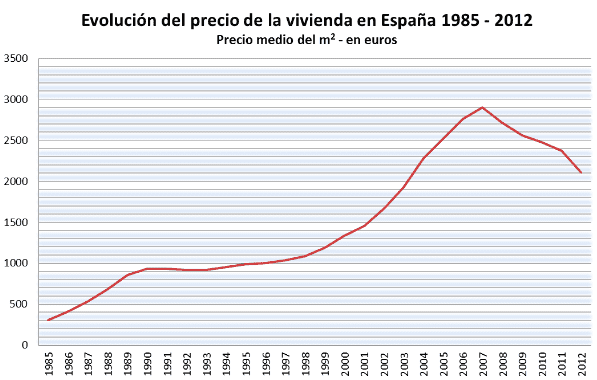
Caption: property prices from 1985 to 2012.
Source: Wikipedia / INE
In 2008, the subprime crisis in the United States and its effects on global finance burst this property bubble, causing a sharp fall in property prices, mass repossessions and lasting economic damage for Spain, including soaring unemployment, which hit a record 27% in the first quarter of 2013, according to Spain's National Statistics Institute.
Many owners were left with homes worth less than their loan. Some, with their backs to the wall, could no longer afford their mortgage repayments. The impact on the sector was huge. This unprecedented crisis changed its shape and is still on the minds of Spaniards and experts, who watch for the slightest change in the market.
An oversupply of homes
After the crisis, Spain's economy recovered very slowly and, on top of the properties repossessed by banks, there was an oversupply of new homes built during the bubble. Many had found no buyer. They too ended up being taken over by banks to stabilise the market.
Even today, thousands of homes are held by these institutions. And, over time, bank repossession has become a normal part of the market.
Are you looking for a repossessed property in Torrevieja? A property opportunity in Madrid? Contact our team. Alveo Search is the buyer's agency of the Alveo group in Spain. Our experts can support you at every step of the buying process.
The bank repossession procedure in Spain
The stages of a bank repossession in Spain
The repossession procedure in Spain is governed by law, in particular by articles 551.3 and 612 of the LEC (the Civil Procedure Act).
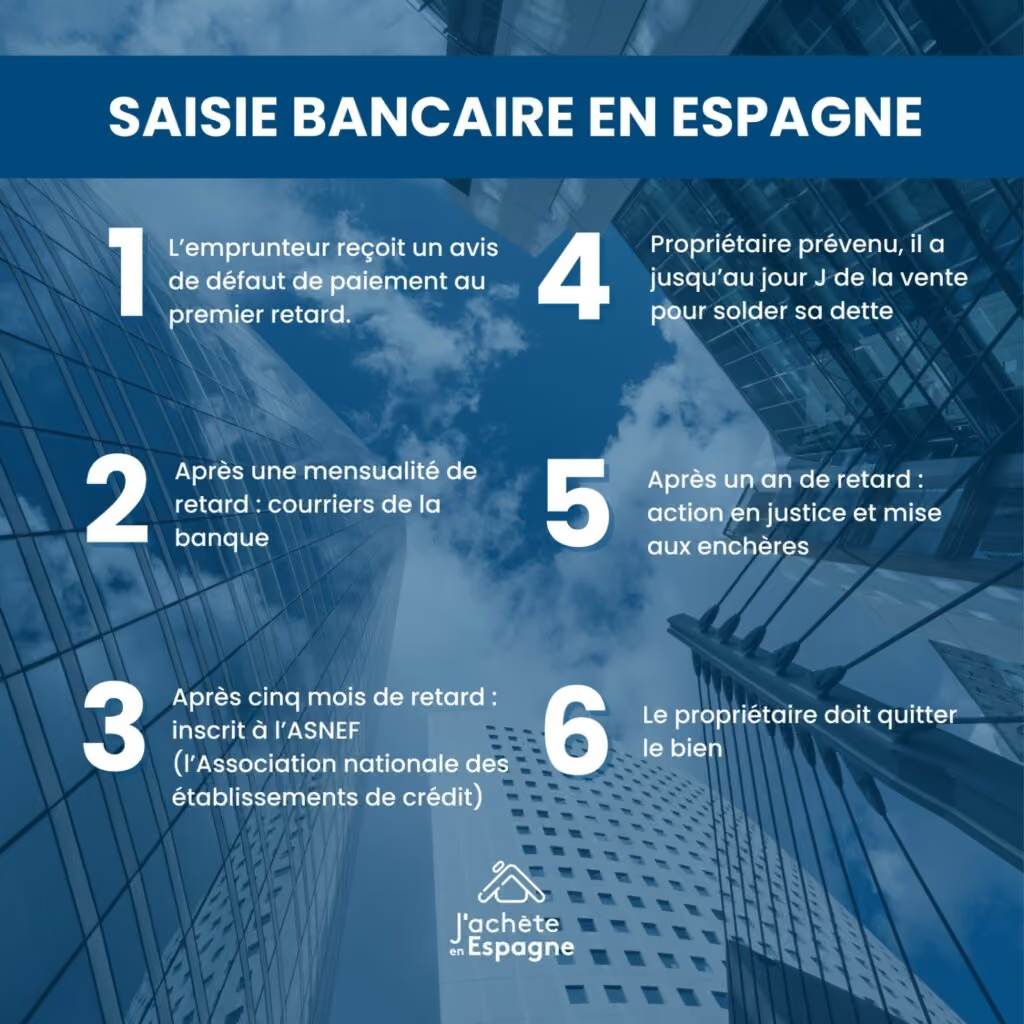
Here are the stages an owner goes through before being permanently dispossessed of their property:
- The borrower receives a notice of default after the first late payment.
- After one missed monthly payment, they receive several letters from the bank warning them about the situation.
- After five months of arrears, they may be added to the bad debtors' register of ASNEF (the Spanish national association of credit institutions).
- After more than a year of arrears, legal action is taken. An auction is ordered.
- The owner is notified. They have until the day of the sale to pay off the debt.
- The owner must leave the property.
But what happens if the home is not sold at auction? Several scenarios are possible:
- Purchase by the bank: the bank may decide to acquire the property for an amount equal to the debt or to a percentage of its valuation.
- New auction: if the property is not sold at the first auction, the court may decide to lower the price and hold a new auction.
- Direct sale: the bank may choose to sell the property outside the auction process, at a reduced price on the open market.
- Kept by the bank: if none of these options leads to a sale, the bank may take possession of the property and keep it on its balance sheet as a property asset.

Who owns the properties once repossessed?
- The property belongs to financial institutions:
- As you will have gathered, in some cases banks and financial institutions acquire these homes. They can then be resold directly by the bank, through its own estate agency, through high-street agencies or directly on online portals.
- The property becomes owned by Sareb:
- Some of the properties repossessed during the crisis are still for sale and now belong to Sareb (the company that manages assets from the restructuring of the banking sector).
- It is a Spanish entity (50% of Sareb is owned by the State) that oversees the sale of property from certain banks. It was created after the 2008 financial crisis, in 2012 to be precise. According to its website, Sareb's aim is to recapitalise the banks most affected by the crisis. From 2012 to 2013, it bought nearly 200,000 so-called “problem” assets from them. Today, it sells them while trying to maximise returns.
Recent changes in the law on bank repossessions
Legislative changes, such as the law of May 2013, were introduced to give borrowers more protection. It makes debt restructuring easier. These changes aim to balance the interests of creditors and borrowers while stabilising the property market.
Are there more bank repossessions in Spain than elsewhere in Europe?
Up-to-date figures on this are hard to find. However, there are probably fewer bank repossessions in other European countries. This is partly a matter of habit. In France, for example, banks are more inclined to renegotiate loan terms with borrowers in difficulty to avoid repossession.
In Spain, on the data side, note that a report published in June 2020 by the DESCA Observatory (the Centre for Economic, Social, Cultural and Environmental Rights) reports 1.7 million evictions from 2008 to 2020. According to this observatory, since the crisis, repossessions have become structural in Spain.
Buying a property that comes from a bank repossession
Want to buy a repossessed property? Here is what you need to keep in mind.
Advantages of buying a repossessed property
Buying a repossessed property can have some advantages, but it carries risks, such as unresolved legal or structural problems. It is essential to get support from a specialist before going ahead with this kind of purchase. Contact us to speak to an expert who can advise you.
- Occasional discounts:
- To get rid of repossessed homes, many banks regularly run promotions on them. In that case, the properties really are much cheaper than the market price. We come back to this below.
- The valuation is covered if the repossession is recent:
- The bank values all the properties in its portfolio. So, to know their market value, you will not need to pay for a new valuation, the tasación in Spanish.
- Note: if the repossession took place more than six months ago, you will probably have to have the home valued and pay for it. To make sure it reflects the market, the tasación is only valid for six months.
- Financing of up to 80%, sometimes 100%: Since the war in Ukraine, inflation and the successive rate rises decided by the European Central Bank have changed the property market. Rates went from -0.5% to +4% in just over a year, forcing banks to cut loan amounts sharply and tighten borrowing conditions. In this context, mortgages on bank-repossessed properties are a category of their own. If you have your eye on a property of this kind, you could get maximum financing, as the banks' goal is to sell their properties as quickly as possible to clean up their balance sheets. So what are the features of mortgages on bank-owned flats?
- Longer repayment term: banks usually offer a maximum of 30 years, but with this type of mortgage you could get up to 40 years to repay.
- More flexible payments: for banks, it matters that the new owner can keep up with all the mortgage payments. That is why they are usually more flexible. In some cases, in the first years, the borrower only pays the interest and a small share of the capital.
Drawbacks of buying a repossessed property
Here are the main challenges to consider if you want to buy a repossessed property.
- Likely paperwork complications: transactions involving repossessions are often complex administratively. You need patience and competent professionals around you.
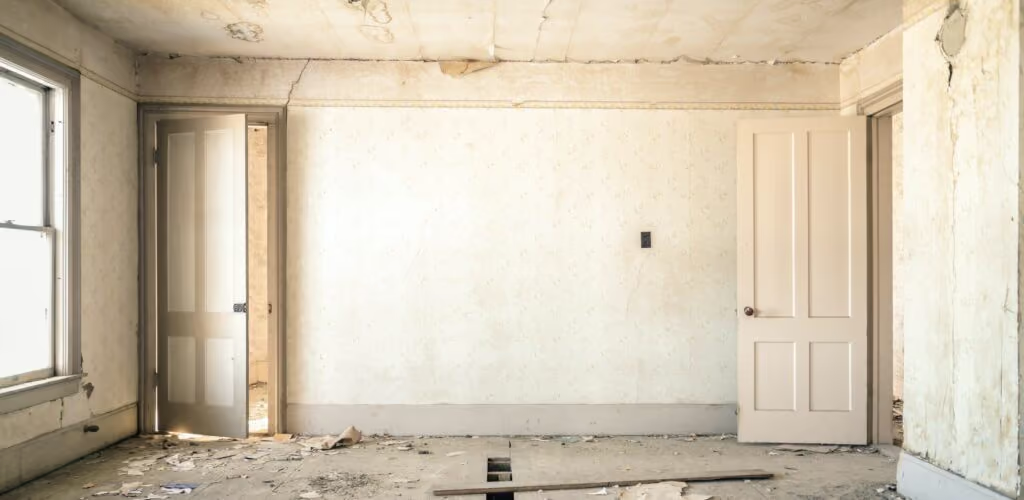
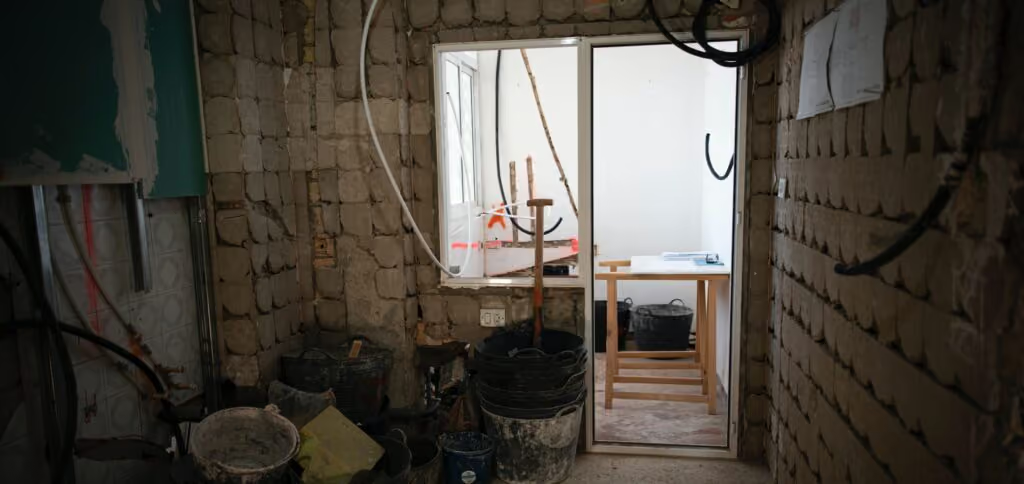
- Poor condition: many of these repossessed homes have been for sale for some time and may be damaged. You will need to factor repair costs into your purchase.
- Construction and registration defects: in Spain, the notary is not responsible for checking the property during the sale. They only make sure the transaction complies with local law. To find out more on this point, read our practical guide: “The role of the notary in Spain”.
Put simply, in Spain it is the buyer who must check the property and the legal documents (title deeds, community of owners documents, building permits, etc.). This pre-purchase check is decisive. That is why buyers use a lawyer. With a repossessed property, getting compensation from the bank later for construction defects, missing registration, planning breaches or disputes with neighbours can take even longer and be harder than with a private owner.
Note: at Alveo Search, we handle these checks and the resolution of these problems. Lawyer's fees are included in our fees. Book an online call with our team.
- Existing debt: as regular readers of our blog know, one of the points to check before any property purchase is that no debts are attached to the property. With a repossessed property, it is logical that unpaid amounts are linked to the home (to the tax office, the community of owners, etc.). You therefore need to check the property's Land Registry extract and the certificate of debts to the community of owners (the bank must provide these documents).
- Be wary of the asking price: the price of repossessed flats and houses is often the subject of fantasy. In the popular imagination, these properties are always cheaper. Once again, we stress that in most cases this is a misconception.
In reality, these properties are sold at market price, except when the bank offers discounts in a one-off promotion because it urgently needs to recover funds.
So why are these properties not necessarily cheaper? Mainly because the bank needs to recover all the money it lent. Second, because they are valued by a professional based on the current market price (the tasación we mentioned above). Finally, because they are properties tied to unpaid debts or legal problems that will have to be resolved, which costs money.
Our advice: do not get carried away, do your checks (inspect the property and all the related legal documents) and your sums, with help from a property professional. And, contrary to what you might think, the price of a repossessed property can also be negotiated. Alveo Search can support you with this kind of purchase and handle the negotiation if needed. Book a call with us.
- Limited supply: it stands to reason, but supply is limited. Banks do not have properties in every town in Spain and do not necessarily offer homes with the features you need.
In which regions can you find bank-repossessed properties in Spain?
Repossessed properties all over Spain
Every Spanish autonomous community has repossessed properties for sale. A simple search on the most popular property portals is enough to see it. In early November 2023, Idealista (the leading portal) listed more than 23,000 repossessed homes. You can see how they are spread across regions on the portal. According to these figures, Barcelona, Murcia, in the south-east of the peninsula, and Tarragona, in the south of Catalonia, are the cities with the most repossessed properties.
Bank repossessions on the Costa Brava
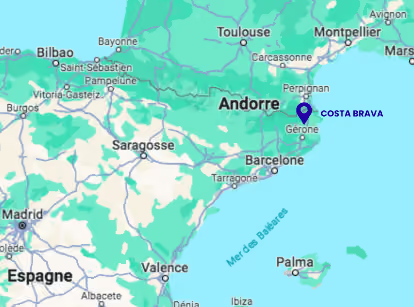
Many of you contact us to ask whether there are repossessed properties on the Costa Brava. The answer is yes. According to Spain's leading property portal, there are just under 250 at the moment.
Source: Google
These properties can be opportunities for investors or informed buyers looking for “bargains” in this very popular part of Spain. But do not take on this purchase alone. Contact us, our team can give you complete, high-quality support for this kind of purchase.
Practical tips for buying a bank-repossessed property
How can you find out the real price of these flats?
As you will have understood, the fact that these properties are part of a bank's asset portfolio does not mean they are always priced below market. Even if the bank mainly wants to recover the money it lent, the price of these homes is based on a valuation of the current market.
So how can you tell whether a property offered by a bank is really a bargain?
Follow these steps:
Carefully analyse the following factors and compare them with properties in the same area:
- Floor area;
- Number of bedrooms and bathrooms;
- Year of construction, but also the state of repair and any defects. The property could be very cheap because of its poor condition. Do not hesitate to open drawers and cupboards, check the windows and the plumbing, etc.
- Position of the flat in the building (1st floor, facing the courtyard or the street);
- Shared features (lift, communal terrace, etc.);
- Quality of the building materials;
- Location (region, town, neighbourhood);
- Look at how the flat's price has changed. See whether the price has gone down or up over recent months or years. This will tell you whether the bank is desperate to sell, and you will be able to negotiate.
Where can you find repossessed properties?
Now that you know what makes these properties different, all you need is to know where to find them.
Here are the channels banks use to advertise repossessed properties:
- In bank branches: you can go straight to a bank and ask to see the catalogue of homes it has for sale.
- Through banks' property agencies: some banks sell the properties they have acquired through their own estate agencies or agencies they work with.
- On online property portals: Fotocasa, Habitaclia, Idealista, etc. These sites usually have search filters to find properties sold by banks. For more on property portals, read our article: “Spanish property portals: how to use Idealista, Fotocasa and others”.
- At Sareb: we mentioned this body above.
- On the official dedicated portal: you can see the listings by clicking on this link and selecting the region you are interested in.
The process of buying a repossessed property
The process for buying a repossessed property is the same as for buying any property in Spain. On this point, see our article: “How to buy a property in Spain: the complete guide”
In short:
- You will make an offer to the owner (here, the bank).
- You will handle all the structural and legal checks on the property. Do not do this alone, contact an expert. Lawyer's fees are included in our service.
- We advise you to draw up and sign an arras contract to reserve the property (for more details, see our practical guide: “What is an arras contract?”).
- You will probably need a mortgage.”
- Finally, you will sign the deed of sale before a notary.
When should you consider bank-repossessed properties?
We advise considering a repossessed home only in one of these two situations:
- If you have little money saved:
- As we mentioned, normally, when buying property in Spain, a bank loan only covers up to 80% of the price. If you buy a repossessed flat, the bank that owns it may finance up to 90% or 100% of its cost.
- If the bank's flat is a bargain:
- It does not always happen, but some banks really do have to cut the price of their properties considerably. If you find a very cheap flat, it may be worth buying, but first make sure it is in good condition and free of charges.
FAQ
How to look for houses or flats repossessed by banks in Spain?
There are several ways to find repossessed properties.
- Estate agencies: some estate agencies specialise in repossessed properties or have access to lists of them.
- Banks: banks that have repossessed properties often list them on their websites or in their local branches.
- Specialist websites: some websites are dedicated to listing repossessed properties in Spain.
- Auctions: court or bank auctions are events where repossessed properties are offered to the public at knock-down prices. Whichever channel you use, work with an estate agent or a lawyer to make sure you understand the process and the risks of buying a repossessed property in Spain.
Is a bank-repossessed property cheaper in Spain?
Bank-repossessed properties generally tend to be cheaper in Spain. This is because banks want to recover the amount owed as quickly as possible, which can lead them to set prices below market to encourage a quick sale. On the other hand, these properties are often in debt, run down and sometimes occupied. Resolving these issues will take time and, in the end, cost money.
Planning to buy a property in Spain?
Get a call back from one of our experts on the ground.
Thomas Rouer is the founder of Alveo Search and the CEO of the Alveo group. Based in Spain for almost ten years, he develops property services designed for the specific needs of foreign buyers.
His expertise covers every aspect of buying property in Spain: understanding the market, searching for and selecting properties, negotiation, financing, paperwork, tax and securing the purchase process.

Our resources for buying in Spain