Français
 English
Buying land and building a house in Spain

- Context: in the second quarter of 2023, British buyers were the largest group of foreign buyers in Spain (8.8%), ahead of Germans (7.25%) and French buyers (6.56%). A square metre costs €2,000 on average, according to Idealista.
- Costs: building from scratch costs around €900/m² according to Fotocasa, so nearly €100,000 for 100 m². The land usually accounts for half the budget. Allow 1% of its price for the notary (minimum €1,500), 1 to 2% for the lawyer and around €1,000 for the soil survey.
- Tax: 21% VAT if you buy the land from a company, 6 to 10% transfer tax (ITP) if you buy it from a private seller, depending on the region.
- Steps: NIE required, checks of the cadastre, the PGOU and the cédula urbanística, a 2 to 5-day reservation with a deposit of €1,000 to €3,000, an arras contract bringing the deposit to 10%, then the escritura. The building permit can take up to a year in big cities.
- Key point: allow around two years before you move in, and surround yourself with professionals.
From the Costa Brava to Andalusia, via the Balearic Islands and the Canary Islands, there are plenty of listings for land for sale. But in Spain, not every plot can be built on.
Land for sale does not have the same features depending on whether you want to buy on the Costa Brava, buy in Andalusia, buy in the Balearic Islands or buy in the Canary Islands. From one region to another, prices, the availability of plots, planning constraints and natural risks can vary considerably.
Before you commit, you need to understand how the plot is classified. Land can be urban, developable, rustic or non-developable. This classification determines what uses are allowed, what can be built and which steps you will have to take. You also need to check who the owner is, any charges on the land, local planning rules, access to the plot, the available connections and natural risks.
The cadastre is a first checkpoint, but on its own it cannot confirm that a plot is buildable. This must be checked with the town hall and the Registro de la Propiedad (Land Registry), ideally with the help of an architect and an independent lawyer. Before signing a reservation or an arras contract, always ask for written confirmation of what can be built on the plot and the conditions that apply.
The 3 types of land in Spain: urban, developable or rustic
Before comparing listings of land for sale in Spain on Idealista and other property portals, you need to understand the vocabulary used in Spanish planning documents. There are generally three main categories: the suelo urbano, the suelo urbanizable and the suelo rústico, also called suelo no urbanizable depending on the region. To sum up, the three categories are: the suelo urbano, the suelo urbanizable and the suelo rústico, also called suelo no urbanizable depending on the region.
This classification determines not only whether a building is possible, but also how long it will take, on what conditions and at what extra cost. As the exact rules vary from one region and town to another, the category given by the seller must always be confirmed with the town hall.
Urban land, or suelo urbano
Urban land is part of the built-up area and has, or can have under the planning rules, the infrastructure and services it needs. It is usually the best category for a house project, provided the plot really is a buildable solar (building plot) and meets all local rules.
Developable land, or suelo urbanizable
Developable land is set aside for future development, but it may remain unbuildable until planning and development works are complete. Timescales, development charges and the obligation to hand over land must be studied carefully. For a private buyer who wants to build quickly, it often carries more uncertainty than urban land that already has services.
Rustic land, or suelo rústico/no urbanizable
Rural or non-developable land is in principle reserved for uses that suit its nature, such as farming, forestry or environmental uses. Building options are limited and depend heavily on regional and local law. Some exceptions exist, but they must never be assumed from a listing, a neighbouring building or a simple verbal agreement.
Can you build on farmland in Spain?
Buying farmland in Spain may suit a farming or conservation project, but not automatically a home. Have the intended use approved by the town hall and by a local legal professional before paying any deposit. Be especially wary of solutions presented as workarounds: a caravan, a tiny house or a prefab home placed on rustic land is subject to the same rules on use and permits as a traditional building, and does not turn farmland into building land.
The 7 checks to make before buying land in Spain
1. Get the planning classification of the plot
Ask the town hall for the local planning information document, often called the cédula urbanística, certificado urbanístico or informe urbanístico. It must state the class and category of the land, the permitted use and the main rules to follow. Also look at the local development plan, often known by the acronym PGOU or by an equivalent regional name.
Land presented as developable is not necessarily ready to build on. Its development may depend on a plan, a development scheme, land transfers or works that are neither immediate nor guaranteed. Do not buy on the assumption that it will soon be reclassified.
2. Check ownership and charges at the Registro de la Propiedad
Order a recent nota simple. It shows the registered owner and lists mortgages, seizures, usufructs, easements and other registered restrictions. It is for information only: for proof that holds against third parties, a registry certificate may be needed. Check that the seller has the right to sell and that any charge due to be removed will be cleared before or at the signing.
3. Compare the Registro, the cadastre and the land itself
The cadastral reference lets you locate the plot and see its area, use and map. Compare this information with the nota simple, the title deed, a topographic survey and the boundaries you can see on site. Any difference in area or shape must be understood and, if necessary, put right before you buy.
To find out more, read our guide to the role of the cadastre in Spain.
4. Check exactly what you are allowed to build
The words "suelo urbano" do not give you a free hand. Have the following confirmed: minimum plot size, building footprint, buildable floor area, setbacks from boundaries, height, number of floors, permitted use, parking rules and any architectural requirements. Ask a local architect to compare these rules with your project before you make any firm commitment.
5. Cost the access and the connections
Check that there is legal access to a public road and that the plot can really be connected to water, electricity, sewerage and telecoms. Being close to a network does not mean the connection is guaranteed. Ask the utility companies and the town hall for written confirmation and estimates. On a rural or isolated plot, this work can change the budget and timetable considerably.
6. Look at risks and easements
Check private and public easements, flood zones, fire risk, environmental protection, heritage constraints and, near the coast, the rules of the Ley de Costas (Coastal Law). Spain's National Flood Zone Mapping System (SNCZI) gives a first overview, but the absence of mapping does not guarantee the absence of risk. A local assessment is still needed.
7. Have technical surveys carried out
A topographic survey confirms the shape, levels and access of the plot (usually between €500 and €2,000). A geotechnical survey analyses the soil to guide the choice of foundations (usually between €1,000 and €3,000). Their cost is small compared with that of a design error, unexpected earthworks or reinforced foundations. Bring in the architect before you buy, not only afterwards.
Buying seafront land: the extra checks
Building land by the sea in Spain can come with several constraints at once: coastal rules (Ley de Costas), setbacks from the public maritime zone, landscape protection, flood risk, erosion, access and the cost of connections. A sea view or being close to the beach says nothing about building rights: the seven checks above apply, with extra attention to risks and easements.
In rural areas, check the permitted use, the minimum plot size, access, water, sewerage, fire risk and environmental protection. Always ask the town hall before installing anything, even lightweight housing.
How to buy land in Spain, step by step
Buying land in Spain calls for more checks than buying a home that is already built. Before you commit, you must confirm in particular that the plot is legally and in planning terms compatible with your building project.
1. Define your project and prepare the purchase
Start by defining the area you are looking for, the type of building you have in mind, your timetable and your overall budget, including the price of the land but also the taxes and costs of buying it. See our guide to the costs of buying a property in Spain.
You will also need your NIE, which is essential for many administrative and tax formalities. You will find the steps in our dedicated guide: how to get your NIE in Spain.
2. Choose the land and carry out the checks
Once you have found a few plots, visit them, ideally with an architect or a technician who can assess whether they suit your project.
Before signing anything, have the necessary planning, land registry, cadastral, environmental and technical checks carried out. The aim is to confirm what can really be built on the land, and on what conditions.
3. Make an offer and secure the arras contract
If the land meets your criteria, you can make a written offer, possibly with conditions precedent.
The reservation or the arras contract should only be signed after a legal check. The document must state in particular the land concerned, the price, the deadlines, any charges, the terms of the sale and what happens if either party withdraws.
Be aware: in Spain, the arras contract does not automatically protect the buyer if the mortgage is refused or building turns out to be impossible. These conditions must be written into the contract. See our guide to the arras contract.
4. Complete the purchase, then start the building project
The final sale is completed by signing the escritura pública before a notary. You must then pay the applicable taxes and register the purchase at the Registro de la Propiedad.
Once you own the land, you can start the architectural project and the various permit applications needed before work begins. To see how these steps fit into the whole buying process, also read the steps of buying a property in Spain.
How much does it cost to buy land in Spain?
The cost of building land in Spain depends above all on its location, size, buildability and the planning rules that apply. On top of this come the taxes and costs of buying it.
As a benchmark, the average transaction price for urban land was €171/m² in Spain in the fourth quarter of 2025, according to data from the Spanish Ministry of Housing. In towns with more than 50,000 inhabitants, the average reached €302.5/m². These figures hide very wide gaps, however: in the same quarter, the average reached €387.7/m² in the Balearic Islands and €310.6/m² in the Madrid region.
These figures give a national order of magnitude: to assess a real project, you need to compare the plots available in the town and area you are targeting, and also check the floor area you can actually build. A plot that is cheaper per square metre can turn out to be less attractive if local rules strictly limit the floor area or the type of building allowed.
What budget should you plan on top of the price of the land?
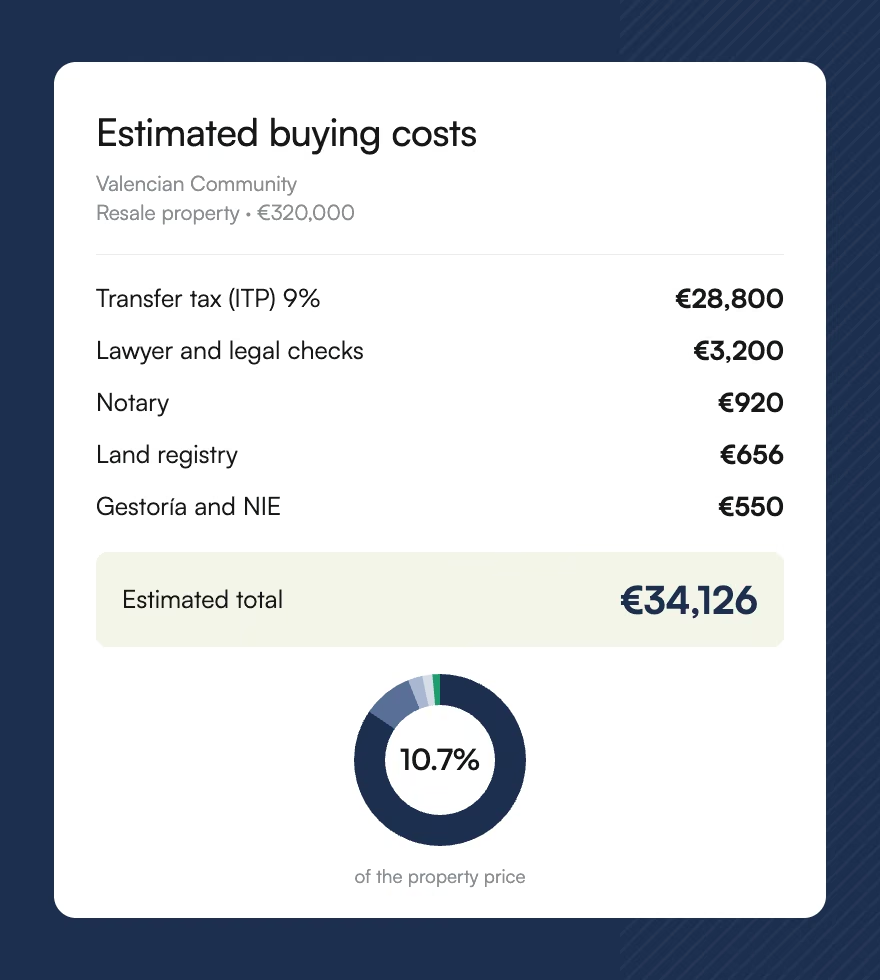
The advertised price of the land is not the total cost of buying it. In particular, you need to allow for:
- the taxes on the purchase, which depend on the seller and the type of land;
- the notary fees and the cost of registering at the Registro de la Propiedad;
- any fees for a lawyer, architect or technician hired before the purchase;
- the surveys or technical checks the project needs.
If you buy the land from a private seller, the purchase is usually subject to ITP, the transfer tax, whose rate depends on the region. You will find the rates in our guide to ITP in Spain.
For some purchases from a business, in particular for building land subject to VAT, the tax rules are different: the standard Spanish VAT rate is 21%, and stamp duty (AJD) may be added depending on the case. Spanish law distinguishes between building land and non-building land, and the latter may be exempt from VAT.
To work out the budget for the project, also see our guide to the taxes when buying a property in Spain.
Do not confuse the price of the land with the building budget
Finally, buying the plot is only the first part of the project. The overall budget must then include the design of the house, technical surveys, permits, taxes on the works, the building itself and any connections or development works.
So before you buy, it is better to think in terms of total cost: land + buying costs + building, rather than the price of the land alone.
Building your house in Spain: watch the budget
The budget is the starting point. Do not fool yourself: be honest about your finances. Do not overestimate it, but do not underestimate it either.
What are the different costs of a building project in Spain?
- The land: its price depends on many factors (location, type of land, size of the plot). There is land at every price, from a few thousand euros to several million. As a rule of thumb, though, the land should cost around half the total cost of your project.
- The building work: building costs, in Spain as elsewhere, can vary considerably depending on several factors: the type of work, materials, labour and the economic situation. Since the war in Ukraine, for example, building work has become more expensive. According to an article published recently by the property portal Fotocasa, building a property from scratch costs approximately €900 per square metre. In other words, for 100 square metres built, allow roughly €100,000 (materials, labour, permits, fees, etc. included).
Given that the average purchase price in Spain is around €2,000 per square metre, it is easy to get a good deal and, with some effort, end up with a house that matches your expectations in every way. - The fees of the various professionals involved in the process: allow 1% of the price of the land for the notary and registration costs (with a minimum of €1,500) and 1 to 2% of the property price for the lawyer, while an architect can cost from €5,000 at the low end to several tens of thousands of euros at the high end.
- Geotechnical survey: allow around €1,000 for a detailed analysis of the soil (is it soft, hard, rocky, porous?). You cannot skip this analysis. It will tell you what type of foundations your future house needs. Its findings can lead to a negotiation and affect the price of the land by 5 to 20%.
- Borrowing costs: allow around 0.5% of the loan amount for the arrangement fee.
Taxes when buying land in Spain
From a tax point of view, these are the taxes you will have to pay to become the owner of land in Spain.
- 21% VAT (IVA) if you buy the land from a company.
- 6 to 10% ITP (Impuesto sobre Transmisiones Patrimoniales, the transfer tax, which varies by region) if you buy from a private seller.
Buying land in Spain: hire a professional
We strongly advise you not to go it alone in this search.
Get help from a property professional. It is the only way to protect yourself against the scams that are rife in Spain (see our article on the subject: “Property scams in Spain: 16 steps to avoid them”). They are even more common with land: false information, illegal plots, identity theft of the owner (common with abandoned land), etc. These are the traps you could fall into. Our experience has allowed us to detect defects and inconsistencies, and to help several of our clients avoid problems that could have cost them dearly in the long run.
Feel free to book a call online with our agents based in Spain. They are English-speaking, know the market inside out and will raise the alarm if anything looks suspicious.
How do you assess a plot's potential?
Knowing whether a three-bedroom, two-bathroom flat in the centre of a big city such as Barcelona or Madrid is a good deal, or whether a beautiful Andalusian finca could become a profitable guest house, is easier than assessing the potential of a plot of land. Especially when you are not a professional yourself and have little to compare it with.
Here are our tips for choosing the right plot.
Check the features of your future plot: work with a technical expert
Before you make your decision and start the process of buying land, consult an architect. They will confirm that you are making the right choice and that the land suits your project. Be careful not to do it the other way round: you could discover limitations on your plot too late, and then have to work around them.
The location of the land is key
It should of course suit your lifestyle. But, as you now know, land in an urban area costs much more per square metre than rustic land. It will probably also have a smaller outdoor area. If you are open to the idea, consider widening your search to the outskirts of big cities. You could probably find bigger, cheaper plots. There will also be fewer planning constraints, and therefore more flexibility in the design of the house.
Basic infrastructure
Before buying land, make sure it has all the services (water supply, electricity, cabling, street lighting and sewerage), or that you have the right to install them and can easily do so. The town hall will confirm this. If these services do not exist, you must also take this into account in your budget.
Check the features of the land
Visit and inspect the land: before buying, examine it with your chosen architect to confirm its area, location and other planning and legal features. Then review and assess several criteria:
- Orientation: this is key. Orientation plays a fundamental role when choosing an existing home, and even more so when choosing land. It will determine the layout of your living spaces, your choice of building materials and the adjustments needed to make the most of the sun's heat or to deal with possible damp.
- Sunlight: your house must get natural light, which helps reduce electricity and heating consumption.
- Slope: sloping plots are often cheaper than others. Why? Because a steep plot limits what you can do. It will complicate the works and make them more expensive.
- Flood risk: if your plot is near the sea, for example (which is tempting), make sure the land can withstand flooding.
- It is important to check whether the land is affected by other easements. These are rights acquired earlier, by private individuals or by local authorities, and they cannot be changed after you buy the land.
- You should also ask the town hall for the area's planning scheme: it can show whether other services or infrastructure are planned nearby in the coming years, which can be positive (a brand-new shopping centre, for example) or negative (a new railway station, an airport, etc.)
Comply with the town's planning regulations
Whatever you build on the chosen land is subject to strict legislation. To comply, here is what you need to do:
- Check the local development plan (Plan General de Ordenación Urbana or PGOU): each town has its own regulations that determine how land is used and set the rules and limits for building, renovating, extending or restoring a home. The percentage of buildable land, the colour of the façade or the number of floors may be regulated.
On the island of Lanzarote, for example, one of the 8 islands of the Canary archipelago, façades can only be white or beige. The reason is as much aesthetic as thermal (white reflects sunlight, which keeps homes cool) and the authorities are strict about it. - Check the cadastre and the land registry: ask for a nota simple (think of it as the property's identity card) to check the legal status of the land and any charges on it before the transaction is formalised. A cadastral certificate will let you check that the information given by the owner is accurate.
- Ask for a cédula urbanística from the town hall: it shows whether the land can be developed, the type of home that can be built on it and the services available.
- Get building permits: you will need these permits to build your house, and sometimes even for minor works.
The process of buying land in Spain
We touched on it above, but to buy land in Spain you will have to go through several steps. There are more of them than when buying a home that is already built, whether resale or new.
Getting your NIE
Make sure you have your NIE (Número de Identidad de Extranjero, the foreigner identity number). This document is essential to buy a property or land in Spain. Without it, there is no property transaction. We have summed up what you need to know in this practical guide: “How to get an NIE”.
Financing
Secure your financing. In Spain, there is no legal right to withdraw if your mortgage is refused. So it is extremely important to be clear about what you can afford.
If you need a bank loan, you will have to approach banks and present your project to them. Ideally, you will already have contacted an architect who can estimate the cost and time needed to carry out your project. Even if it is still approximate, this will let you start talking to the banks.
Good to know: self-build loans work differently from conventional mortgages. Banks often ask you to have bought the land with your own funds before they finance the building. In other words, be ready to put in a substantial amount of your own money.
Also, for a building project, the bank does not usually pay the full loan amount into your account in one go. It pays for each stage of the building once it has been checked.
To find out more about mortgages, read our guide: “How does a mortgage work in Spain?”.
Administrative and legal checks on your land
The buyer must:
- Check the square metres and that the property matches the cadastre;
- Look into any planning projects affecting the property;
- Get the registration certificate from the town hall and check that there are no debts;
- Note that the Spanish notary only certifies that the deed of sale is lawful, without protecting the interests of either party. Get help from a lawyer. At Alveo Search, this assistance is included in our fees. Contact us for more information.
Signing the reservation contract (la señal)
- Reserve the property for 2 to 5 days with a deposit of €1,000 to €3,000.
- If the offer is refused, the reservation amount must be refunded.
- If it is accepted, this sum is deducted from the sale price.
- Be careful: never pay any money without a written contract, to avoid fraud.
Signing the preliminary contract (arras contract)
- This preliminary contract is not signed before a notary, but it is required for the sale.
- It sets out the terms of sale, the identity of the parties, the address of the property, the sale price, the deadline for signing at the notary's office, existing debts, payment terms and how the notary fees are shared.
- The deposit is usually topped up to 10% of the sale price.
- If the buyer withdraws, they lose the sum paid. If the seller withdraws, they must pay the buyer back double.
To find out all about arras, see our practical guide: “What is an arras contract?”.
Signing the deed of sale (escritura)
The sale will be completed before a notary and you will receive the title deed to your land.
Building a house on land bought in Spain
Once you have bought your land, it is time to move on to building your house. Only an architect can guide you through this phase of your project. They will be your partner throughout the process.
Building in Spain: get your building permit
To start building, you will need to get a building permit. It confirms that your project complies with local regulations, so it is essential and your top priority. You and your architect can get this document from the town hall where the land is located.
Managing the building process: builder and architect
Next, you will need to find a builder you can trust. Check their references to avoid disappointment. Make sure the site is monitored regularly. Even if you have found an architect, stay involved throughout the project. This brings us to the next point, which is crucial.
Be clear about what you want
When you start from scratch, anything is possible. You need to take stock and know what you want before you start: how many square metres do you really need? How many bedrooms and bathrooms? Do you prefer an open-plan or a separate kitchen?
Building licences and permits
Once you have finalised the design, it must be reviewed by the Colegio de Arquitectos (the official association of architects, with one in each province) to assess its feasibility. Once approved, it must be submitted to the town hall, which issues the building permit. Be aware that in big cities this process can take up to a year.
Can you put a caravan on a plot of land?
Many of you ask about this, so here is our answer. Putting a caravan on private building land is not usually a problem. It can, however, become more complicated in the following situations:
Putting a caravan on rustic land
It depends on the type of land and local regulations.
In general, there are strict restrictions on rustic land. You may need a "change of use" permit for the land, and there are often laws that prevent non-fixed structures such as caravans from being installed permanently. It is advisable to consult a lawyer specialising in Spanish property law to find your way through the legal framework and make sure every step is followed correctly. We work with trusted experts, contact us.
Putting a caravan on non-building land
In general, non-building land is meant for farming. That is why putting a caravan on such land may be restricted. A permit may be granted for a limited period.
So what happens if a caravan is placed on land without permission? It can have legal consequences. Local authorities can impose fines and require the caravan to be removed immediately. Note that, as always in Spain, regulations vary from place to place. The best advice we can give you is to check with the town hall.
CONCLUSION
In conclusion, building a house on a plot of land in Spain is an adventure that calls for real preparation and a lot of personal involvement. By getting to know the land classifications, the administrative and legal risks and the costs, and above all by getting help from qualified professionals, you can turn this dream into reality.
Arnaud Attencia is head of Alveo Finance. He supports residents and non-residents with the financing of their property purchase in Spain. He shares his advice on assessing borrowing capacity, planning for the deposit and buying costs, and preparing a mortgage application.

Our resources for buying in Spain