Français
 English
Living in Barcelona: the complete guide

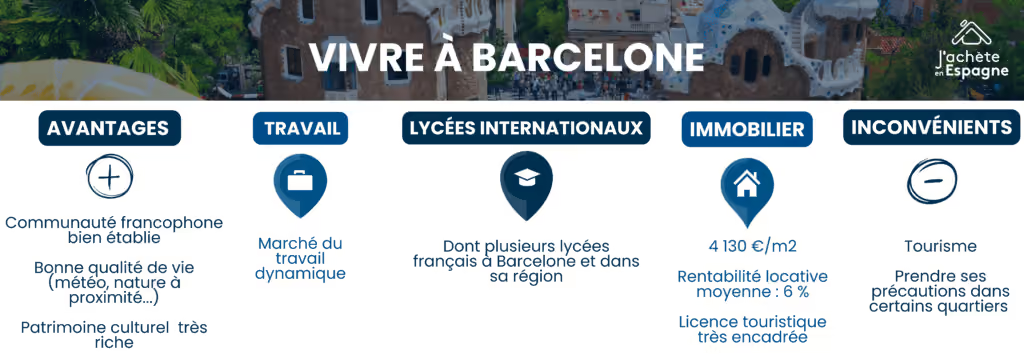
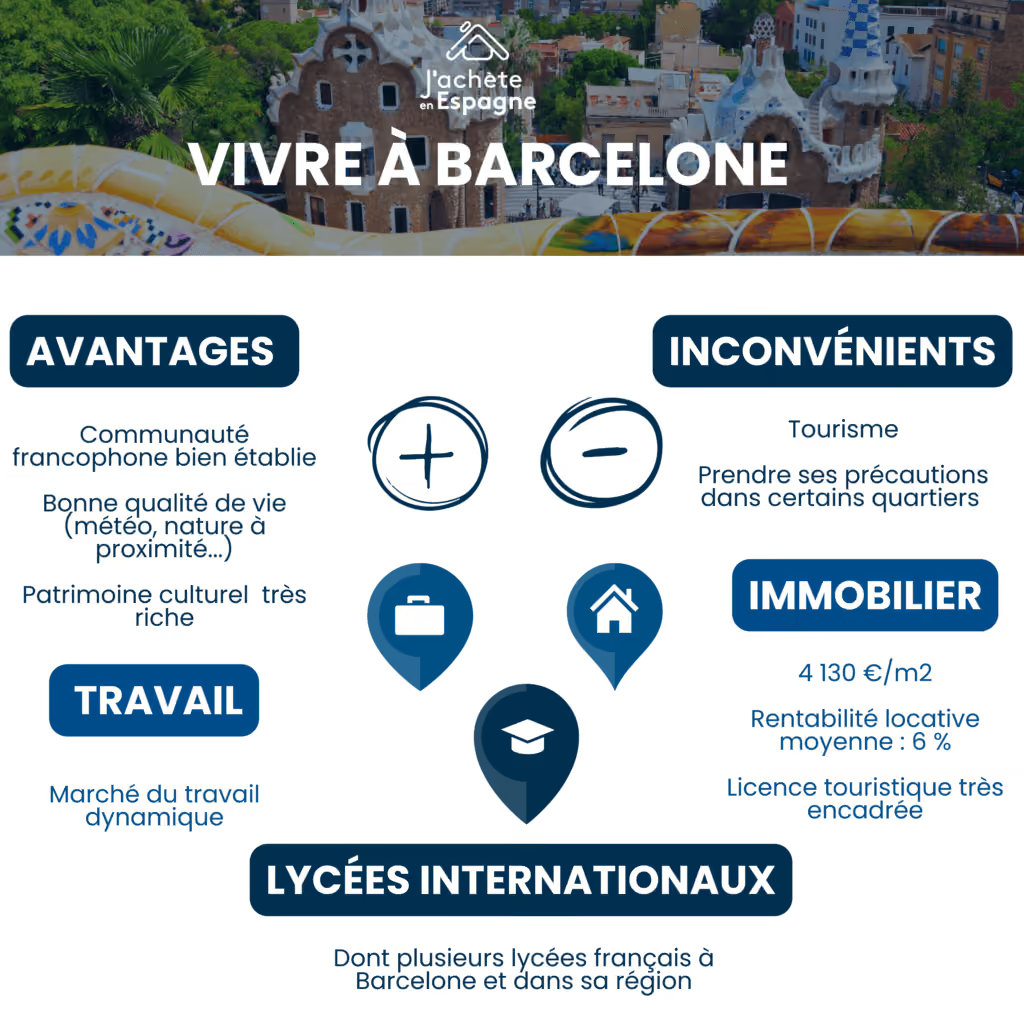
- Town: 1.6 million inhabitants, 5.5 million in the province. Around 30% of the population is foreign. The city's GDP reached €270 billion in 2022.
- Cost of living: higher than in the rest of Spain: in Alicante, consumer prices are 12.5% lower and rents 41% lower. The average salary in Catalonia is €1,958 a month.
- Budget: allow around €1,500 a month to get by, €2,000 a month to live well and €2,500 a month for a very comfortable life. The Numbeo quality of life index stands at 139.44.
- Property: €4,130/m² to buy according to Idealista in July 2023, with median rental yields of 6.1% according to Pisos.com. Tourist rentals are strictly regulated: the city no longer grants new licences and plans to end the existing ones in 2028.
- Key point: a cultural, well-connected city where crime and crowds of tourists are residents' main complaints.
If you have not yet seen Cédric Klapisch's film L'Auberge espagnole, watch it once you have finished this article. Released in 2002, it has not aged a bit. We recommend it for fun, of course, but also, more seriously, to understand the impact it had on several generations of European students who chose Barcelona for their Erasmus exchange. Many of them never went home, and others came back later to settle in the beautiful Catalan city. Barcelona is Spain's second city. It has everything to appeal to expats and to the millions of tourists who walk its streets. If you are thinking of settling there, let Alveo Search take you to the heart of the Ciudad Condal (the City of Counts).
History of Barcelona
An ideal location
Barcelona lies in the north-east of Spain, between the sea and the mountains, with the Mediterranean to the east and the Serra de Collserola to the west. Capital of the autonomous community of Catalonia, it is a dynamic international city that has fully embraced modernity while keeping its traditions.
Key historical facts
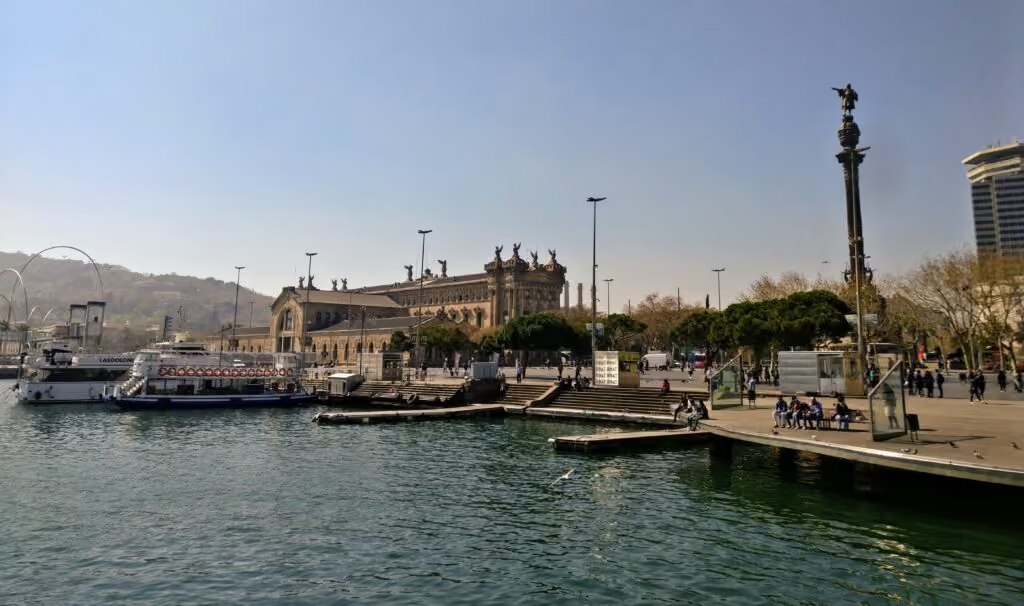
The city was founded by the Romans. In the Middle Ages, Barcelona became an important centre of the Crown of Aragon and a leading maritime power. In the 9th century, it was the capital of one of the counties that made up the Catalan territory of the Carolingian Empire (hence its nickname, the "City of Counts"). Later, in the 18th century, it was integrated into the Kingdom of Spain. Barcelona then went through a period of rapid industrialisation, becoming a highly influential industrial centre in the 19th century. It was in the second half of the 20th century that it became the modern, cosmopolitan city we know today. The 1992 Olympic Games played a major part in transforming the city: its urban planning, its relationship with sport and its reputation around the world all changed. It was during this period that Barcelona's seafront became an iconic place for residents and visitors alike.
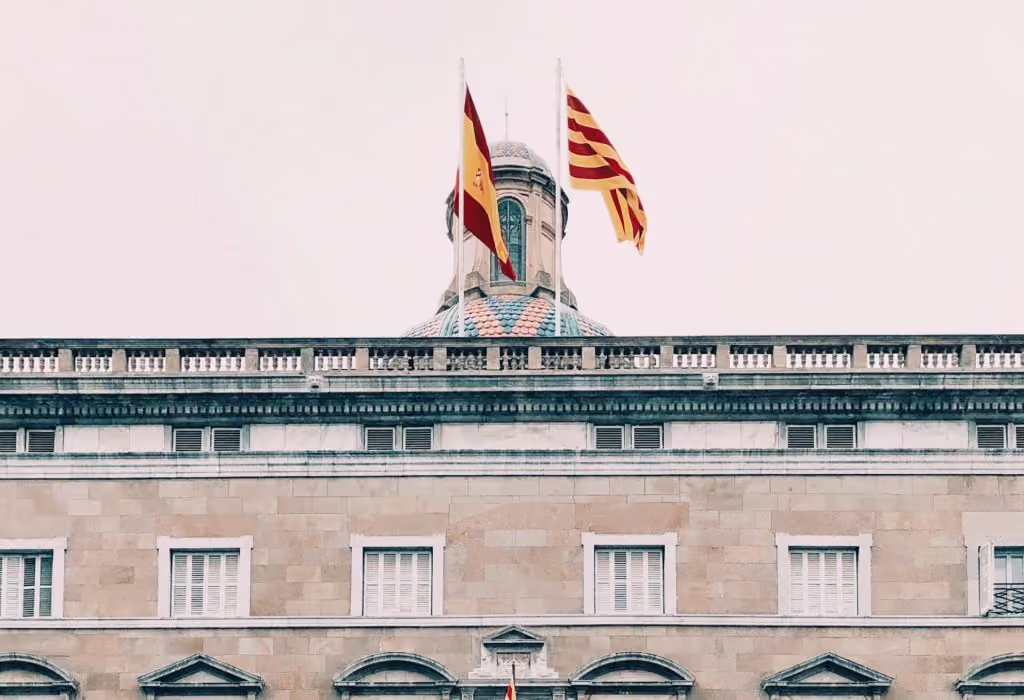
During the 36 long years of Franco's dictatorship, the city was a Republican stronghold. Francisco Franco violently repressed Catalan identity and silenced its language, Catalan. Since his death in 1975, a growing share of the region's inhabitants has called for independence. This has led to several periods of tension and political conflict, notably around the 2017 Catalan independence referendum, which the Spanish government declared illegal. 44% of the population was in favour of independence, according to a 2019 survey by the Generalitat (the Catalan regional government). Since June 2023, the city has been run by Jaume Collboni and the Catalan Socialist Party, a centre-left party.
Catalan culture
Barcelona, the cradle of Catalan culture
Barcelona is the cradle of Catalan culture. It is proud of it, and you can feel it in many aspects of daily life:
- Catalan, the region's official language alongside Castilian Spanish, is spoken and cherished by locals.
- Food: calçots (onions grilled over embers), escudella i carn d'olla (a meat and vegetable stew) and other traditional dishes are well worth trying.
- Lively festivals held throughout the year celebrate Catalan culture: the Diada de Catalunya, the Festes Majors, the castellers (human towers recognised by UNESCO as Intangible Cultural Heritage of Humanity), and more.
For Romain Traversino, head of our Barcelona office: “Catalans have a reputation for being reserved, but they are actually very tolerant. Remember that 30% of the people living in Barcelona are foreign, and they are welcomed with open arms. Catalan culture is also extremely rich: its language, its brilliant architects and artists, its way of life. It is well worth discovering.”
A vast cultural heritage
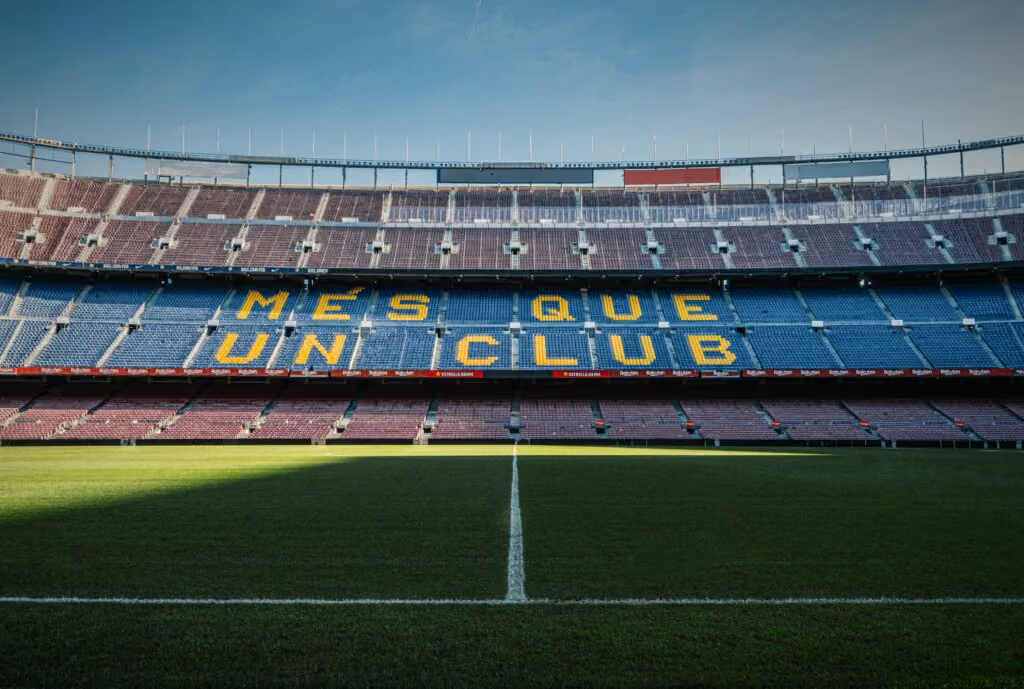
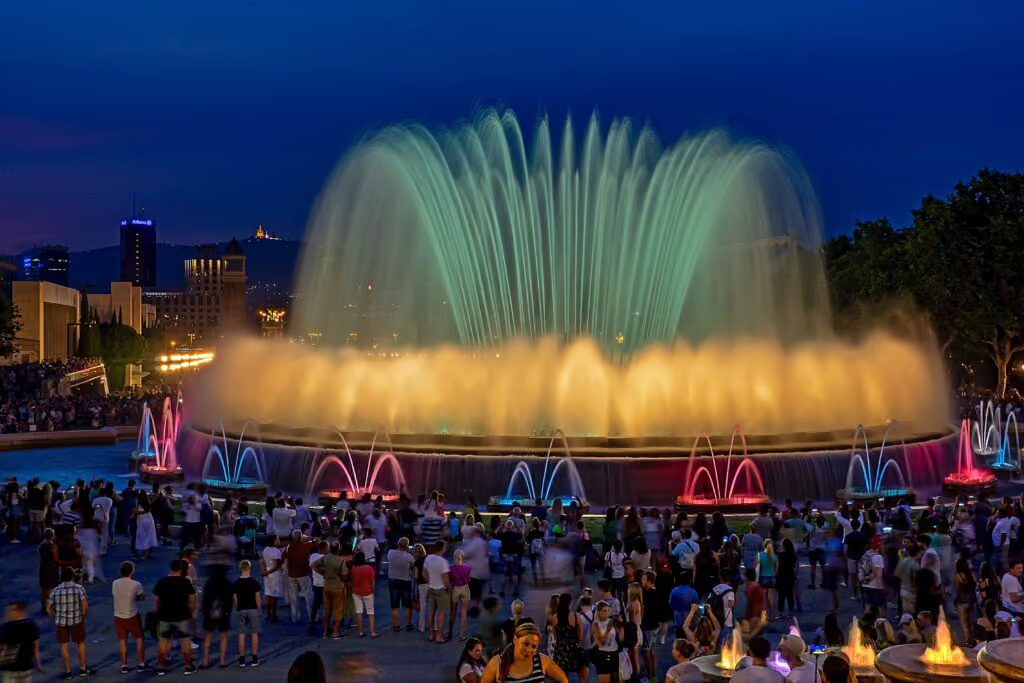
Now for culture. You have surely heard of the Sagrada Família, La Pedrera, Casa Batlló and Park Güell (a UNESCO World Heritage Site), all born of Antoni Gaudí's genius. But the Cathedral, Las Ramblas, the Montjuïc fountain, the Gothic Quarter and the Camp Nou football stadium are also part of the city's rich heritage. Interestingly, the city is now also home to modern buildings, such as the Torre Glòries by the renowned French architect Jean Nouvel. Completed in 2005, it now houses Facebook's centre for fighting fake news. Worth knowing if you are planning a short stay: tourist queues keep getting longer, especially in summer, so visit out of season if you can. If you would rather buy in Barcelona than spend your holidays there, book a call online with our property advisers on the ground. They will give you all the information you need to get your property project started.
Barcelona, Spain's second city
Barcelona is more than a beach city
Barcelona is Spain's second city in size and population. According to the latest figures from the municipal register (Padrón municipal), the city has 1.6 million inhabitants. That rises to 5.5 million for the province of Barcelona. Madrid, the capital, has twice as many: 3.2 million. Barcelona is much more than a beach city, with remarkable architecture. Its port is a major one: port activity brought in more than €180 million in 2022, making it a hub of international trade. It also plays a leading economic role as a dynamic centre of commercial, industrial, cultural and, of course, tourist activity for the whole country. As we mentioned, the city enjoys an exceptional location that makes it a gateway to Europe. With rail, air and sea links, all the major cities are easy to reach. This accessibility is a key advantage for visiting students, expats and investors. In terms of GDP, the city is one of the most prosperous in Spain and makes a significant contribution to the national economy. Its gross domestic product stood at €270 billion in 2022.
Tourism
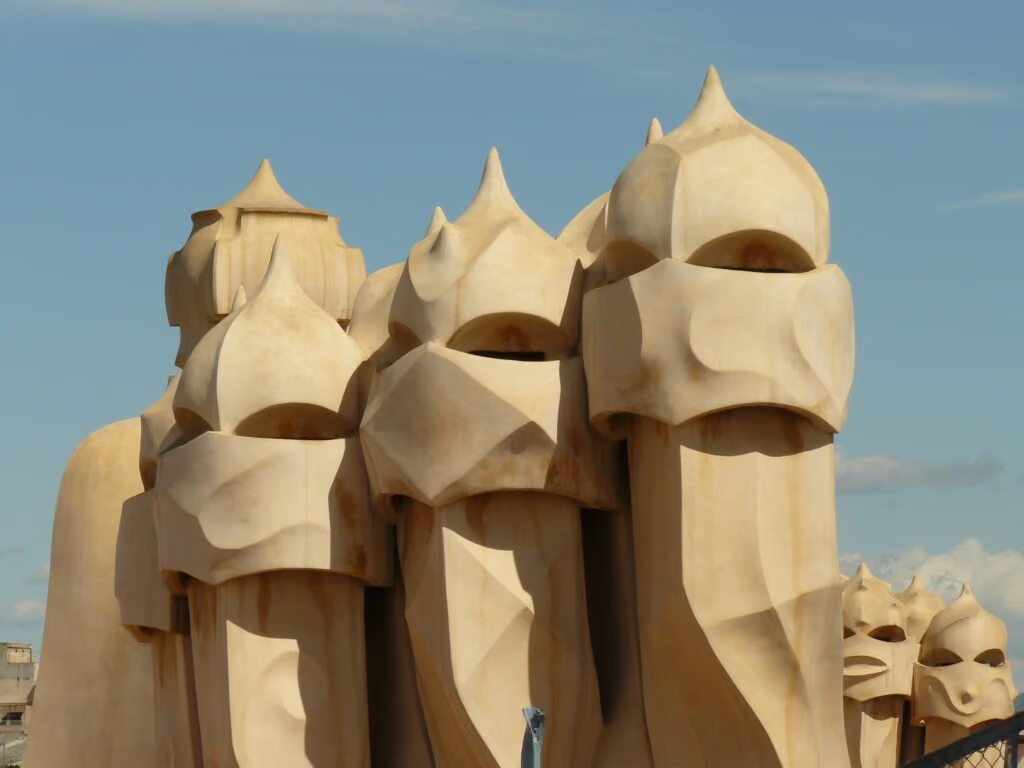
Tourism is the cornerstone of Barcelona's economy. Just before the pandemic, in 2019, the city welcomed 28 million tourists and, according to industry experts, 2023 is on the same track. Mass tourism in Barcelona is often criticised by residents and by tourists themselves. It has picked up since the end of the pandemic. Tourism is criticised, but it partly keeps the city going: from 2019 to May 2023, it reportedly brought in nearly €55 million.
Barcelona's tech boom
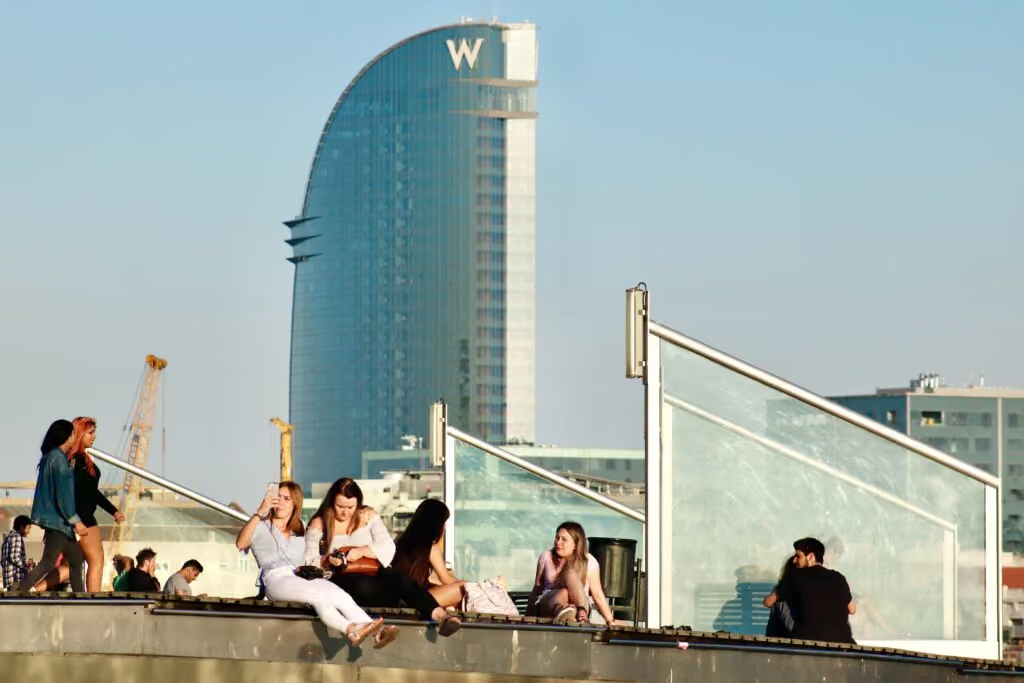
Barcelona is gradually becoming the "Mediterranean Silicon Valley". It is positioning itself as a base for start-ups and innovative companies in fields such as tech, the green economy and sustainable finance. No fewer than 4,000 companies, including Mediapro, Amazon and Facebook, have already set up in this booming district. Working habits had started to change before the pandemic, but the health crisis sped up this underlying trend. Tech talent, who can now work from anywhere, see the city as an ideal place to live.
The international community in Barcelona
Barcelona is a very international city, with well-established expat communities. Around 30% of its residents are foreign and many nationalities are represented, according to data from the Padrón municipal. This is a real advantage for anyone who wants to settle there: it is easy to build relationships with people who have made the same move and face the same questions. If, like them, you want to settle in the beautiful city of Barcelona, book a call with our local team, and read on: this guide contains plenty of useful practical information. We will cover:
- The best neighbourhoods for families and retirees.
- The healthcare system.
- Education and career opportunities.
- Property in Barcelona.
Barcelona's neighbourhoods: where to live?
A quick overview of the neighbourhoods
Barcelona is a "patchwork" city. Each neighbourhood has its own character.
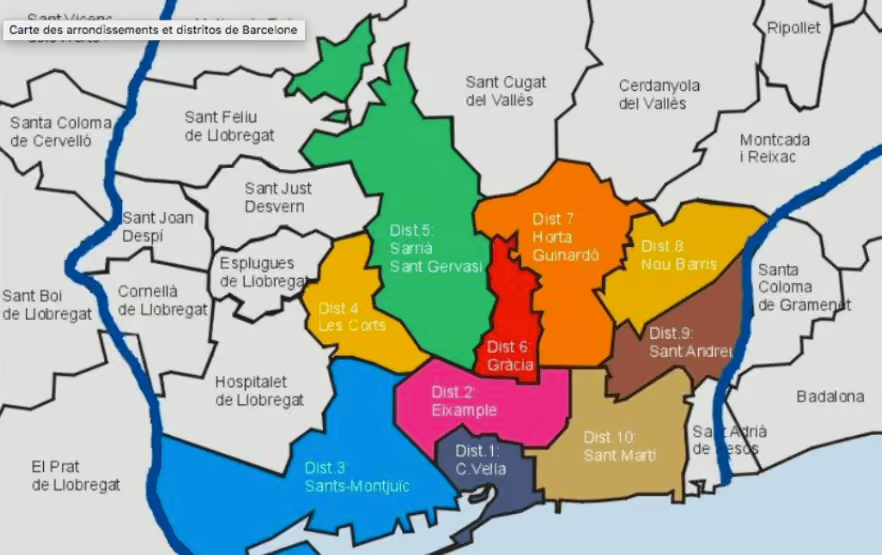
Source: barcelonamap360.com Ciutat Vella, the old town, is an enchanting district. Apart from the beach area (La Barceloneta), it covers the whole area originally enclosed by the old walls that surrounded the city in the 14th century. El Born is our favourite: its narrow streets, churches, squares, trendy restaurants and bars. All of this has made it a fashionable area that expats snap up.
The Eixample is a very lively, cosmopolitan neighbourhood, popular with young people.
Romain Traversino, head of our local office, who knows the city inside out, shares a secret: in his view, the neighbourhood of Poble-Sec (in the Montjuïc district) is the one that most deserves to be better known. It is clean and quiet, yet very close to the centre. Some neighbourhoods are ideal for families, others for retirees and others for investors. We will come back to this later in the article. If you would like advice on how to buy in Barcelona, book a call online with our experts on the ground.
Living in Barcelona with a family
The advantages of family life in Barcelona
Moving to Barcelona with children: a good or bad idea? In our view, family life in the Catalan capital has far more advantages than drawbacks.
- The climate encourages an outdoor life and lets you enjoy the beach for much of the year. That is a big plus when you have children.
- Museums (Picasso Museum, Joan Miró Foundation, Barcelona History Museum, Barcelona Museum of Contemporary Art, Maritime Museum and more), theatres, cinemas, concert halls of every size: cultural life in Barcelona is rich, which is not the case in every Spanish city. And that is a big plus for families.
- The city itself is an open-air museum. Its architecture is among the most original in the world.
- The mountains and countryside nearby make for family weekend getaways.
- Children are treated like royalty, as everywhere in Spain, which makes daily life very pleasant.
- Since 2021, paternity leave in Spain has been the same length as maternity leave. Since 2025, each parent is entitled to 19 weeks of paid leave.
- There is a wide choice of nurseries and schools, including British, American and other international schools.
Where to live in Barcelona with a family?
- The Eixample is Barcelona's most densely populated district. Central, it has wide pavements and green spaces, as well as countless restaurants and bars. This makes it a very lively and pleasant area for families.
- The residential area of Pedralbes is much sought after for its large houses with beautiful gardens and its private schools.
- The Sant Gervasi-Galvany neighbourhood is perfect for families, with schools, libraries and leisure facilities.
- Sarrià is an upmarket neighbourhood known for its green spaces, prestigious private schools and peaceful residential feel. It is a safe area with a good reputation.
- Poblenou, which we mentioned earlier, is also ideal for families. Close to the centre but quieter, it has every service you need.
- Avoid the old town, which is impractical for family life (noise, crowds, narrow streets, etc.).
Retiring in Barcelona
Welcome and cost of living
Barcelona and its region are perfect for active retirees. The city is sunny and you can live outdoors all year round, which helps both your social life and your fitness, two key factors in ageing well. The cost of living is higher than in the rest of Spain, as we will see below. For example, in Alicante (popular with many foreign retirees), consumer prices are 12.5% lower than in Barcelona and rents are 41% lower. This is worth knowing when deciding where to settle in retirement. The healthcare system is of a high standard, which is reassuring as you get older.
Where to live in Barcelona when you retire?
It depends on your lifestyle. Here is what to bear in mind before you choose.
- If you are active and enjoy city life, choose Pedralbes, Sarrià or Gràcia, neighbourhoods close to the centre. They were small towns before becoming part of Barcelona, and they have kept the special charm of small Spanish villages.
- El Born is perfect if you want to do everything on foot and enjoy a coffee surrounded by beautiful old stone.
- La Barceloneta, for lovers of beachside living.
- If you want more peace and more square metres, look at the outskirts of the city. There are real gems on the Costa Brava (Cadaqués, Begur, L'Escala, etc.).
To find out about all the steps for enjoying your retirement in Barcelona to the full, read our complete guide to retiring in Spain.
Healthcare in Spain and in Barcelona
A cutting-edge healthcare system
The Spanish healthcare system is known for its efficiency and accessibility. The WHO ranks it among the best in the world. Barcelona has leading medical centres and hospitals that provide quality care to residents and expats. Catalonia is also the Spanish region with the most hospitals: 60 public and 140 private. We have listed the main ones below.
- Hospital Clínic
- Address: Calle de Villarroel, 170, 08036 Barcelona
- Phone: +34 932 27 54 00
- https://www.clinicbarcelona.org/
- Hospital Universitario Vall d'Hebron
- Address: Pg. de la Vall d'Hebron, 119, 08035 Barcelona
- Phone: +34 934 89 30 00
- https://hospital.vallhebron.com/
- Hospital del Mar
- Address: Pg. Marítim de la Barceloneta, 25-29, 08003 Barcelona
- Phone: +34 932 48 30 00
- https://www.parcdesalutmar.cat/ca/
Healthcare for expats
Visitors from the EU can be treated in Barcelona's health centres with their European Health Insurance Card, and UK visitors with their GHIC; others, such as Americans, need private health insurance. Residents show their tarjeta sanitaria (the Spanish public health card) once they have applied for it. To find out all about the formalities, we have written this article: “Living in Spain: the complete guide”.
Education and career opportunities in Barcelona for foreigners
Barcelona's universities
The university system in the city is excellent. You will find several top institutions:
- The University of Barcelona,
- The Autonomous University of Barcelona,
- Pompeu Fabra University,
- The Polytechnic University of Catalonia,
- IESE, a renowned business school,
- As is ESADE,
- The internationally renowned Istituto Europeo di Design (IED).
Career opportunities in Barcelona
There are plenty of job opportunities in the city, far more than elsewhere in Spain (except for Madrid, the capital). As we mentioned at the start of this article, tourism of course, but also hospitality, international trade and tech are major sources of jobs. A tip: you will find work more easily if you speak Spanish.
Pros and cons of living in Barcelona as an expat
According to Romain Traversino, head of our local office, the main appeal of life in Barcelona is also its main drawback: “Being close to the rest of Europe and Barcelona's international side are real pluses,” he says, “but it feels less foreign than Seville or even Madrid, which are very typical Spanish cities. Many residents speak English and the international community is very large. Catalan culture is a treasure, but it is different from Spanish culture. In other words, Barcelona is a city apart, and not quite Spain.”
The quality of life
For our office head, being close to nature is essential, and since he moved to Barcelona it has been right on his doorstep: “Living by the beach and being able to enjoy the Costa Brava coastline is an incredible stroke of luck.” We have mentioned the many other advantages of life in Barcelona: its pleasant climate all year round, its cultural richness, its first-class healthcare and education systems and its job opportunities. This is what makes the city a top choice for expats. Anything is possible in Barcelona: finding fulfilling work, raising children by the beach, enjoying a busy cultural life. And all this at a much more relaxed pace than in most big cities. According to data from the crowdsourced website Numbeo, Barcelona has a very high quality of life index: 139.44.
The cost of living
The cost of living in Spain is generally lower than in northern Europe. This is only a rough guide: you will not live the same way on the same budget in Madrid or Barcelona as in a small town in the centre of the country. But you will usually come out ahead. The average salary in Catalonia is €1,958 a month. It is the 4th highest in the country. Allow around €1,500 a month to get by, around €2,000 a month to live well and €2,500 a month for a very comfortable life.
Drawbacks of life in Barcelona
There is no point pretending otherwise: every city has its drawbacks, and Barcelona is no exception. They include:
- Property prices are at the top end of the national range, whether you buy or rent. We will come back to this in our chapter on property. To buy a property in Barcelona, contact us.
- The growing importance of Catalan can be a handicap for expats who do not speak it.
- Crowds of tourists can cause nuisance, especially in the old town (noise, a feeling of insecurity, queues, etc.).
- Crime is the city's number one problem. In 2022, the Ministry of the Interior recorded 459 offences a day in the city. Nearly 33,000 crimes were recorded in the first quarter of 2023.
Tips for settling in Barcelona
Practical tips
- You will fit in more easily in Barcelona if you speak good Spanish.
- If you know some Catalan or are curious about the language, many people in Barcelona will welcome you with open arms, and it will be an asset at work.
- Start your paperwork from your home country to save time. We explain it in the next section.
- It is wiser to find an apartment in Barcelona before you leave. Book a call online with our team of specialists, who can help you.
Paperwork
To find out all about the paperwork needed to move to Barcelona, read our article: “Moving to Spain from the UK or US: the complete guide”. The formalities are neither numerous nor complicated, but they can take time. That is why we advise you to start them from your home country, especially your application for your NIE, the foreigner identification number. It is the only document you really need before you leave. We have written a practical guide on the subject: “How to get an NIE”. If you are an EU citizen, also check that your European Health Insurance Card is valid (UK residents use the GHIC; Americans need private health insurance). Each card is personal, so every member of your family needs one to be covered. It will cover you while you arrange access to Spanish social security.
How to move to Barcelona?
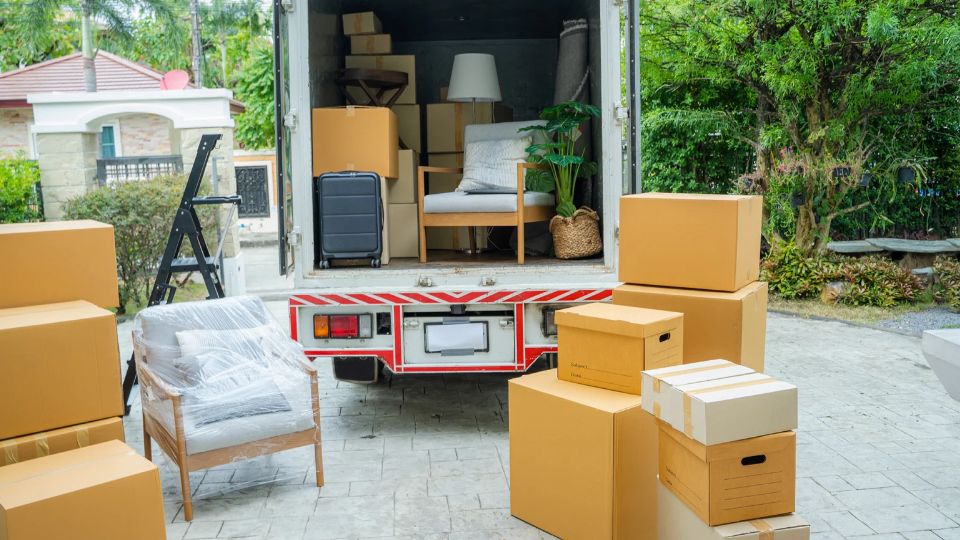
Moving to another country can be daunting. But, as with everything, a little organisation makes it all possible. Our tips:
- Sort through your belongings before you leave and take only what you need.
- Look online for international removal companies that move people to Spain.
- Choose a company that offers groupage (several moves to the same area at the same time) to cut costs and your carbon footprint.
Property in Barcelona
Property in Barcelona is more expensive than in the rest of Spain. But that does not make the city any less attractive to property buyers. Barcelona is a major investment hub, offering attractive returns and low risk, especially for foreign investors. The city has purchase prices of €4,130/m² (latest figures published by the Idealista portal in July 2023) and good rental yields. According to the latest study by the property portal Pisos.com, investing in Barcelona brings median yields of 6.1%. What makes Barcelona a safe place to invest is that few properties are available to rent. In other words, landlords hold the upper hand. If you would like to buy an apartment in Barcelona, contact our team of specialists.
Holiday lets
Important: if you are interested in tourist rentals in Barcelona, be aware that they are extremely regulated. The city is famous for fining Airbnb a record €600,000 in 2016. It no longer grants new tourist licences, and the city council has announced that the 10,000 or so existing licences will not be renewed: these flats are due to return to the residential market in 2028. Penalties for illegal letting are severe. For more information, see our guide to the tourist licence.
In short
FAQ
Is it easy to find affordable housing in Barcelona?
Finding affordable housing in Barcelona can be a challenge. To find a property, it helps to know the local market. At Alveo Search, we specialise in finding property for international buyers. If you would like to buy a property in Barcelona or the surrounding area, contact us.
When is the best time to visit Barcelona?
Spring and autumn are the best seasons to visit Barcelona. The weather is pleasant and there are fewer tourists.
Do you need to speak Catalan to live in Barcelona?
No. Catalan is the region's official language alongside Castilian Spanish, so most residents speak Spanish fluently. That said, knowing some Catalan will be useful.
Are there job opportunities for expats in Barcelona?
Yes. Barcelona offers job opportunities in many sectors, including tourism, technology and more. The city is a booming economic centre that attracts international companies and innovative start-ups. To improve your chances of finding a job, it helps to speak Spanish or Catalan, although some international companies work mainly in English.
What are Barcelona's main tourist attractions?
The must-sees: the Sagrada Família, Park Güell, a colourful garden with impressive mosaics, and Casa Batlló, a unique modernist house. The Gothic Quarter with its picturesque medieval streets, La Rambla and Barceloneta beach are also places you should not miss.
What salary do you need to live in Barcelona?
The cost of living in Barcelona varies with your lifestyle and spending habits. With €2,000 a month, you will live decently; with €2,500 a month, quite well.
Is life in Barcelona expensive?
Life in Barcelona is more expensive than in the rest of Spain, but generally cheaper than in northern Europe. Property in Barcelona is at the top end of the price range. We recommend working with an expert in the local market. You can contact us to start your property project in Barcelona.
Romain Traversino is head of the Barcelona office of Alveo Search (Alveo group). He supports international buyers with their property projects in Barcelona and in Catalonia, from search to signing. He speaks six languages and shares his advice on choosing neighbourhoods, analysing prices and buying remotely.

Our resources for buying in Spain