Français
 English
Holiday rentals in Spain: the new rules explained

- Framework: holiday rentals cover furnished homes let for 31 days at most and require a licence applied for at the town hall. The legal stock grew by 15% in 2024 according to INE, to 400,000 homes, for 94 million holidaymakers.
- Digital Single Window: created in January 2025, this national registry centralised data and checks. Registration became mandatory in July 2025, on top of the regional licence, but the Supreme Court annulled it in May 2026.
- Owners' associations: since April 2025, a new holiday rental needs the prior approval of three fifths of the owners. The same majority can restrict or ban the activity, raise its service charges by up to 20% and refuse key boxes in the street.
- Regional rules: Catalonia: 5-year licence, quota of 10 per 100 inhabitants, Barcelona aiming to phase them out by 2028-2029; Valencian Community: 10 days maximum per guest; Balearic Islands: cap of 90,000 places and €3,500 in fees; Madrid: new licences were suspended until February 2026.
- Key point: licence fees range from €30 to €120 depending on the region, and fines from €2,000 to €600,000.
Introduction
Driven by a tourism boom (94 million holidaymakers in 2024) and high yields, holiday rentals in Spain reached a turning point in 2025. New national obligations, tighter checks, more powers for owners' associations and heavy penalties for breaking the rules. Find out in this guide what changed in 2025 for holiday rentals in Spain, and what has changed since.

Holiday rentals in Spain: an overview of a lucrative market
A holiday rental means letting a furnished home for short periods (31 days maximum), mostly to holidaymakers. To be compliant, the owner must apply for a licence from the town hall.
After a spectacular boom in the sector (+15% in legal holiday rentals in 2024 according to INE, for a total of 400,000 holiday homes) and a surge in fraud, the Spanish authorities tightened the rules considerably in 2025 to protect residents and limit speculation.
Legal framework: a two-level system
Rules that vary by region
To understand what is at stake, keep in mind that Spain is a decentralised state: each autonomous community (17 in all) sets its own rules on holiday rentals (and on many other matters). These rules are often reinforced by municipal bylaws. That is why the conditions for getting a licence, safety standards and restrictions vary greatly from one region to another.
The Digital Single Window: a national registry, annulled in 2026
In January 2025, a central national platform, the Digital Single Window (Ventanilla Única Digital de Arrendamientos) was set up to:
- Standardise administrative procedures.
- Centralise data on holiday rentals.
- Allow tighter tax and administrative checks.
From July 2025, registration in this registry was mandatory for all owners, on top of the regional licence. In May 2026, however, the Supreme Court annulled this national registration procedure: the regional licence and its registration number remain the requirement.
Holiday rentals and owners' associations
A very important point: since April 2025, any new holiday rental in a building needs the prior, express approval of the owners' association by a 3/5 majority, and the same majority can restrict or ban the activity.
The association can also:
- Decide to raise service charges by up to 20% for holiday rentals.
- Set rules for the use of common areas.
- And refuse key boxes in the street.
Our advice: always check the community rules before investing or letting your property; it could save you many costly problems later on.
Specific rules by region in 2025

There are as many sets of rules on holiday rentals as there are autonomous communities: 17. Here is what to remember for the most popular areas for this activity in 2025:
- Tourist licence in Catalonia: licence required (valid for 5 years), strict quotas (max. 10 per 100 inhabitants). In Barcelona, the aim is to phase out licences by 2028-2029 (current licences will not be renewed), with fines of up to €600,000.
- Tourist licence in Andalusia: licences can be frozen in saturated areas, and checks have been tightened.
- Tourist licence in the Valencian Community: key boxes banned in the street, maximum stay of 10 days per guest, fines of up to €600,000.
- Tourist licence in the Balearic Islands: cap of 90,000 places, high licence fees (€3,500), no new licences in apartment buildings from April 2025, fines of up to €500,000.
- Tourist licence in Madrid: new licences were suspended until February 2026, and the city's plan to protect residential use in the historic centre, given final approval in August 2025, now limits tourist accommodation there; fines of up to €190,000.
- Tourist licence in the Canary Islands: a limit of 10% of residential floor space for holiday rentals, municipal decisions, tourist tax.
Rental platforms: new obligations
To keep a closer eye on holiday rentals, Spain now puts more pressure on platforms such as Airbnb.
They are required to:
- Check that listings are legal by making sure the registration number is valid.
- Remove listings without a valid number when the authorities order it, under an EU regulation that has applied since 20 May 2026.
- Cooperate with the tax and administrative authorities.
How to rent to tourists legally

Getting the regional tourist licence
Step 1: Check the local rules
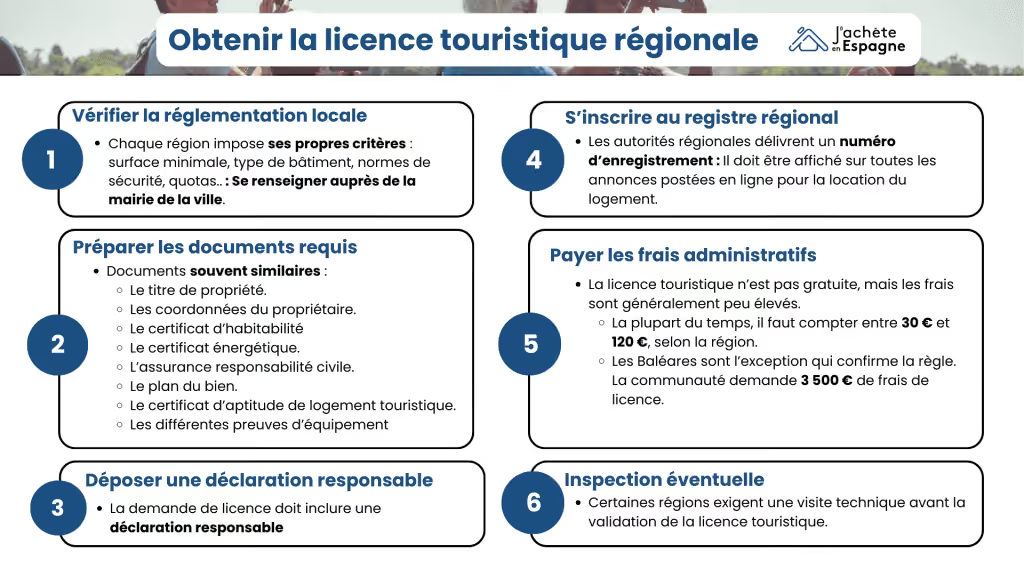
As we have seen, each region sets its own criteria for granting the tourist licence: minimum floor area, type of building, safety standards, quotas, zoning restrictions, etc. So it is essential to check with the town hall of the town where your property is located. The Alveo Search team can guide you and help you choose the area best suited to your project.
Step 2: Prepare the required documents
Although each autonomous community has its own rules, the documents needed for a tourist licence are always more or less the same.
- The title deed.
- The owner's contact details.
- The certificate of occupancy (Cédula de habitabilidad).
- The energy performance certificate.
- Third-party liability insurance.
- The floor plan of the property.
- The certificate of suitability for tourist accommodation: a document issued by an architect confirming that your home meets the conditions to be let to third parties (heating, ventilation, evacuation plan: everything is checked).
- Proof of the equipment provided (furniture, appliances, wifi, etc.).
Step 3: File a responsible declaration
Every owner applying for a tourist licence must add a responsible declaration (declaración responsable) to the file: a written commitment to comply with the rules.
Step 4: Register in the regional registry
Once the licence is granted, the regional authorities issue a registration number. It must be shown on every online listing for the property.
Step 5: Pay the administrative fees
The tourist licence is not free, but the fees are generally low.
- In most cases, expect to pay between €30 and €120, depending on the region.
- The Balearic Islands are the exception: the region charges €3,500 in licence fees.
Step 6: Possible inspection
Be prepared for it: some regions require a technical visit before the tourist licence is approved.
The Digital Single Window: no longer required
This was the real novelty. Once the regional licence was granted, owners also had to register on the Digital Single Window. This became mandatory in July 2025.
Until the Supreme Court ruling of May 2026, the owner had to:
- Create an account on the national platform.
- Fill in a detailed form (address, number of guests, use, etc.).
- Provide the documents requested (title deed, energy certificate, tourist licence).
The registration also had to be renewed every year.
Since the ruling, the national registration number is no longer required: the regional registration number is the one to show in your listings.
Our practical tips for investing and letting with peace of mind
- Study the local rules closely: some areas are completely closed to new licences.
- Plan ahead for the owners' association: its opposition can block your project.
- Build a solid file from the start: a complete application speeds up registration and avoids refusals.
- Get professional support to save time and avoid costly mistakes.
To find out more about the tourist licence in Spain, see our full article.
Conclusion

Despite a sharp tightening of the rules in 2025, holiday rentals in Spain are still a lucrative investment, as long as you choose the right area for this activity and follow the rules in force to the letter. Need personal support to secure your investment and make your business last? Contact our advisers who specialise in buy-to-let. They can guide you at every step: feasibility study, paperwork, tax, rental management.
FAQ: what changed for holiday rentals in Spain in 2025
What is a holiday rental in Spain?
A furnished home let for profit, repeatedly, for short periods (up to 31 days), often through online platforms.
Do you need a tourist licence to let to holidaymakers?
Yes, a tourist licence is required in every region of Spain. Letting without a licence exposes you to heavy fines (up to €600,000 in Catalonia) and to your listings being removed.
What changed in 2025, and what has changed since?
The rules on holiday rentals were tightened considerably in 2025.
- On top of the regional licence, owners had to register their property in the national registry through the Digital Single Window from July 2025. The Supreme Court annulled this national procedure in May 2026: the regional registration number remains the one that counts.
- Since April 2025, a new holiday rental needs the approval of the owners' association by a 3/5 majority, which can also restrict or ban the activity.
- Tighter checks and heavier penalties for breaking the rules.
What steps do you need to take to get a tourist licence?
- Check the local and municipal rules.
- Prepare the documents for your licence: the title deed, the owner's contact details, the certificate of occupancy (Cédula de habitabilidad), the energy performance certificate, third-party liability insurance, the floor plan, the certificate of suitability for tourist accommodation and proof of the equipment provided (furniture, appliances, wifi, etc.).
- File a responsible declaration.
- Register in the regional registry.
- Check the national rules too (the national registry required from July 2025 was annulled in May 2026).
- Show the registration number on every listing.
What equipment is required in a holiday rental?
The home must be furnished, have basic appliances (washing machine, hob, fridge, etc.) and a wifi connection, and the owner must give guests an emergency number.
Can owners' associations ban holiday rentals?
Yes. Since April 2025, a new holiday rental needs the prior approval of the owners' association by a 3/5 majority, and the same majority can restrict or ban it; rentals already operating legally before that date can continue. Service charges can also be raised by up to 20%.
What penalties does an owner face for breaking the rules?
In Spain, an owner who lets a property to tourists illegally faces heavy penalties.
- Fines of €2,000 to €600,000 depending on the region.
- Suspension or withdrawal of the licence.
- Removal of listings from platforms.
- Risk of criminal prosecution for serious breaches.
Which areas are the most restrictive in 2025?
The most restrictive areas are Catalonia, especially Barcelona, the Balearic Islands, Madrid and Valencia.
Can you hand over the management of your holiday rental to an agency or a professional?
Yes, it is strongly recommended to hand over the management of your holiday rental to a professional to deal with the administrative and tax complexity, especially if you are not resident in Spain.
Sources:
- INE
- Idealista
- Ministerio de Vivienda
Thomas Rouer is the founder of Alveo Search and the CEO of the Alveo group. Based in Spain for almost ten years, he develops property services designed for the specific needs of foreign buyers.
His expertise covers every aspect of buying property in Spain: understanding the market, searching for and selecting properties, negotiation, financing, paperwork, tax and securing the purchase process.

Our resources for buying in Spain