Français
 English
Buy-to-let in Spain: where to invest in 2026

- Yields: in the first quarter of 2026, gross yields on residential rentals ranged from 6% to 6.7% according to Idealista. The lowest yields are in central areas, the highest in secondary cities.
- Price comparison: in April 2026, the average price in Spain was €2,748/m², lower than in many other European countries. The average rent in Spain was €15.0/m².
- Cities: Madrid stood at €5,960/m² and Barcelona at €5,221/m² in April 2026: two prime markets with very strong rental demand. Valencia, Alicante and Málaga balance appeal and yield; Murcia and Seville offer a lower entry price.
- Strategies: long-term lets, mid-term lets of 31 days to 11 months, holiday lets or room rentals. Short-term letting depends on the town, the community of owners and a licence, to be checked before buying. Plan ahead for non-resident tax and double taxation.
- Key point: the advertised yield is not enough: weigh up price, realistic rent, vacancy, running costs, tax and resale, then choose the city according to your goal.
Buy-to-let in Spain is attracting more and more foreign investors looking for a dynamic, accessible and varied property market. Purchase prices that are still competitive in some areas, strong rental demand, tourist appeal, quality of life, easy flights from the UK and northern Europe: Spain has plenty of arguments for building a profitable long-term investment.
But investing in Spain takes preparation. Between local taxes, holiday let rules, price gaps between cities, buying costs and managing from abroad, a good buy-to-let investment in Spain rests above all on a clear strategy. The choice of city, neighbourhood, type of property and type of letting has a direct impact on the real return.
In this guide, we look at the opportunities on the Spanish market in 2026, the cities to consider, the yield criteria to analyse and the precautions to take to invest in Spain in the right conditions.
Why buy-to-let in Spain appeals to so many foreign investors
Spain holds a special place for many investors from the UK and northern Europe. The country is close, easy to reach, culturally familiar and has a very positive image among foreign buyers. For an investor who wants to diversify outside their home country, buy-to-let in Spain is a concrete, clear and relatively simple option to understand.
One of the main draws remains the level of yield. In the first quarter of 2026, gross yields on residential rental property in Spain stood at around 6% according to Idealista. Even though this average yield is edging down slightly, it remains high for an investor used to prime home markets, where yields are often tighter.
This does not mean that Spain is automatically profitable everywhere. The lowest yields are usually found in the safest, most central or most sought-after areas. Conversely, the highest yields often appear in secondary cities, up-and-coming neighbourhoods or less liquid markets. For a foreign investor, the goal is the right balance between return, rental security, potential for capital growth and ease of management, rather than the highest possible yield.
Unlike other European markets that are harder to enter, Spain offers a wide range of property types: city-centre flats, homes near the coast, student housing, second homes with rental potential, small units to let all year round or properties suited to mid-term lets. This variety means the project can be adapted to different budgets and investment goals.
Prices still affordable in several parts of Spain
One of the first arguments in favour of property investment in Spain remains the ratio between purchase prices and rents. In April 2026, the average price of residential property in Spain reached €2,748/m², lower than in many other European countries.
For an investor from the UK or northern Europe, this difference can give access to better-located or larger properties, closer to sought-after areas, than in many home markets for the same budget. This is the case in cities such as Murcia, Alicante, Seville or some neighbourhoods of Valencia, where the entry price remains lower than in many large cities in the UK, the Netherlands or Germany.
Be careful, though: a low price does not automatically mean a good deal. Always compare the price per square metre with actual rents, rental demand, the quality of the neighbourhood and resale potential. A cheap property in a sluggish area can be riskier than a more expensive one in an area where demand is constant.
Strong rental demand in big cities and coastal areas
Spain's other strength is the depth of its rental demand. In big cities, it is driven by students, workers, expats, young couples and people relocating for work. In coastal areas, it can also be supported by tourism, second homes, foreign retirees and mid-term lets.
This varied demand is useful for an investor, because it allows different strategies: long-term lets, furnished lets, temporary lets, student lets or holiday lets where local rules allow them.
This is precisely what makes the Spanish market attractive, but also demanding. The strategy will not be the same in Valencia, Alicante, Málaga, Madrid, Murcia or Seville. Each city has its own balance between purchase price, rents, seasonality, regulation and potential for growth.
An investment that combines personal use and return
For many foreign buyers, investing in Spain is about more than yield. The project often has a personal and long-term wealth dimension. The property can be let for part of the year, kept as a pied-à-terre, used for holidays or eventually become a second home.
This mix of investment and personal use is a real advantage. It lets you buy an asset that can generate income while fitting into a wider life project.
Keep one rule in mind, though: the more you use the property yourself, the more it can reduce the rental return. Before buying, it is essential to define the priority of the project. Are you looking first for a yield? A property to enjoy? A future home? A long-term asset to keep?
This answer will determine the right city, neighbourhood and type of letting. To find out more about buying motives, you can also read our guide on why buy in Spain.
Investing in Spain or at home: the differences for a buy-to-let investor
For an investor from the UK, the US or northern Europe, comparing the home market with Spain is often the starting point. Should you invest close to home, in a market you know better, or turn to Spain for an entry price that is sometimes lower and a potentially higher yield?
The answer depends on the investor's profile, budget, experience and goals. Buy-to-let in Spain can offer good opportunities, but it does not work exactly like property investment at home. Prices, rents, tax, letting practices and administrative constraints need to be analysed methodically.
Purchase price, rents and potential yield
The first difference is the purchase price. At home, the most sought-after markets are often very expensive: London, Amsterdam, Dublin or Munich, for example. This pressure on prices mechanically reduces the gross rental yield, even when rental demand is strong.
In Spain, some cities still combine more moderate purchase prices with solid rents. This is what produces an attractive theoretical yield, notably in cities such as Murcia, Alicante, Seville or Valencia. Conversely, Madrid, Barcelona and some parts of Málaga have higher prices, which makes them more of a long-term wealth play.
To compare your home market with Spain properly, do not look only at the price per square metre. Also analyse the realistic rent, occupancy rate, running costs, buying costs, tax and the property's long-term growth potential.
Tax, management and regulations
The second major difference concerns property taxation in Spain. At home, investors usually know the schemes, tax returns, tax regimes and letting obligations better. In Spain, the framework is different, especially for a non-resident owner.
A foreign investor buying in Spain needs to plan for tax on rental income, local taxes, management fees, community fees and possible reporting obligations in both countries. The question of double taxation between Spain and your country of residence should also be looked at, to understand how the income will be declared.
The rules also vary with the type of letting. Long-term lets are generally clearer. Holiday lets, on the other hand, can be subject to strict local rules. Some cities or regions require tourist licences, limit permits or tightly control short-term lets. Before buying a property to let to tourists, check exactly what is allowed in the city, the neighbourhood and sometimes even the building.
The investor profiles for whom Spain makes most sense
Spain suits first of all investors who want to diversify outside their home country. Buying in Spain avoids concentrating all your property in one market and exposes part of your wealth to a dynamic country that is popular with tourists and foreign residents.
It can also suit investors looking for a better balance between yield and asset quality. In some Spanish cities, you can still aim for an attractive rental yield while buying in a pleasant, well-connected area that tenants want.
Finally, Spain is relevant for buyers who want to combine investment and personal use. A property can be let for part of the year, then used from time to time as a pied-à-terre or second home. This approach is particularly common on the coast, in Valencia, Alicante or Málaga.
Types of buy-to-let investment to consider in Spain
There is no single way to invest in Spain. The right model depends on the city, the type of property, local regulations and how much management the investor is prepared to take on.
Long-term lets
Long-term letting is often the most stable strategy. It means letting the property to a tenant who lives in it as their main home. For an investor based abroad, it is usually the clearest model: income is more regular, tenant turnover is lower and day-to-day management can be simplified.
This strategy works particularly well in big cities, employment hubs, university areas and well-connected residential neighbourhoods. It suits investors who put rental security ahead of the highest possible yield.
Mid-term or temporary lets
Mid-term lets cover stays of a few weeks to several months (between 31 days and 11 months). They can appeal to students, employees on assignment, expats, freelancers or foreign retirees who want to spend part of the year in Spain.
This format can work well in cities such as Valencia, Málaga, Alicante, Madrid or Barcelona, where temporary demand is real. It can also offer more flexibility than a long-term let, without necessarily taking on the constraints of pure holiday letting.
Holiday lets and local restrictions
Holiday lets attract many investors because they can generate higher rents at certain times of year. But this is also the most regulated strategy and the one most dependent on the season.
Before buying, check whether short-term letting is allowed in the town, whether a tourist licence is required, whether the building allows this use and whether the area is subject to specific restrictions. Some Spanish cities have tightened their rules to limit the pressure of tourism on housing.
Holiday lets can therefore be profitable, but they need to be studied carefully.
Room rentals and student lets in some cities
Renting by the room can also be a sound strategy in some university cities or large employment hubs. It can sometimes improve the rental yield compared with a standard let, especially for larger properties.
On the other hand, it means more hands-on management: finding housemates, renewing leases, more frequent upkeep, managing shared areas and keeping a closer eye on the property. This model therefore suits investors who are ready to delegate management or accept a higher level of involvement.
How to assess the return on a buy-to-let investment in Spain
In recent years, the average gross yield in Spain has been above 4.5%. In the first quarter of 2026, it even reached 6.7% for residential rental property according to Idealista. However, yields are generally lower in the safest and most sought-after areas, while they can be higher in secondary areas, up-and-coming neighbourhoods or riskier markets.
To analyse a buy-to-let investment in Spain properly, you therefore need to look beyond the advertised yield. A high gross yield can look attractive on paper, but it does not always guarantee a good investment.
Gross yield, net yield and cash flow: how do you calculate them?
Gross yield is the ratio between annual rent and the purchase price. It gives a quick first estimate of rental potential. For example, if a property bought for €200,000 brings in €12,000 of rent a year, its gross yield is 6%.
But this figure is incomplete. Net yield takes into account running costs, management fees, local taxes, insurance, any works, vacant periods and income tax. This is what measures the real performance of the investment.
Cash flow, finally, is what is left each month after paying all expenses, including the mortgage if the property is financed with a loan. An investment can show a good gross yield while generating weak or even negative cash flow if running costs or tax have been underestimated.
The costs to include in the real calculation
To calculate the return on a property investment in Spain correctly, include all costs: buying costs, community fees, local property tax, insurance, letting management fees, works, furniture, maintenance, tax and possible vacant periods.
Management fees are particularly important for an investor who does not live in Spain. Even if delegating management reduces the net yield, it can secure the project, avoid mistakes and improve the quality of follow-up.
Why a good yield is not enough on its own
A high yield can hide a greater risk: a less liquid neighbourhood, more irregular rental demand, works to plan for, tenants who are harder to find or a more difficult resale. Conversely, a more moderate yield in a sought-after area can offer greater long-term stability.
The best investment combines a realistic return, a solid location, lasting rental demand, controlled tax and resale potential, even if its percentage is not the highest.
Where to invest in Spain for a buy-to-let in 2026
The choice of city is decisive. There is no single best city to invest in Spain, but several markets suited to different goals. An investor looking for stability will not necessarily choose the same area as one aiming for the highest yield.
In April 2026, the average purchase price in Spain was €2,748/m², while the average rent reached €15.0/m². These averages hide big differences between cities, though.
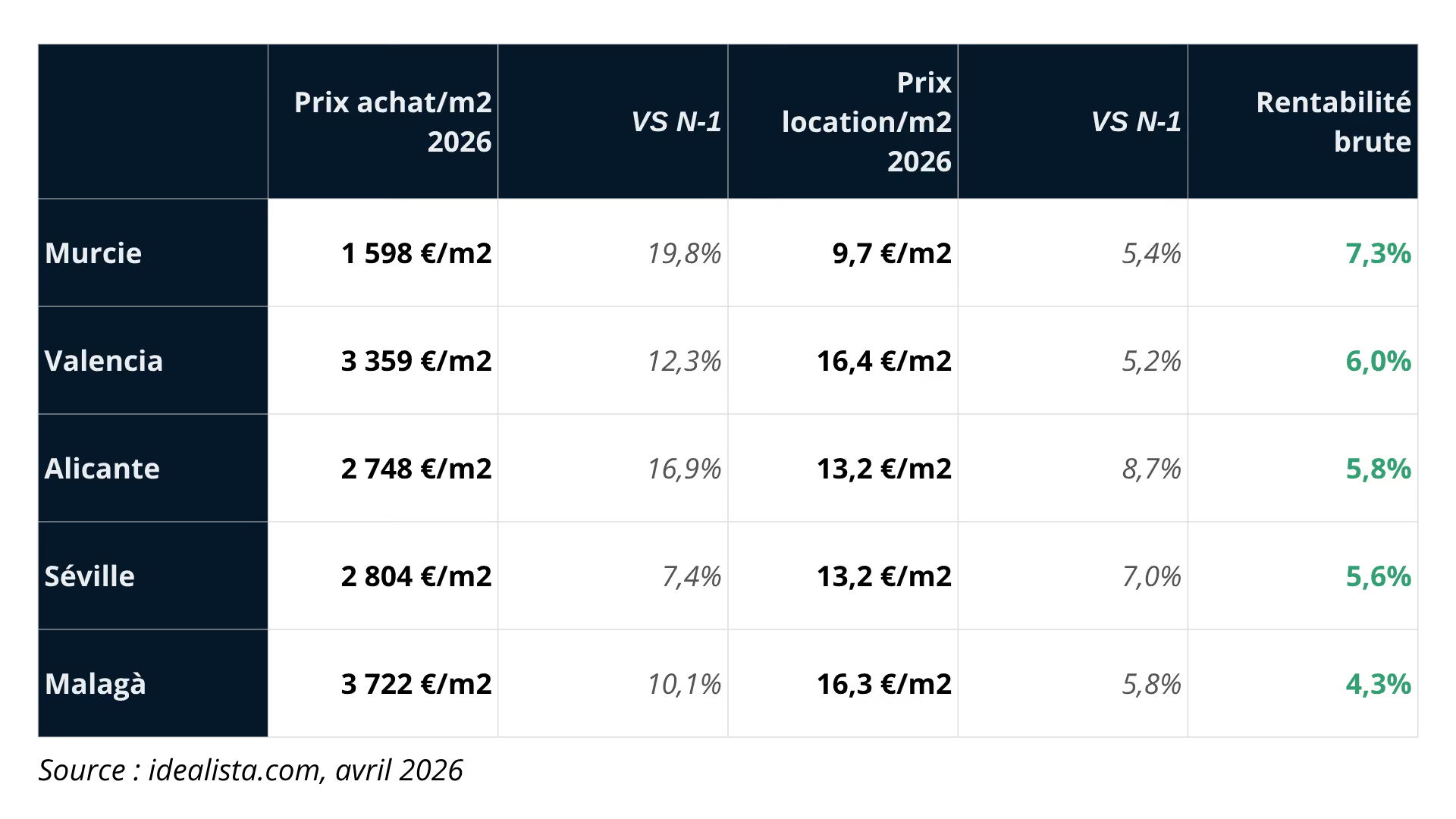
The table below gives an estimate of theoretical gross yield based on the purchase prices and monthly rents per square metre published by Idealista in April 2026. The formula used is: monthly rent per m² × 12 / purchase price per m².
Madrid and Barcelona: strong rental demand, higher entry price
Madrid and Barcelona remain two major markets for investing in Spain. Their strength lies in very deep rental demand: students, professionals, families, expats, companies, international relocations. Demand for rentals is high in both cities and resale is generally easier.
On the other hand, the entry price is much higher. In April 2026, Madrid reached €5,960/m² to buy and Barcelona €5,221/m². Rents are also high there, but not always enough to fully offset the price level. These cities therefore suit investors looking for a solid long-term asset better than those who want to maximise gross yield.
Valencia, Alicante and Málaga: a balance between appeal and yield
Valencia remains one of the most interesting markets for foreign investors. The city combines quality of life, a dynamic economy, international appeal and varied rental demand. Prices are higher than a few years ago, but the market still makes sense for an investor looking for a good balance between yield and long-term value.
Alicante offers a lower entry price and steady demand, helped by its coastal appeal, its climate and its links with foreign buyers. It is an interesting city for tighter budgets.
Málaga, for its part, enjoys a very strong image and significant economic momentum. But this appeal has already pushed prices up. The gross yield can therefore be tighter depending on the neighbourhood, especially if you buy in the most sought-after areas.
Secondary cities to watch, depending on budget and strategy
Murcia and Seville also deserve attention. Murcia shows an attractive theoretical gross yield thanks to purchase prices that are still contained. This type of market can suit investors looking for a lower entry price and a higher yield.
Seville has a different profile: a large Andalusian city with a strong cultural identity and student and tourist rental demand, but prices that are still more affordable than in Málaga or Madrid. It can be a good compromise for an investor willing to study neighbourhoods closely.
How to choose between a big city, the coast and a niche market
A big city usually offers better rental stability and more regular demand. The coast can let you combine personal use and letting, but it is more exposed to seasonality. Secondary cities can offer higher yields, but sometimes with lower liquidity.
Your choice should therefore start from your goal: yield, security, personal use, capital growth or diversification. This priority should guide the choice between Madrid, Barcelona, Valencia, Alicante, Málaga, Murcia, Seville or other local markets.
What to analyse before investing in Spain
Before buying, you need to analyse much more than the price per square metre. Spain is a very local market: two properties in the same city can perform very differently depending on the neighbourhood, the building, the condition of the home and the type of tenant targeted.
The exact location and neighbourhood
Location remains the first criterion. Look at how close the property is to transport, shops, universities, beaches, employment hubs, services and popular areas. A dynamic city is not enough: the neighbourhood, or even the street, often determines the quality of the investment.
A central, sought-after neighbourhood will usually offer better rental security and easier resale. An up-and-coming neighbourhood can offer a lower price and growth potential, but also more uncertainty.
The type of property and target tenants
The property must match a specific target. A studio will rather suit a student, a young professional or an employee on assignment. A family flat will attract more stable tenants. A property near the coast can appeal to seasonal tenants, foreign retirees or remote workers.
Before buying, ask yourself a simple question: who will rent this property, at what price, for how long and how often will tenants change?
Rental potential: all year round or seasonal
Letting all year round offers more stability. Seasonal letting can bring in more income, but it depends on regulations, seasonality and the quality of management. In between, mid-term letting can be an interesting solution in some cities.
The right choice depends on the local market. In a university city or employment hub, long-term letting may make more sense. In a well-regulated tourist area, short-term letting can be considered, provided all permits have been checked.
Local rules on holiday lets
Holiday let rules are one of the main points to watch. They vary between autonomous communities, cities and sometimes buildings. Before buying a property for short-term letting, check whether a licence is possible, whether the community of owners allows it and whether the town has introduced restrictions.
Never buy on the assumption that you can let to tourists without checking first. It is one of the most expensive mistakes a foreign investor can make.
The steps to invest in Spain as a foreign buyer
A property investment in Spain should follow a clear method. The aim is to secure the project before buying, rather than correct mistakes after signing.
Define your budget and investment goal
The first step is to set your overall budget. Do not stop at the advertised price of the property. Include buying costs, any works, furniture, running costs, tax, letting management and a safety margin.
You also need to clarify your goal: are you looking for rental yield? A second home let for part of the year? Diversification? A future home? The answer will shape the whole strategy.
Financing your purchase
Financing can be arranged in your home country or with a Spanish bank, depending on the buyer's profile, deposit and financial situation. Conditions can vary, especially for non-residents.
Before making an offer on a property, it is best to have a clear idea of your borrowing capacity and of how to get a mortgage in Spain.
Securing the purchase legally and administratively
The purchase must be checked on several points: title deeds, community fees, any debts, the property's legal compliance, its condition, the building's rules and whether letting is allowed.
These checks matter all the more when you buy from abroad. Local support helps you avoid unpleasant surprises and secure each step of the transaction.
Plan remote letting management
Management must be thought through before buying. Who will find the tenant? Who will do the inventory check? Who will deal with repairs? Who will track payments? Who will handle the paperwork?
A good investment can lose part of its return if management is badly organised. Conversely, professional management can secure income and preserve the property over time.
Our tips for a successful buy-to-let investment in Spain
Succeeding with buy-to-let in Spain takes method, caution and a good understanding of the local market. The market is attractive, but it does not forgive decisions based only on a price or an advertised yield.
Adapt your strategy to your investor profile
A cautious investor will often favour a solid city, a well-connected neighbourhood and a long-term let. A more ambitious profile may look at secondary cities, changing neighbourhoods or more active strategies such as room rentals or mid-term lets.
There is no universal strategy. The right project is the one that fits your budget, risk tolerance, holding period and level of involvement.
Do not reason only in price per square metre
A low price can look attractive, but it can also hide weak rental demand, a poor location or a difficult resale. Conversely, a more expensive property can be more profitable in the long run if it is better located, easier to let and easier to sell.
So cross-check several indicators: price, rent, vacancy, neighbourhood, condition of the property, running costs, tax, real demand and resale potential.
Work with local experts to secure the project
Investing in a foreign country means relying on professionals who know the local market. They help you identify the right neighbourhoods, avoid overpriced properties, check legal constraints and secure the transaction.
For a foreign investor, local support is often decisive. It saves time, prevents mistakes, helps you avoid scams and gives you access to a more precise analysis of the market.
Look into tax before buying
Tax should be studied from the start. It directly affects the net yield and can change how worthwhile the project really is. Rental income, non-resident obligations, tax returns in Spain, tax treatment in your country of residence: all of this needs to be anticipated before signing.
A project that is profitable on paper can become much less attractive if tax, running costs or management have been poorly factored in. That is why a realistic forecast is essential.
Should you invest in Spain in 2026?
Yes, buy-to-let in Spain remains a very interesting option for foreign investors in 2026. The market still offers opportunities, thanks in particular to average prices that remain moderate in many areas, an attractive gross residential yield and strong rental demand in several cities.
But Spain is not a uniform market. Madrid, Barcelona, Valencia, Alicante, Málaga, Murcia and Seville work in different ways. Some cities are more about long-term value, others more about yield. Some are better suited to long-term lets, others to mid-term lets or a mixed strategy.
A good buy-to-let investment in Spain therefore rests on precise analysis: city, neighbourhood, type of property, realistic rent, tax, regulations and management. With the right support, a foreign investor can build a solid, profitable project that matches their goals.
Would you like to invest in Spain but are not sure which city best suits your budget and letting strategy? Alveo Search helps you find, analyse and secure your property project.
Thomas Rouer is the founder of Alveo Search and the CEO of the Alveo group. Based in Spain for almost ten years, he develops property services designed for the specific needs of foreign buyers.
His expertise covers every aspect of buying property in Spain: understanding the market, searching for and selecting properties, negotiation, financing, paperwork, tax and securing the purchase process.


Our resources for buying in Spain