Français
 English
Living in the Canary Islands: cost, islands and moving guide

- The Canary Islands have eight inhabited islands; Tenerife and Gran Canaria have the main urban centres and a large share of the services.
- The climate is mild, but it varies with the island, the altitude, the exposure and the side of the island. If you can, visit the home at different times of day and in different seasons.
- In September 2026, the average asking price was €3,349/m² to buy and €15.2/m² a month to rent across the Canary Islands, according to Idealista. These are listing prices, not final prices.
- The job market needs preparation: tourism and services are important, but your Spanish, your experience and your sector decide what is possible.
- The discount on some air and sea routes is for eligible residents and set routes. It does not remove taxes or the extra costs of island life.
- Before choosing an address, check schools, healthcare, transport, internet connection and the rental rules that apply to the property.
In our "Living in Spain" guide series, we focus on the Canary Islands. Living in the Canary Islands means choosing an island as much as a country. Tenerife and Gran Canaria have the most complete infrastructure; Lanzarote and Fuerteventura appeal for their landscapes and coastline; La Palma, La Gomera and El Hierro suit those looking for a quieter setting. Climate, jobs, housing and travel vary from one island to another: a scouting trip helps you check whether daily life matches your plans.
The archipelago is part of Spain and the European Union, but its position in the Atlantic means it works a little differently. Before you go, compare the islands based on your work, your budget, your healthcare needs and how often you plan to travel home. For general formalities, see also our guide Living in Spain. If you are thinking of buying, see our page on property in the Canary Islands.
Why live in the Canary Islands?
A mild climate, with differences between islands
The climate is one of the main attractions of the Canary Islands, often called the “islands of eternal spring”. This does not mean the temperature is the same everywhere, or that there are never hot, cool or rainy spells. There are 2 "seasons":
- Winter (December to March): Mild and pleasant, with highs of around 20°C to 22°C and lows rarely below 15°C.
- Summer (July to September): Warm but cooled by the wind, with averages of 24°C to 28°C.
Outdoor days can be part of everyday life: walking, hiking, swimming, cycling or water sports. The Teide, Garajonay and Timanfaya national parks show how varied the landscapes are.
What makes each island different
As we said, the archipelago is made up of 8 islands that are very different from one another. Each has its own character and strengths.
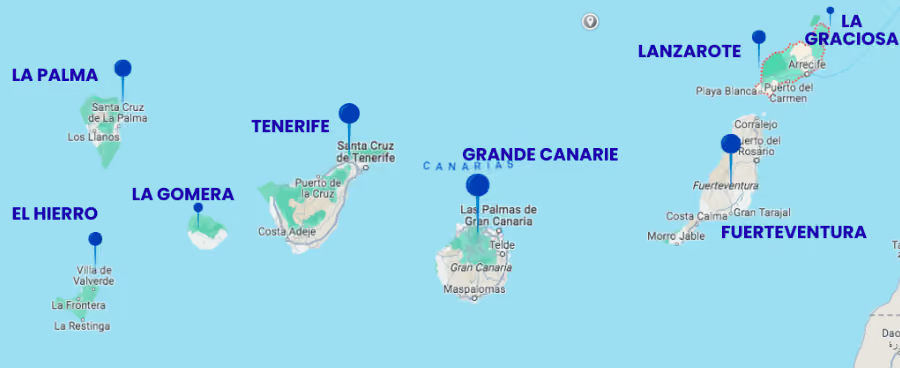
Tenerife and Gran Canaria are the most cosmopolitan, combining lively city life, modern town centres and outstanding landscapes. They are also the most touristy. Gran Canaria is less green than Tenerife and less desert-like than Fuerteventura. Lanzarote was one of the first islands to be declared a UNESCO biosphere reserve in its entirety. La Gomera, El Hierro and La Graciosa are ideal for lovers of peace and authenticity.
Here is what we think you should know about each of them.
- Tenerife is the most populated island of the Canary Islands, with just under a million inhabitants. Until 1927, Tenerife was the only island in the archipelago to host its capital, Santa Cruz. To find out more about this island, read our article: “Living in Tenerife: the complete guide”.
- Fuerteventura is the second-largest island in the archipelago, known for its white sand beaches and water sports.
- Gran Canaria is famous for the Maspalomas dunes and for being home, since 1927, to the second capital of the Canary Islands, Las Palmas de Gran Canaria. It is also the second most populated island, after Tenerife, with around 850,000 inhabitants, according to recent data from Spain's National Statistics Institute (INE).
- Lanzarote is known for its lunar landscapes and volcanoes, its beautiful beaches and its architecture inspired by local artist César Manrique, who played a key role in protecting the island. UNESCO declared it a biosphere reserve in 1993 for the exceptional beauty of its volcanic landscape and its efforts to promote sustainable development in the region.
- La Palma is nicknamed La Isla Bonita (literally “the beautiful island”) and is known for its natural beauty, volcanoes and hiking trails.
- La Gomera is marked by its deep valleys. It is also known for Garajonay National Park, a UNESCO World Heritage Site. Its traditional whistled language, called silbo gomero (there are said to be around 70 whistled languages in the world), is used by locals to communicate over long distances and is recognised by UNESCO as intangible cultural heritage.
- El Hierro is the westernmost of the inhabited Canary Islands. It has also been a biosphere reserve since 2000.
- La Graciosa is the smallest inhabited island in the archipelago (27 km²), located north of Lanzarote. It was officially recognised as the eighth inhabited Canary Island in 2018. It has around 750 inhabitants and lives mainly from tourism and fishing. Drinking water is brought in from Lanzarote.
A European setting and island life
The Canary Islands are part of Spain and the European Union. For EU citizens, free movement rules make the move easier, but they do not remove the formalities for long-term residence. British and American citizens need a visa to stay longer than 90 days. Spanish is the language of work and of most formalities. In some situations, a few basics are enough to start; learning the language makes dealing with authorities, professionals and neighbours easier.
Island life can bring a calmer pace and easy access to nature. It also means planning ahead for travel, deliveries, some specialist appointments and trips home. Timetables and fares vary with the seasons. For some activities or medical specialities, you may need to travel to Tenerife or Gran Canaria.
Drawbacks to plan for
The first challenge is often housing. The most sought-after islands are under strong housing pressure, and asking prices can be beyond the means of many households working locally. You also need to factor in running costs, the condition of the building, thermal comfort and the cost of getting around.
Finding a job can take time. Tourism, hotels, restaurants, retail, logistics, healthcare and services are sectors to explore, but needs differ by island and season. A job offer, an existing client base or remote income makes the plan more predictable.
Finally, the distance from home is real. Direct flights, their frequency and fares depend on the season and the airport. Travel between islands sometimes adds a connection. Before committing, test the journey to the airport, hospital, school or workplace from the address you are interested in.
What budget do you need to live in the Canary Islands?
Housing, the first cost to compare
To draw up a budget, start with listings that match the island, town, number of bedrooms and type of contract you want. In September 2026, Idealista showed an average asking price of €15.2/m² a month to rent across the archipelago. To buy, the average asking price was €3,349/m². These regional averages do not show the differences between islands and towns, and they are not the final amounts of contracts or sales.
As a simple calculation from these averages, a 50 m² home would cost around €760 a month, a 70 m² home €1,064 and a 100 m² home €1,520. Actual listings can be very different. A city centre, a tourist area, a rural village and a furnished home cannot be compared directly.
Everyday cost of living: the example of Las Palmas
To give an idea of everyday spending, we took October 2026 figures from Numbeo for Las Palmas de Gran Canaria and kept three examples. They give a concrete picture of one island, but they do not represent every town or all eight inhabited islands.
- Meal at an inexpensive restaurant: €12 in Las Palmas.
- Cappuccino: €2.27 in Las Palmas.
- Monthly utilities for an 85 m² flat: €100.74 in Las Palmas.
Tax in the Canary Islands: what you need to know
The Canary Islands have a special economic and tax regime. The IGIC, the Canary Islands' indirect tax presented by the Canary Islands Tax Agency, replaces VAT for the transactions concerned, with a general rate of 7% plus specific rates and rules for some goods and services. This rate does not mean that everything is automatically cheaper.
The Canary Islands Special Zone (Zona Especial Canaria, or ZEC) offers a reduced corporate tax rate to companies that meet strict conditions on activity, investment and job creation. The Spanish Tax Agency explains the ZEC conditions. This scheme is not an automatic tax advantage for anyone who moves to or works remotely from the islands. Before setting up a company or moving a business, have your situation reviewed by a professional who knows Spanish tax law and the double taxation treaty between Spain and your country of residence.
When buying property, taxes depend on the type of property, whether it is new or resale, and the buyer's situation. Buying costs and reporting obligations must be part of your budget. See our guide to taxes when buying property in Spain to find out more.
Where to live in the Canary Islands for your profile
There is no single “best island”. The right choice depends on how urban a life you want, your job, healthcare, schools, how much travel you can accept and your budget. Here are pointers to guide your visits, not a ranking.
Tenerife and Gran Canaria for more services
Tenerife and Gran Canaria are home to the archipelago's two capitals and have a wide range of shops, schools, public services and healthcare. They can suit people who want to live in a city while staying close to the sea and nature.
In Tenerife, compare Santa Cruz, La Laguna, the north of the island and the towns in the south. Exposure, terrain and travel time can make a real difference to daily life. Gran Canaria also offers several settings: Las Palmas is a big city, while the towns in the south are more shaped by tourism.
To look more closely at the island, see our guide Living in Tenerife. That dedicated page complements this general guide rather than repeating everything about the archipelago.
Lanzarote and Fuerteventura for coastal living
Lanzarote and Fuerteventura attract people looking for volcanic landscapes, beaches and outdoor activities. They offer different settings: Arrecife and Puerto del Rosario are the hubs for city life and services, while other towns are more spread out.
The holiday image can hide what a permanent home needs. Check which shops are open all year, journeys to work, transport, access to a doctor and long-term rentals for residents. In remote towns, a car may become necessary.
La Palma, La Gomera, El Hierro and La Graciosa for a quieter life
These islands attract people who value nature, a less urban pace or life in a small town. Quiet does not necessarily mean simpler: jobs, access to some services and travel may take more planning.
La Graciosa is linked to Lanzarote by boat and has constraints of its own due to its small size. For each of these islands, spend several days there outside the tourist season. Try the shopping, the paperwork, the internet connection and the journey to the services you need.
Living in the Canary Islands with a family
For a family, Tenerife and Gran Canaria are often the first islands to compare if you want a wider choice of services, schools and activities. In Tenerife, look at journeys from Santa Cruz and La Laguna, but also from towns in the north or south: a school on the other side of the island can make for very long days. In Gran Canaria, Las Palmas and the nearby towns offer an urban setting; in the south or in more rural areas, check daily journeys and the services you can actually reach from your address.
Lanzarote and Fuerteventura can suit family life, especially around Arrecife and Puerto del Rosario, but the choice of area, school and activities must be tested at town level. On La Palma, La Gomera or El Hierro, the pace can be calmer; on the other hand, journeys, after-school activities and access to some services take more organisation. If a child needs specific support or regular follow-up, check what is available on the island before settling on a home.
For schools, do not rely only on the distance shown in a listing. The official Canary Islands school search tool lets you filter by island, town, level and services, including transport and school meals. Contact the schools to confirm places, admission rules, the languages used in class, timetables, school transport and the full cost. Then do the journey at drop-off and pick-up times: it can matter more than a few extra square metres.
Retiring to the Canary Islands
When retiring to the Canary Islands, the choice is often between being close to services and the peace you are looking for. Look at Tenerife and Gran Canaria if you want to stay near large urban centres, shops and a wider range of hospitals. The smaller towns on these islands can offer a quieter setting, as long as you check travel times to appointments and everyday activities.
Lanzarote, Fuerteventura, La Palma, La Gomera and El Hierro can appeal for their pace and landscapes. There is healthcare on every island, but some specialist care may mean travelling to another island. Before you move, check on the Canary Islands Health Service's list of hospitals and services by island where your follow-up care, tests or treatment are provided, and the transport options for appointments. If you have regular medical follow-up, this check may guide your choice of island before your choice of area.
For housing, look at accessibility beyond the view: lift, steps at the entrance, shower, moving around the flat, summer heat and walking distance to a pharmacy, health centre and shops. Also test routes without a car and how often services run if you need to get to hospital or visit family. A stay in different seasons, then a short-term rental, helps you judge daily life before buying. See also our guide to retiring in Spain.
Buy or rent in the Canary Islands?
Rent to test the island and the area
A long-term rental lets you get to know an area before committing to a purchase. In September 2026, listings on Idealista showed an average of €15.2/m² a month across the archipelago. For a 70 m² home, that is around €1,064 a month, as a rough guide. Differences between towns are marked:
- Las Palmas de Gran Canaria: €14.6/m², or about €1,022 a month for 70 m².
- Santa Cruz de Tenerife: €14/m², or about €980 a month for 70 m².
- Puerto del Rosario: €12.3/m², or about €861 a month for 70 m².
- La Oliva: €18.8/m², or about €1,316 a month for 70 m².
- Adeje: €19/m², or about €1,330 a month for 70 m².
These amounts are calculations based on average asking prices, not guaranteed rents. They do not account for the actual living area, condition, furniture or service charges. Check that the contract fits your plan to make it your main home, then look at its length, the deposit, the equipment and the renewal terms. In high-demand areas, have the usual documents ready and be wary of listings that look too good to be true.
During the viewing, check for damp, windows, ventilation, noise, hot water, internet connection and parking. Ask whether the home is let furnished, whether bills are included and how repairs are handled. If you are moving as a family, test the journey to school and the shops at the times you will use them.
Buying in the Canary Islands as a main home or an investment
Buying can make sense if you plan to live there for the long term and already know the island. In September 2026, the average asking price was €3,349/m² across the archipelago, according to the Idealista sales report. Differences between towns are large: €2,843/m² in Las Palmas de Gran Canaria, €2,860/m² in Santa Cruz de Tenerife, €2,506/m² in Arrecife, €2,200/m² in Puerto del Rosario and €4,763/m² in Adeje. For an 80 m² flat, that would be around €267,920 at the regional average price, compared with €200,480 in Arrecife or €381,040 in Adeje. These are simulations based on asking prices, before costs and taxes, not valuations of specific properties. The area, condition, view, works needed and features of the building can change the price a lot. Before making an offer, check the property's legal status, community charges, planned works, permits and the condition of the installations. To plan for costs, see our guide to taxes when buying property in Spain. If you need a mortgage, our guide explains how to get a mortgage in Spain.
If you are considering a buy-to-let investment, calculate a net yield that takes into account buying costs, empty periods, maintenance, management, insurance and tax. Expected holiday rental income should not be the basis for a purchase until the rules and permits are confirmed.
Holiday rentals: check the rules that apply
Holiday lets are subject to rules that can change and also depend on the town, the building and the permits required. A listing or a past registration does not guarantee that a property can be rented out the same way after a purchase. Our guide to tourist rental licences in Spain sets out the main points to check.
Before signing, ask a professional to check planning compliance, the status of the community of owners and the conditions in force at the exact address. Our guide to buying in the Canary Islands can be a starting point to prepare your property questions.
Working in the Canary Islands or working remotely from the islands
The local job market
Tourism and services play a big part in the archipelago's economy. Opportunities can also be found in retail, restaurants, healthcare, logistics, education, construction and digital jobs. The sectors and the number of vacancies differ from island to island.
In the second quarter of 2026, ISTAC, based on the Labour Force Survey, reported an unemployment rate of 11.6% in the Canary Islands. This regional figure describes the working population as a whole; it does not predict your own chances of finding a job. Look at vacancies in your field, compare net salaries with housing costs, then start the process before you leave.
Speaking Spanish generally improves access to jobs and makes it easier to fit into a local team. Jobs serving international clients may look for other languages, but check the actual requirements of each vacancy. To prepare your search, read our guide Working in Spain.
Remote work and self-employment
Keeping a job or clients remotely can make the move easier, but remote work does not remove residence, social security and tax obligations. Before you go, talk to your employer or adviser about where you will be working from, social security cover, the tax treatment of your income and any reporting obligations.
Also check the quality of the connection at the exact address, network stability and whether you have a quiet place to work. Coworking spaces are more common in the main urban centres and tourist areas. On smaller islands or in rural towns, it is wise to test the connection before signing a lease.
Schools, healthcare and getting around the archipelago
Sending your children to school
Families can compare state schools, private schools partly funded with public money, private schools and international schools. Admission criteria, languages of teaching, levels offered, fees and enrolment dates vary from one school to another. The Canary Islands Government portal on admission and enrolment gives the official information for the schools concerned.
Contact the schools you are considering directly and ask for the full cost: enrolment, fees, meals, transport, supplies and activities. To understand the options in the local system, see our guide to the Spanish school system and our guide to British and international schools in Spain. Then check that there is a suitable school on the island and in the town you choose.
Accessing healthcare
The Canary Islands have public and private healthcare, but the services and specialities available vary by island and town. The official register of healthcare centres in the Canary Islands lets you search for authorised centres and services. Before you go, work out your rights to health cover based on your status: employee, self-employed, retired, student or dependant.
The European Health Insurance Card (or the UK GHIC) covers medically necessary care during a temporary stay. It does not replace registering for healthcare when you live in Spain. Depending on your situation, an S1 form, registration with the Spanish system or private health insurance may be needed. The European Commission explains health cover rules in the host country; check your case with the health or social security body in your home country and the relevant Spanish bodies. If you are having treatment, prepare prescriptions, medical reports and continuity of care before you move.
Getting around and travelling to the other islands
Bus networks, taxis and transport services are organised differently on each island. The tram serves the Tenerife metropolitan area, between Santa Cruz and La Laguna; the Cabildo de Tenerife brings together information on transport, TITSA and the tram. Buses play a major role on the other islands. In other towns, a car can be useful to get to work, school or the shops. Compare the total cost of a vehicle (purchase or rental, fuel, insurance, maintenance and parking) with your actual journeys.
Air and sea connections link the islands. Timetables, frequencies and fares vary; check the full journey for appointments, business trips and trips home. In 2026, temporary discounts or subsidised passes may apply to public land transport. The Canary Islands Government sets out the transport discounts for residents; check the conditions and fares that apply when you prepare your budget.
Preparing your move and settling into the Canary Islands
Residence formalities
EU citizens can enter and settle in Spain without a visa. For stays of more than three months, they must register their residence and meet the conditions that apply to their situation; British and American citizens need a visa to stay longer than 90 days. The Your Europe website explains the residence rights of EU citizens. The NIE is an identification number needed for many formalities, but on its own it is not a residence certificate.
Depending on your plans, you will need to arrange registration on your town's municipal register, social security and healthcare, tax, banking, energy contracts and insurance. The documents requested and the way appointments work may vary. Check the information with the relevant authorities and see our guide to getting an NIE in Spain.
Learning Spanish and meeting local people
English-speaking expat communities can help with practical information and first contacts. They do not replace contact with local residents and professionals. A regular Spanish class, an association, a sport or a neighbourhood group helps you practise the language and build routines.
Before choosing an island, ask yourself what kind of social life you want: cultural outings, clubs and associations, nightlife, hiking or contact with neighbours. There are more options in the cities, while smaller towns can offer a calmer daily life and a different kind of social life.
Planning a scouting trip
If your schedule allows, visit the island at two different times of year. View several homes in different areas and make your usual journeys at the times you would really make them. Do your shopping, find a health centre, a school, a gym and the nearest bus stop.
A scouting trip is also a chance to check whether you accept the constraints of island life: connections, boat or plane journeys, seasonal activities and the distance from your loved ones. You can then tell the appeal of a holiday apart from your ability to build a daily life there.
Arnaud Attencia is head of Alveo Finance. He supports residents and non-residents with the financing of their property purchase in Spain. He shares his advice on assessing borrowing capacity, planning for the deposit and buying costs, and preparing a mortgage application.


Our resources for buying in Spain